
TL;DR: Nonprofit mission drift rarely starts with a values debate. It starts with a funding decision: a program shaped to fit a grant, or a gift too large for the systems behind it. Drift is funder-led change. Evolution is community-led change. Sequence strategy, systems, and story before the next revenue chase.
Ask a development director what nonprofit mission drift looks like and you'll usually hear about values. A board that lost its way. A founder who got distracted. In our experience, that is almost never how it happens. Drift starts in the budget meeting, with a perfectly reasonable decision to go after money that doesn't quite fit.
Quick answer: mission drift is the gradual reshaping of what a nonprofit does, and who it serves, to match what funders will pay for instead of what the community needs. It is a sequencing problem more than a character problem, and it is reversible if you catch it early.
What is mission drift in a nonprofit, and how does it start?
Mission drift is the slow divergence between the mission on your website and the work your team actually spends its hours on. No single decision causes it. A grant here, a new program there, a reporting requirement that changes how you count success. Five years later, the people you serve can't explain what you do, and neither can half your staff.
It almost always starts with funding. A development team under pressure finds an opportunity that sits next to the mission, and the case for saying yes is strong. The money is real, the deadline is close, and the alternative is a shortfall. So the program bends toward the grant. Then the next grant. Each bend is small enough to justify. The drift is the sum.
The second common trigger is a gift that is too big for the infrastructure behind it. A multi-year award or a first federal contract lands on a team with no grants manager, no cash reserve to float reimbursement-based payments, and a donor database that still lives in three spreadsheets. The mission didn't change. The organization's ability to deliver it did, and drift follows as the team reorganizes around compliance instead of impact.
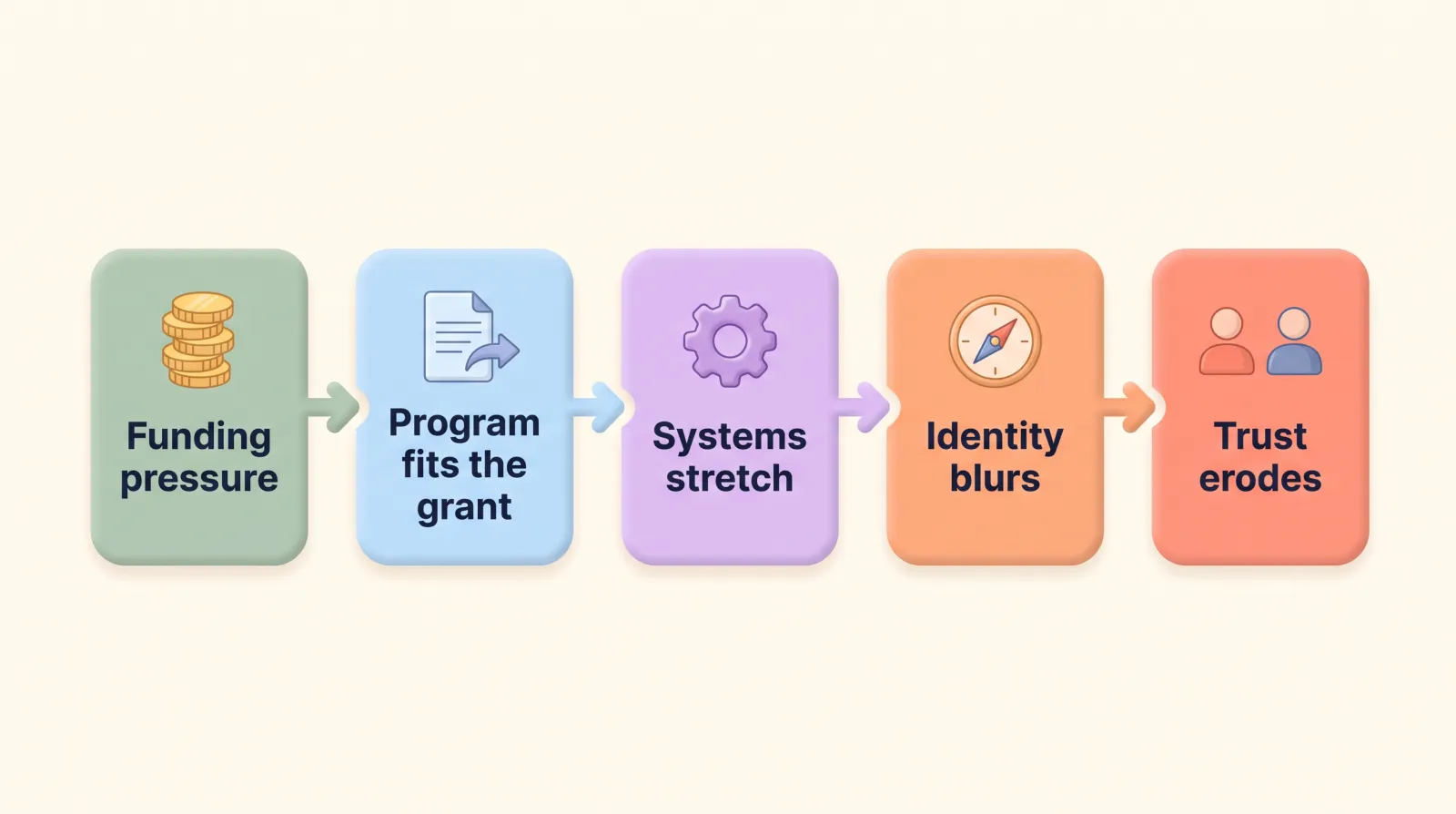
Why does chasing funding pull nonprofits off mission?
Because the funding environment is genuinely hard right now, and hard environments reward short-term thinking. In the Center for Effective Philanthropy's 2026 State of Nonprofits report, almost 60 percent of nonprofit CEOs said it has been harder to secure foundation grants since January 2025, and 39 percent reported a deficit in their most recent fiscal year, up from 22 percent in 2022. Eighty-eight percent said they are considering pursuing funding from new funders or donors in response.
That last number is the drift engine. When nearly nine in ten organizations are planning to chase new money at the same time, the money that is easiest to win is often the money that fits your mission least. Nonprofit Finance Fund's 2025 State of the Nonprofit Sector Survey found that 48 percent of respondents with foundation funding said grants have gotten smaller on average since late 2022, and only 36 percent of all respondents reported that half or more of their grants and donations were unrestricted. Smaller, more restricted grants mean more applications, more programs shaped to fit them, and less room to fund the work you would choose on your own.
Restricted money also underpays for the infrastructure that keeps a mission coherent. Stanford Social Innovation Review named this dynamic the nonprofit starvation cycle: funders hold unrealistic expectations about overhead, nonprofits underreport to match them, and the gap gets covered with staff time that should have gone to the mission.
Government funding carries its own version of the risk. The Urban Institute's 2025 national survey found that one in three nonprofits experienced a government funding disruption in the first half of 2025, and that the disrupted organizations drew 42 percent of their revenue from government sources, against a sector average of 28 percent. Candid's analysis puts the exposure in sharper terms: more than 35,000 nonprofits, about a third of all government grantees, rely on those grants for more than half their revenue. When one funder is half your budget, that funder's priorities become your mission whether you intended it or not.
How do you tell mission drift from healthy mission evolution?
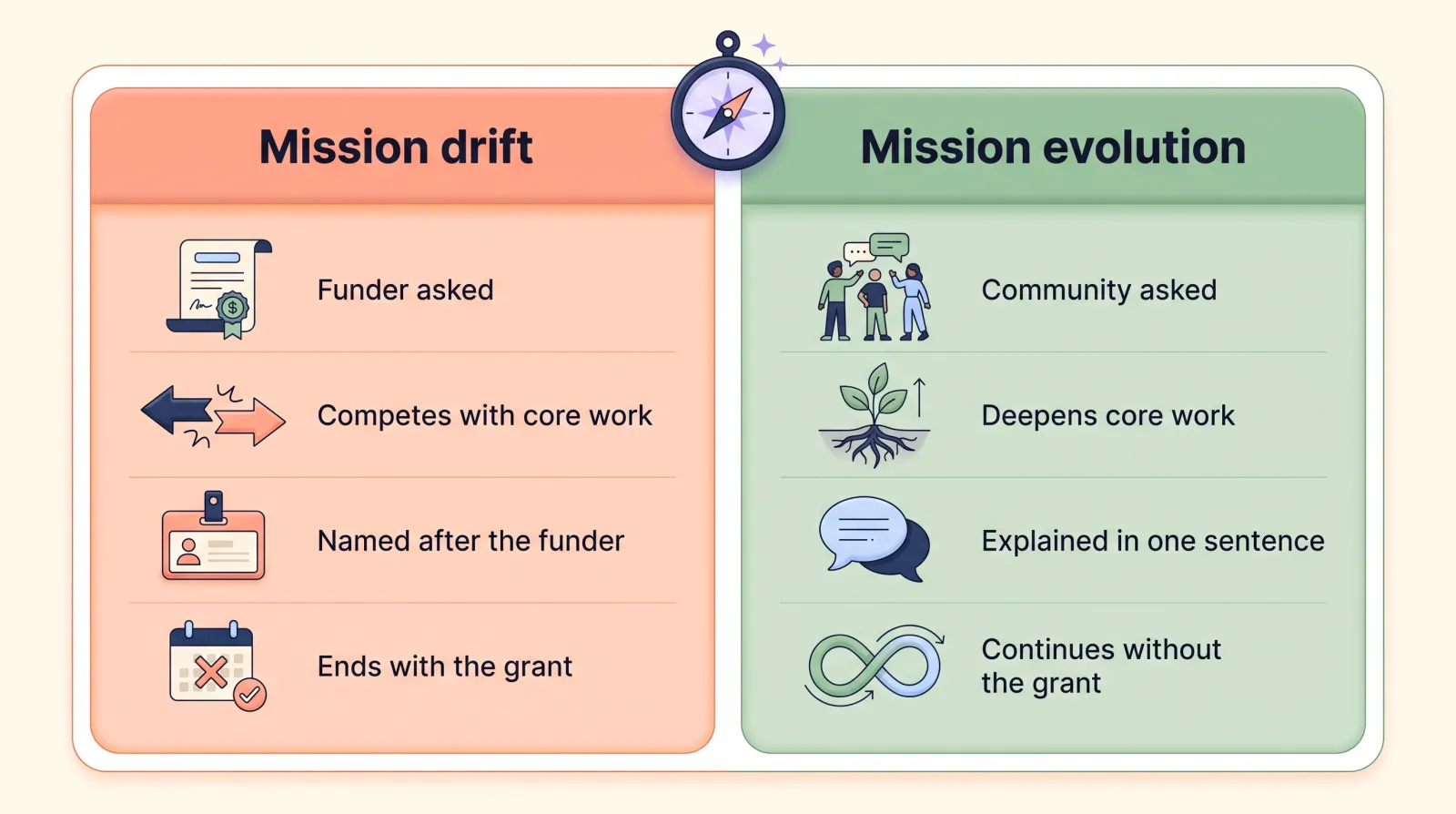
Not every change is drift. Organizations should evolve. The people you serve change, the community changes, and a mission statement written a decade ago should not be a cage. The question is who is asking for the change?
Mission evolution is community-led. The people you serve, your volunteers, and your closest supporters tell you they need something next to what you already offer, and you build it because it deepens a relationship you already have. A housing organization that adds job-readiness support because residents keep asking for it has evolved. The new work makes the core work stronger.
Mission drift is funder-led. A funder publishes a priority, the priority is close enough to your work to justify an application, and you build a program to win it. The people you serve did not ask. Your staff cannot explain the new program in one sentence. And the program only exists as long as the grant does.
Four questions separate the two:
- Who asked? Did the request come from your community or from a funding announcement?
- Does it deepen or dilute? Will the change make your existing programs stronger, or compete with them for staff attention?
- Can you explain it? Could a program manager describe the change in one sentence without naming the funder?
- Would you keep it? If the funding ended tomorrow, would you fight to continue the work with other money?
Two or more answers pointing at the funder is drift, even when the money is good.
What are the early warning signs of mission drift?
Drift hides inside normal operations, which is why it goes unnamed for so long. These are the signals we see most often in growing development teams:
- Restricted revenue is rising as a share of the budget year over year, and nobody decided that on purpose.
- New hires are written into grant budgets before anyone asks how the role serves the mission after the grant ends.
- Board meetings spend more time on the funding pipeline than on program outcomes.
- Reporting hours exceed relationship hours. Compliance is eating stewardship.
- The community you serve shows up less, or refers fewer people, and no one can say why.
- Your team describes programs by funder ("the county contract," "the foundation project") instead of by who they help.
None of these is fatal on its own. Three at once is a pattern.
What should come before the next big funding push?
The antidote to drift is sequencing. Strategy, systems, and story come before revenue, not after it. That feels backwards when the pressure is to raise money now, but each of those three makes the money you raise stick to the mission instead of bending it.
Strategy: decide what you will not do
A focused plan is as much a list of omissions as a list of goals. Before the next funding cycle, write down the programs, populations, and funding types you will decline this year, and why. Our guide to building a focused fundraising plan walks through how to choose your highest-return activities and let the rest go. If your strategic plan lives in a drawer, the free Annual Strategic Planner can get a working version on paper in an afternoon.
Systems: build the container before you fill it
Most drift caused by oversized grants is really an infrastructure gap. Can you track restricted and unrestricted dollars separately? Can you see every funder deadline, document, and report in one place? Can you show a board member the true cost of a program in ten minutes? Teams that answer no should fix the systems first. Fundraising operations are not a luxury for a growing team. They are what lets you say yes to the right money and no to the wrong money with confidence.
Those three questions are really one question about your systems. DonorDock's grant management tracks deadlines, documents, and reports alongside the donors and funders behind them, and Ask Boards give your team a view of every grant and major gift in the pipeline. A "not yet" becomes a deliberate decision your whole team can see, not a missed deadline nobody owns.
Story: know what you are before you sell it
Funders and donors both respond to organizations that can explain themselves. If your team cannot describe the mission in one breath, no amount of grant writing will fix the drift underneath. Your strategic plan becomes a stewardship tool when it shows donors what you chose and why you chose it. Then, and only then, pursue revenue at the scale your infrastructure can carry.
Where should the next dollar come from, if not the big grant?
Usually from the community you already have. Individuals gave $394.2 billion in 2025, roughly 64 percent of all U.S. charitable giving, according to Giving USA 2026. Foundations gave 19 percent and corporations 7 percent. Most of the money in the sector still comes from people.
Community support also arrives in forms your budget probably undercounts. Independent Sector values a volunteer hour at $36.14 for 2025. In-kind gifts of space, services, and goods often add up to a meaningful share of a program budget. A development team that tracks those contributions properly, and our guide to tracking donations in-kind shows how, usually discovers the organization is larger and more resilient than its cash budget suggests. That knowledge changes the funding conversation from "we need this grant to survive" to "this grant would let us do more of what already works."
Smaller asks to existing supporters, in-kind partnerships, and disciplined revenue diversification grow slower than one large award. They also stay attached to the mission, because the people funding you are the people who already believe in it. This is the heart of Smart Stewardship: caring well for the relationships you already have produces steadier revenue than chasing relationships you do not. Teams ready to build a major gifts program as the next step should apply the same principle. Start with the donors who already show up.
How do you steer back once you notice drift?
Carefully, and without a purge. Cutting a drifted program overnight can hurt the people it serves and the funders who backed it. Instead:
- Name it. Put the funder-led versus community-led test in front of your leadership team and score every program honestly.
- Set sunset criteria. For programs that fail the test, decide now what will trigger a wind-down when the current funding ends, and tell the funder early.
- Talk to five people you serve. Sit down with a handful of community members and ask what they need from you. Their answers are your evolution roadmap.
- Share the load. If a program matters to the community but not to your core, find a partner organization for whom it is core, and put the terms in writing.
- Re-sequence the plan. Rebuild next year's fundraising plan around what passed the test, and run a grant readiness checklist before you pursue anything large.
Drift isn't a character flaw. It's what happens to good organizations that raise money faster than they build the foundations to hold it. Fix the sequence and the mission holds. If you want to see how DonorDock keeps every funder, donor, deadline, and dollar in one view so your team can make those calls on purpose, explore the DonorDock CRM