
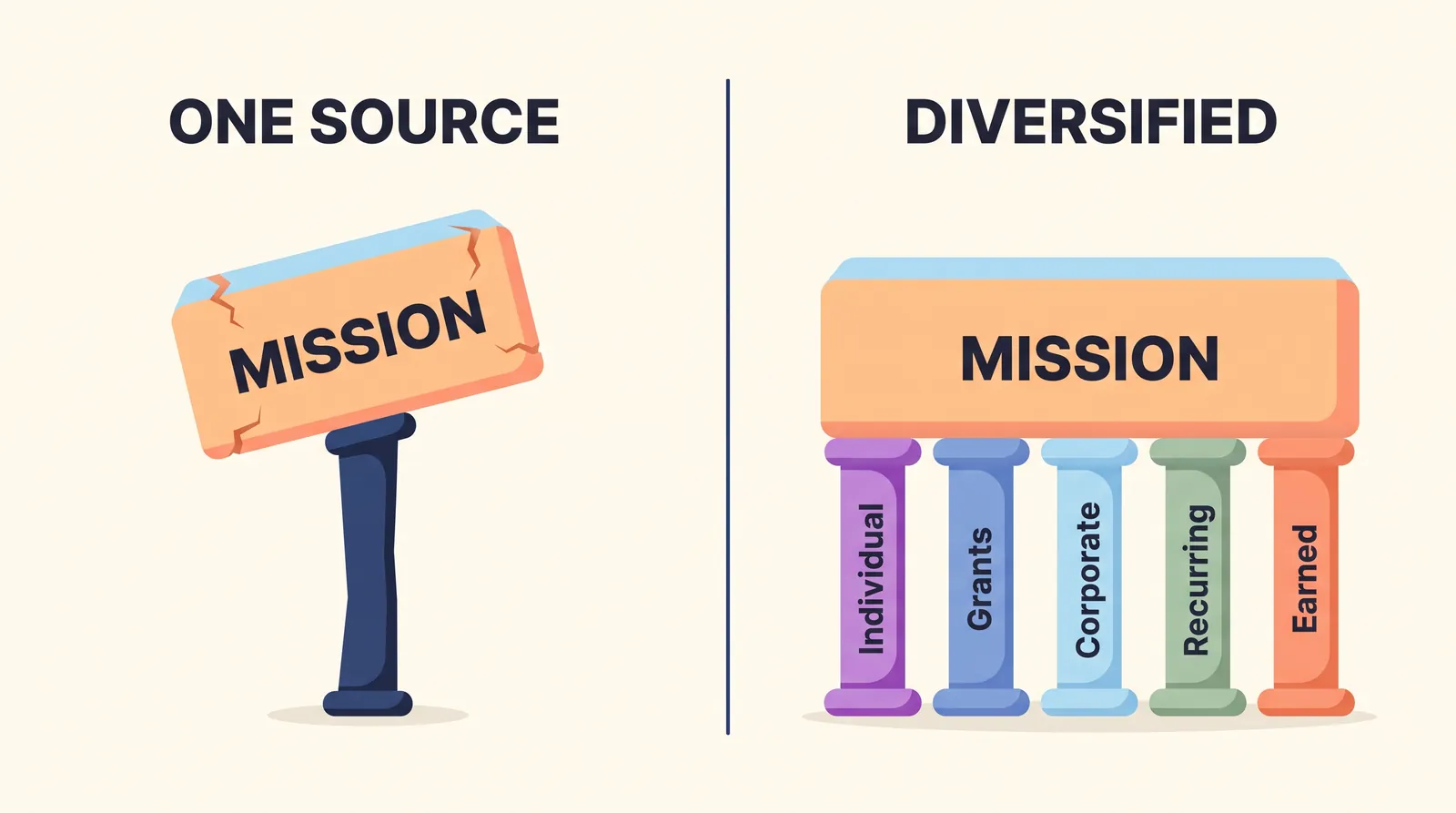
Nonprofit revenue diversification means funding your mission from several independent sources instead of leaning on one. It matters because a single dominant stream, whether that is one grant, one event, or one major donor, turns any disruption into a crisis. Spread the risk, protect the mission.
Ask most development teams where their money comes from, and you will hear a familiar shape: one big source doing most of the heavy lifting, with everything else playing backup. Maybe it is a government contract. Maybe it is the annual gala. Maybe it is a handful of loyal major donors who have carried you for a decade.
That concentration feels efficient right up until the moment it does not. Nonprofit revenue diversification is the discipline of building several independent income streams so that no single loss can take the whole mission down with it. It is not about chasing every dollar. It is about making sure your funding can absorb a punch.
Here is the uncomfortable part. Diversification is easy to nod along to and hard to actually do, because the stream that dominates your budget is usually the one that is working. Walking away from what works feels reckless. But leaning on it entirely is a real risk, and the sector data makes that plain.
What is nonprofit revenue diversification?
Revenue diversification is spreading your funding across multiple, independent sources so the health of your organization does not rise and fall with any one of them. Those sources typically include individual giving, major gifts, grants, government funding, corporate partnerships, earned income, events, and recurring donations.
The key word is independent. Three grants from the same federal agency are not real diversification, because one policy change can freeze all three at once. A healthy mix draws from sources that do not fail for the same reason at the same time. When individual giving softens in a down year, a corporate partnership or an earned-income line can carry more of the load.
Think of it the way a financial advisor thinks about a portfolio. You are not trying to pick one perfect investment. You are trying to build a mix that keeps working even when one piece stumbles.
What are the main nonprofit revenue streams?
Before you can diversify, it helps to know the full menu. Most nonprofit revenue falls into a handful of categories, and each behaves differently when conditions change. A resilient mix usually pulls from several of these:
- Individual giving. Gifts from your donor base, from first-time supporters to loyal annual donors. It is the sector's largest source overall, but it is sensitive to the economy and to how well you retain people.
- Major gifts. Larger commitments from a smaller group of committed donors. High value, but concentrated, so losing one relationship stings.
- Recurring donations. Automatic monthly or quarterly gifts. The steadiest, most predictable stream you can build, because it does not depend on a single campaign or season.
- Grants. Funding from foundations and philanthropic institutions. Powerful for growth, but often restricted and slow to replace when a funder changes priorities.
- Government funding. Contracts and public grants. Can be substantial, but exposed to policy shifts, delays, and freezes outside your control.
- Corporate partnerships. Sponsorships, matching programs, and cause-marketing deals. Great for organizations built on relationships, and they can grow fast.
- Earned income. Revenue from a service, product, or asset the market will pay for. The most independent stream of all, since it does not rely on donated dollars.
- Events. Galas, challenges, and signature campaigns. Strong for awareness and community, though they carry real cost and risk per dollar raised.
No organization should run all eight well, and trying to would spread a lean team too thin. The goal is a deliberate handful that fits your capacity and reinforces one another.
Why is relying on one funding source so risky?
Because the disruptions are not hypothetical, and they are not rare. In early 2025, roughly one in three nonprofits experienced at least one government funding disruption, according to the Urban Institute. Twenty-one percent lost a grant or contract outright, and 27 percent faced delays or freezes, according to the same analysis.
Now layer on how concentrated that exposure is. The same Urban Institute research found that while nonprofits rely on government funding for about 28 percent of their revenue on average, the organizations that actually suffered a disruption had leaned on government for 42 percent of theirs. The more of your budget rides on one source, the harder you fall when it moves.
And most organizations do not have much of a cushion to fall back on. The Nonprofit Finance Fund found that 52 percent of nonprofits hold three months or less of cash on hand, and 18 percent hold one month or less. In the same survey, 36 percent of nonprofits ended 2024 with an operating deficit, the highest share in the ten years the Nonprofit Finance Fund has run the study.
Put those facts together and the math is sobering. A lot of organizations are one delayed contract or one lapsed major donor away from a genuine cash crunch, with no reserve to absorb it.
Does diversification actually protect you?
Mostly yes, with one important caveat worth understanding before you overhaul your whole funding model.
Under normal conditions, spreading your revenue across independent sources measurably lowers financial volatility. That is the steadying effect you are after, and it holds up in the research. A 2025 study in Nonprofit and Voluntary Sector Quarterly confirmed that diversification reduces revenue volatility in ordinary times.
The caveat: that same study found the protective effect did not hold during and after the Great Recession. When a shock hits the entire economy at once, several of your streams can dip together, and diversification alone will not save you. In other words, diversification is necessary but not sufficient. Which streams you choose, and how independent they truly are, matters just as much as how many you have.
This is where a lot of well-meaning diversification goes wrong. Teams add streams that all depend on the same underlying condition, like a strong stock market or a single corporate sector, and then act surprised when they all soften in the same quarter. Real resilience comes from sources that fail for different reasons at different times.
It is also worth remembering that even the sector's largest funding source is not a safe harbor by default. Individuals still give the most by far, accounting for roughly 64 percent of the $617.20 billion Americans donated in 2025, per Giving USA. But an individual-giving base can thin out too, which is exactly why a resilient mix pairs it with streams that behave differently.
How do you diversify around your strengths, not away from them?
Here is the reframe that makes diversification feel less like abandoning what works: you do not have to walk away from your strongest stream. You build around it.
you do not have to walk away from your strongest stream. You build around it.
Every organization has a natural type. Some are built for individual giving, with a compelling personal story and a growing base of small donors. Others are built for institutional relationships, with the kind of leadership and network that lands corporate partners and multi-year grants. A few are built for earned income, sitting on a service or asset the market will actually pay for.
Your strongest stream is a signal. It tells you what your organization is genuinely good at. The smart move is to keep investing in that anchor while deliberately adding two or three complementary streams that lean on the same muscles.
Take an organization whose entire model runs on corporate relationships. Individual giving is not its strength, and forcing a big individual-donor program from scratch would fight its nature. But that same relationship-building strength can extend naturally into corporate matching campaigns, sponsored events, and cause-marketing partnerships. Different streams, same underlying capability. That is diversification that plays to type instead of against it.
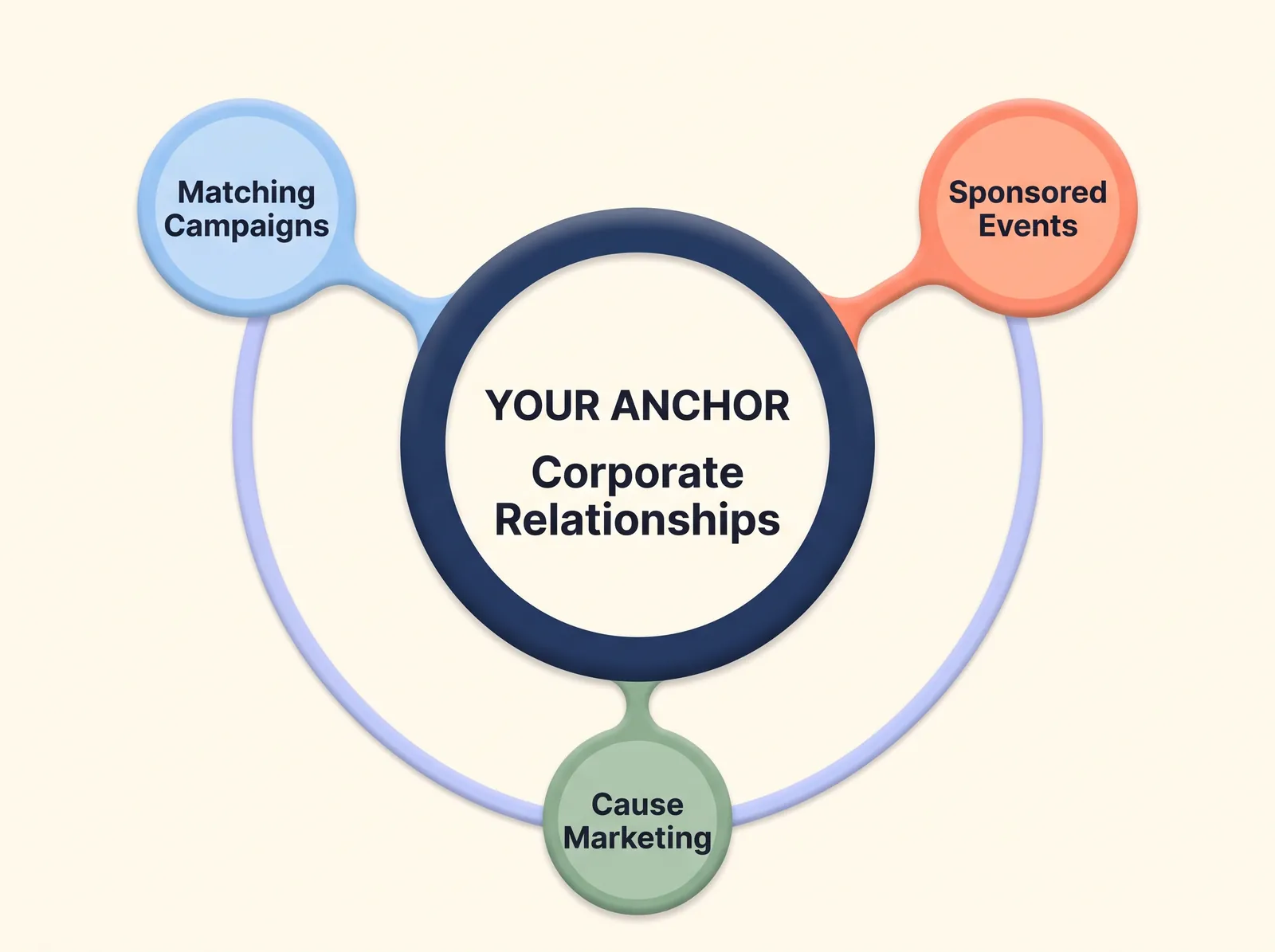
To find your own version, start with three honest questions. What is the one capability your organization is unusually good at? Which additional revenue streams draw on that same capability? And which of those streams would fail for a different reason than your anchor, so a single shock cannot take both?
If you are moving out of an over-reliance on grants, our guide on what to do when federal grants shift walks through a practical pivot. And if recurring revenue is the steadying stream you want to build, recurring giving is one of the most reliable ways to smooth out the peaks and valleys, because it does not depend on a single campaign or a single season.
What is a realistic first step toward a healthier funding mix?
Start by measuring your actual concentration. Pull your revenue by source for the last three years and calculate what percentage comes from your single largest stream. If any one source is north of 30 percent of your budget, you have found your risk. This is far easier when your giving data lives in one place. DonorDock's reporting dashboards let you see your funding mix at a glance instead of stitching it together from spreadsheets and a payment processor.
Next, protect the base you already have before you go chasing new money. Retention is the quiet engine of a resilient budget, because a donor you keep is revenue you do not have to replace. The math here is not encouraging by default: the Fundraising Effectiveness Project has documented four straight years of declining donor counts. Shoring up the relationships you have is often the highest-return diversification move you can make, and it is the heart of what we call the Smart Steward Method. Our take on fixing retention before acquisition digs into why.
Then pick one adjacent stream to test, chosen with the strengths framework above. If you are strong on relationships, that might be a first corporate partnership. If you are strong on individual giving, it might be a recurring program or a planned-giving pilot. Set a modest goal, give it real attention for a season, and track it as its own line so you can see whether it is earning a permanent place in your mix. DonorDock's campaigns, appeals, and funds tools let you manage each stream separately without losing the single view of your donors.
Finally, get your leadership and board bought in early. A new revenue stream rarely pays off in its first season, and it will get cut at the first budget crunch if the people above you see it as a side project instead of an insurance policy. Frame it the way it deserves to be framed: this is how the mission survives a bad year. For more on making the case for bold moves, our take on the hard decisions that move mission forward is worth a read.
Diversification is really about protecting the mission
It is tempting to treat revenue diversification as a finance exercise, something the numbers people worry about. It is bigger than that. Every stream you add is another reason your programs keep running when one funder changes its mind.
You do not need to blow up what is working. Keep your anchor, build around your strengths, and add sources that fail for different reasons than your main one does. Do that, and a bad year stops being an existential threat and becomes what it should be: a bad year, survived, with the mission intact.
The organizations that make it through the next disruption will be the ones that built a foundation broad enough to stand on when one leg gives out. If you want to see how a single, connected view of your donors and funding streams makes that easier, take a look at DonorDock.