
Your nonprofit strategic plan is one of the strongest stewardship assets you already own. It shows donors, in concrete terms, how your organization decides where money goes. Pulling one or two decisions out of it and into donor conversations turns abstract trust into visible evidence.
Somewhere in your shared drive there is a document that cost your organization real money and a lot of goodwill. People sat in a room for two days. Someone brought sticky notes. A facilitator sent an invoice. And then the nonprofit strategic plan got saved, presented once to the board, and then forgotten.
That document is the most under-used donor stewardship tool development teams have, and the reason it stays unused is almost never the quality of the plan.
Here is the short version. Donors are not asking for your strategic plan. They are asking whether you have a defensible way of deciding. Your plan is the written proof that you do.
Why do most nonprofit strategic plans stop working the day they are finished?
Because they are filed as governance artifacts instead of communication assets.
The plan gets built by the executive director and the board. It gets approved in a meeting. It gets referenced at the annual retreat. Development is often in the room for the process and then out of the room for the follow-through, which means the people who talk to donors every week end up with no working knowledge of the organization's stated priorities.
That plan matters more now, because the individual donor relationship is carrying more weight while getting harder to hold.
Giving USA reported that U.S. charitable giving passed $600 billion for the first time in 2025, reaching $617.20 billion, with individuals accounting for $394.2 billion of that. But individuals' share of total giving has been sliding, from 67 percent in 2023 to just under 64 percent last year. More total dollars, a thinner slice coming from the people your development team actually talks to.
Fewer donors, giving more. Every relationship you already have is worth more than it was, and every one you lose costs more to replace.
That is the environment your unopened strategic plan is sitting out.
What are donors actually asking when they ask how you will use the money?
They are rarely asking for a budget line. They are asking a harder question underneath it: does this organization have a way of deciding, or does it just react?
Most donors will ask something softer than this, like what you are focused on this year, or how the new program is going. The question behind the question is about judgment.
The sector still has room to answer it well. Independent Sector's 2025 research, conducted with Edelman Data and Intelligence, found that 57 percent of Americans report high trust in nonprofits, the highest of any sector measured. That is a real advantage. It also means a substantial share of the public is not there yet. And the same study found only 29 percent express high trust in wealthy individuals engaged in philanthropy, a signal that people are paying attention to how philanthropic money moves and who decides.
Trust in the category does not transfer automatically to your organization. It has to be earned in specifics. A strategic plan is where your specifics already live.
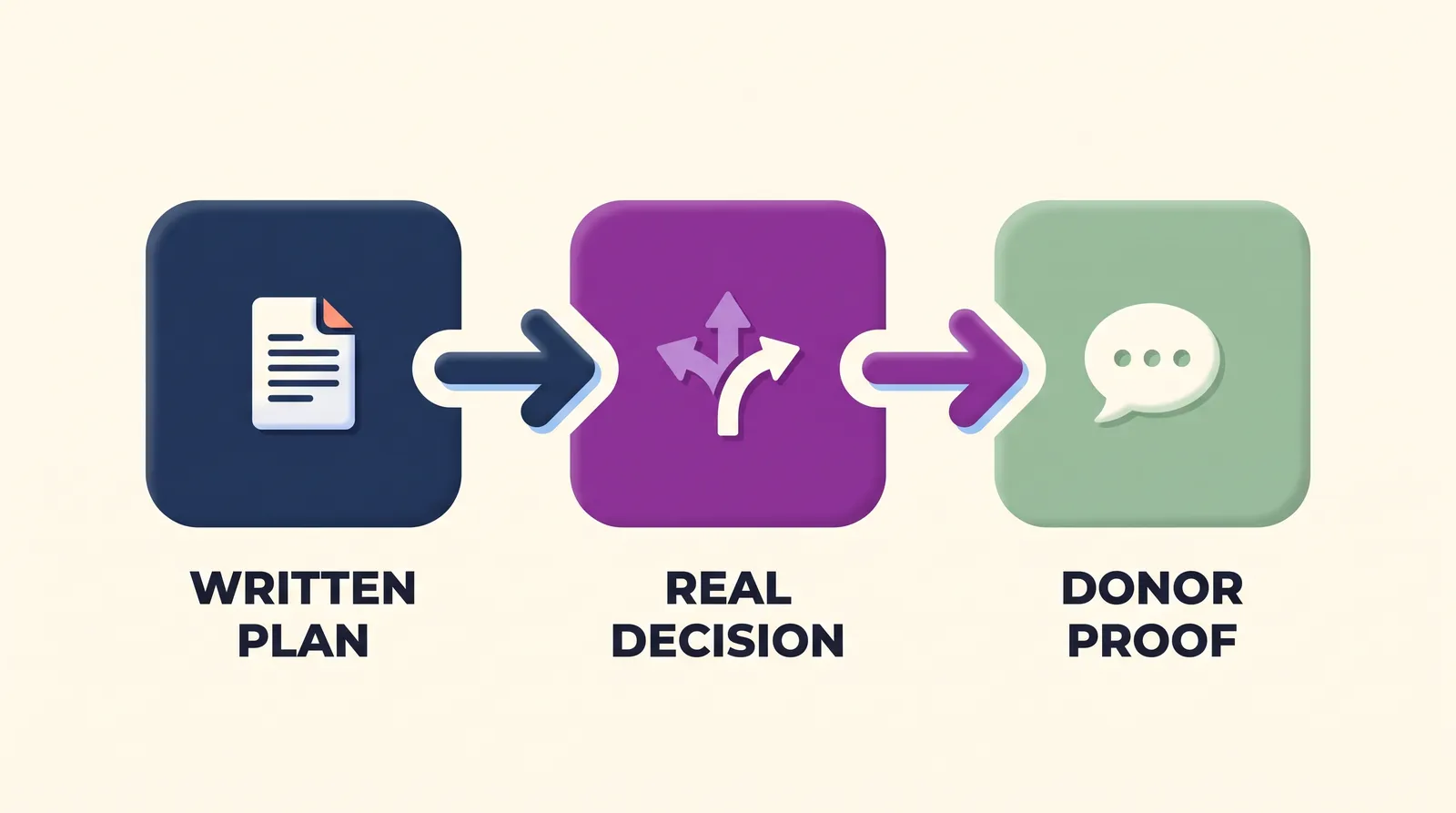
How does a strategic plan prove stewardship?
A plan demonstrates three things a donor cannot see any other way.
Priorities: what you chose
A plan names a small number of things the organization will pursue over a defined period. That is a commitment made in advance, in writing, in front of a board. When you tell a donor "we committed to three priorities this cycle and here is one of them," you are showing them a decision that was made before they walked in the room. That is more credible than any appeal copy.
Tradeoffs: what you declined
This is something just as powerful as what you are doing, and it often is the most persuasive part of the document. A plan that says yes to everything is a wish list. A plan that says "we are not opening a fourth site this cycle so we can stabilize the three we have" is evidence of discipline. Donors who fund operations, and donors who have watched an organization overextend, respond to this more strongly than to any impact number.
There is a reason for that. A major donor evaluating your organization is running a risk assessment. They are not only asking whether the work is good. They are asking whether the organization will still be functional in three years, and whether their gift will be absorbed by growth the team was not ready for. A named tradeoff answers that directly. It says the leadership team can tell the difference between an opportunity and a distraction, which is the single hardest judgment call in a growing nonprofit. Most organizations have made several of these calls and have simply never thought to mention them.
Measures: how you will know
Plans that survive contact with reality attach a way of knowing to each priority. When you can tell a donor what you are measuring, and what number would make you change course, you have moved the conversation from intention to accountability. This is also where making your impact numbers feel real to donors stops being a copywriting exercise and starts being a reporting one.
Priorities, tradeoffs, measures. That is what stewardship-grade transparency looks like, and it is why this sits at the center of the Smart Steward Method. Smart Stewardship is not about thanking donors more often, it is about building a relationship where the donor can see how you think.
Which parts of your plan belong in a donor conversation?
Not the document. Almost never the document.
Handing a donor a 24-page plan is a way of appearing transparent without being useful. What works is pulling one or two decisions out of it and putting them into ordinary language.
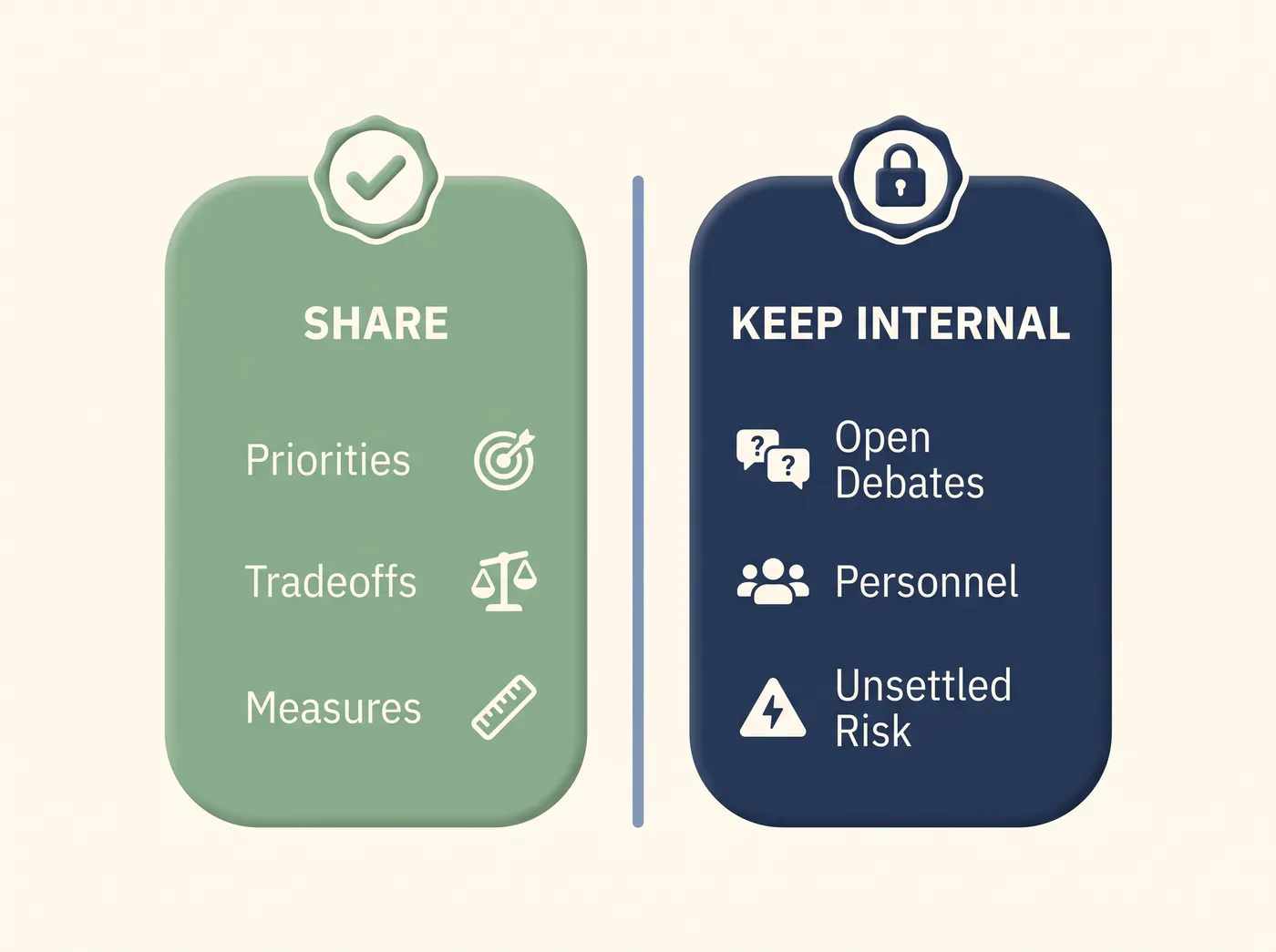
Good candidates to share:
- A staffing investment you made deliberately, and the reason behind it
- A program you chose to deepen rather than expand
- A systems or data change that makes your reporting more accurate
- A measure you added because you could not answer a question you should have been able to answer
- Something you decided not to do, and what that protected
Keep internal:
- Unresolved debates the board has not settled
- Financial vulnerability framed as a complaint rather than a plan
- Personnel specifics
- Anything you would have to walk back if the plan changes next quarter
The line is simple. Share decisions you have already made and stand behind. Do not share deliberations you are still in the middle of.
What if your organization does not have a current strategic plan?
Plenty of growing nonprofits are in exactly this position, and the honest answer is that you do not need a formal plan to get the stewardship benefit. You need documented decisions.
If the last plan expired two years ago, or the process stalled, or leadership decided a rigid three-year document was the wrong shape for a fast-changing environment, you can still answer the donor's real question. Sit down with your executive director and write out the three or four decisions the organization has actually made in the last year that changed where money and time go. Name what each one protected or unlocked.
That short list does the same job. It shows priorities, it shows tradeoffs, and it shows that someone is steering. A donor cannot tell whether that came from a facilitated retreat or a Tuesday afternoon, and it does not matter to them.
What does matter is that the list is real. Decisions you are still arguing about do not belong on it, and neither do aspirations. If you would not defend it to your board, do not say it to a donor.
How do you build this into your stewardship rhythm?
The reason this does not happen on its own is that nothing in a development team's week points at the strategic plan. Fixing that is a systems problem.
Three practical moves.
Translate the plan into talking points once, not every time. After the plan is approved, spend an hour turning each priority into two or three sentences a fundraiser could say out loud without preparation. Write them down somewhere the whole team can reach. This single step is what separates organizations that use their plan from organizations that own one.
Attach the talking points to the donor record, not to a slide deck. When a plan decision is genuinely relevant to a specific donor, it belongs in the place your team already looks before a meeting. DonorDock's donor timeline holds that context alongside the giving history, so the person prepping for a coffee at 9am sees the relationship and the organizational story in one view instead of hunting through a shared drive. If your team splits donor work across several people, shared visibility into who is talking to whom keeps the story consistent.
Refresh quarterly, in writing. A plan point that was true in January is stale by August. A short quarterly pass, updating what moved and what did not, keeps the talking points honest and doubles as board-ready material. This is the same discipline behind needs-based fundraising: you raise against what the work actually requires, not against last year's number.
If your organization is still deciding whether the plan itself is worth the investment, our team walked through the common failure modes in a short video on strategic plans that never get used.
What changes when the plan becomes a stewardship asset?
Three things, in our experience with growing development teams.
Development stops inventing impact language from scratch. The stories fundraisers tell start matching the decisions leadership actually made. Misalignment between what the board approved and what donors are told is one of the most common credibility leaks in a growing nonprofit, and it usually happens by accident.
The board sees the plan in motion. A plan that gets referenced in donor conversations gets reviewed more often, because someone outside the boardroom is depending on it being current.
And donors get a version of your organization that is easier to keep funding. Not a more polished version. A more legible one. When a donor can describe how you make decisions, they can defend the gift to a spouse, a family foundation, or their own sense of whether this was a good use of money. That is what relationship-first fundraising is protecting, and it is why retention work almost always outperforms acquisition work at this stage of growth.
You already paid for the plan. The only thing left is to let it leave the room.
If you want to see how Smart Stewardship works when the strategy, the donor record, and the follow-through all live in one place, take a look at how growing development teams steward donors in DonorDoc