
TL;DR: A grant readiness checklist is a go/no-go scorecard your team runs before anyone writes a proposal. Score seven questions from 0 to 2: mission fit, staffing, cash flow, indirect cost recovery, compliance, reporting and match, and partnership terms. Eleven or more means go. Under seven means not yet.
Most development teams decide whether to pursue a grant the same way: someone forwards the announcement, the deadline is three weeks out, and the writing starts. The question "should we apply?" gets answered by momentum, not by a decision. A grant readiness checklist replaces that momentum with a 30-minute scoring meeting, and it will save your team more hours than any proposal template ever will.
Quick answer: run the seven questions below before you open the application. Each scores 0, 1, or 2. Eleven to fourteen points is a go. Seven to ten means fix the gaps first. Six or under means not yet, and the checklist tells you exactly what to build before the next cycle.
Why do you need a grant readiness checklist before you write?
Because the odds are getting worse and the cost of a bad yes is getting higher. In the Center for Effective Philanthropy's 2026 State of Nonprofits report, two thirds of nonprofit CEOs (66 percent) said they have concerns about their organization's financial stability, and most of them attribute those concerns to the funding environment. Nonprofit Finance Fund's 2025 State of the Nonprofit Sector Survey found that, among respondents with foundation funding, 30 percent said the wait to learn whether they won a grant has gotten longer since late 2022, and 29 percent said reporting requirements have gotten more onerous.
Every hour spent on a proposal you shouldn't have written is an hour not spent on the donors who already fund you. And the grants you should not have written but win anyway are worse. They arrive with staffing you cannot sustain, cash flow you cannot float, and reporting that eats the stewardship time you needed to keep your base. That is how nonprofit mission drift starts, and a checklist is the cheapest place to stop it.
How do you score a grant go/no-go decision?
Put the seven questions below on one page. Gather the people who would actually run the grant: the development director, the program lead, and whoever owns finance. Score each question together, 0 to 2, in one sitting. Do not average opinions. If two people disagree by two points, that disagreement is the finding.
- 2 points: Yes, today, with evidence. You could show a funder the proof in five minutes.
- 1 point: Mostly, or yes with a fix you can make before the deadline.
- 0 points: No, or nobody in the room knows.
Add up the total out of 14. Eleven or more is a go. Seven to ten is a conditional go: name the fixes, assign owners, and re-score in a week. Six or under is a not yet, and you move to the last section of this article. Write the score and the decision down where your team can see it. Teams that log their no decisions stop relitigating them.
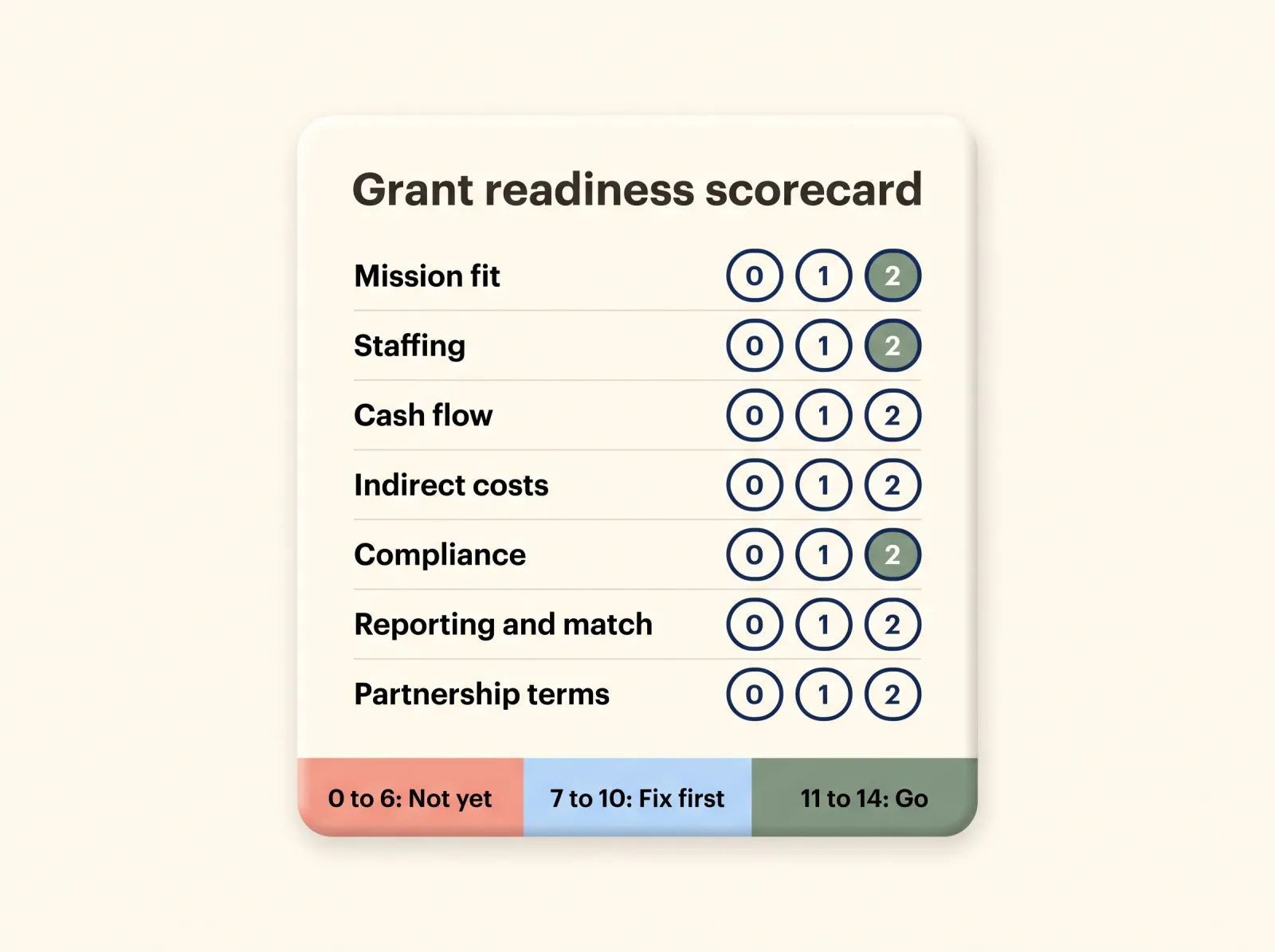
What are the seven grant readiness questions?
1. Mission fit: would you run this program without the money?
Read the funder's priority statement, then describe the program you would build in one sentence without naming the funder. If the sentence sounds like something already in your strategic plan, score 2. If it is next to your mission but new, score 1. If your program lead had to think hard about how to make it fit, score 0. This is the question most teams skip because the money is real, and it is the one that determines whether the grant strengthens your organization or quietly rewrites it.
2. Staffing: who runs it on day one, and who runs it in year three?
Name the person who will manage the grant deliverables, not the person who will write the proposal. If that person exists, has capacity, and the grant budget pays for their time, score 2. If the plan is to hire into the grant, score 1, and only if you can say what happens to that role when the funding ends. If the honest answer is "the development director will figure it out," score 0. A grant that lands on a team with no owner becomes everyone's second job and nobody's first.
3. Cash flow: can you float it if the money comes late?
Many foundation grants pay up front. Most government grants and contracts pay in arrears, after you submit invoices for work already done. Nonprofit Finance Fund's 2025 survey found that more than half (55 percent) of respondents who received government funding in FY2024 were paid late, and among those, 37 percent covered the gap with reserves, 36 percent used a loan or line of credit, 28 percent delayed payments to vendors, 21 percent paused or reduced services, and 7 percent delayed payroll. The same survey found 52 percent of all respondents had three months of cash or less on hand, not counting a separate reserve fund.
- 2: An operating reserve or line of credit can carry the grant's monthly cost for at least 90 days.
- 1: You could carry 30 to 60 days.
- 0: A 60-day payment delay would mean missing payroll.
If your finance lead can't answer this in the room, that is your first fix.
4. Indirect cost recovery: does the allowed rate cover your real overhead?
Your real overhead is almost certainly higher than what the grant will pay for, and the gap is widest on government awards. Nonprofit Finance Fund found that 70 percent of respondents with government funding were allowed an indirect rate of 10 percent or less in FY2024, and 22 percent were held to 5 percent or less. Organizations without a negotiated federal rate can elect a de minimis rate of up to 15 percent of modified total direct costs under the federal Uniform Guidance, raised from 10 percent in 2024.
Do the math before you score. Multiply the grant's direct costs by your true indirect rate, subtract what the grant allows, and that is the amount of unrestricted money this grant will consume.
- 2: The gap is covered by unrestricted revenue you already have.
- 1: You can name where it will come from.
- 0: The gap is a surprise.
A grant that quietly spends your unrestricted dollars is a grant that costs money.
5. Compliance readiness: are you registered, audited, and documented?
Federal grants require an active SAM.gov registration and a Unique Entity ID before you can submit through Grants.gov. Grants.gov tells applicants to allow up to 10 business days for a registration to become active, and warns that it can take weeks or months if information cannot be verified. Registration must be renewed every year. If the award would push your total federal spending to $1,000,000 or more in a fiscal year, the Uniform Guidance audit requirements require a single audit for that year, which is a real cost to budget for. Foundations have their own version of this: current audited financials, a board-approved budget, a conflict-of-interest policy, and a recent Form 990 are the standard document set.
- 2: Every document the application asks for is current and stored where the team can find it.
- 1: One or two need updating and there is time.
- 0: SAM.gov is not active or the audit is not done.
Compliance is the one category where a 0 is a hard stop rather than a judgment call, because no amount of good writing fixes a lapsed registration on deadline day.
6. Reporting and match: what does winning cost you every quarter?
Read the reporting schedule and the match requirement before you read the funding amount. Count the reports per year, estimate the staff hours per report, and price that time. Then look at the match. A one-to-one cash match on a $200,000 grant is a $200,000 fundraising campaign you have not started. An in-kind match is easier to meet if you already track in-kind gifts well, and a trap if you do not.
Score 2 if reporting fits inside the hours the grant budget pays for and the match is money or in-kind value you already have. Score 1 if you would need to raise a modest match or add a few hours of reporting per quarter. Score 0 if the match is larger than your unrestricted revenue for the year or the reporting would fall on someone already at capacity.
7. Partnership terms: if you are applying jointly, is it in writing?
Collaborative applications are genuinely stronger, and funders like to see them. They also fail quietly when nobody wrote down who does what. Before you score, confirm the partnership has a written agreement that covers four things: each organization's deliverables, how the money flows and who reports on it, who owns the data and the relationships with participants, and how the partnership ends when the grant does.
Score 2 if that agreement exists and both boards have seen it. Score 1 if the terms are agreed verbally and someone is drafting. Score 0 if the partnership is a handshake, or if either party cannot say what they need out of it. A collaboration does not have to last forever, but it does have to be clear for as long as it lasts. If you are applying alone, score this question 2 and move on.
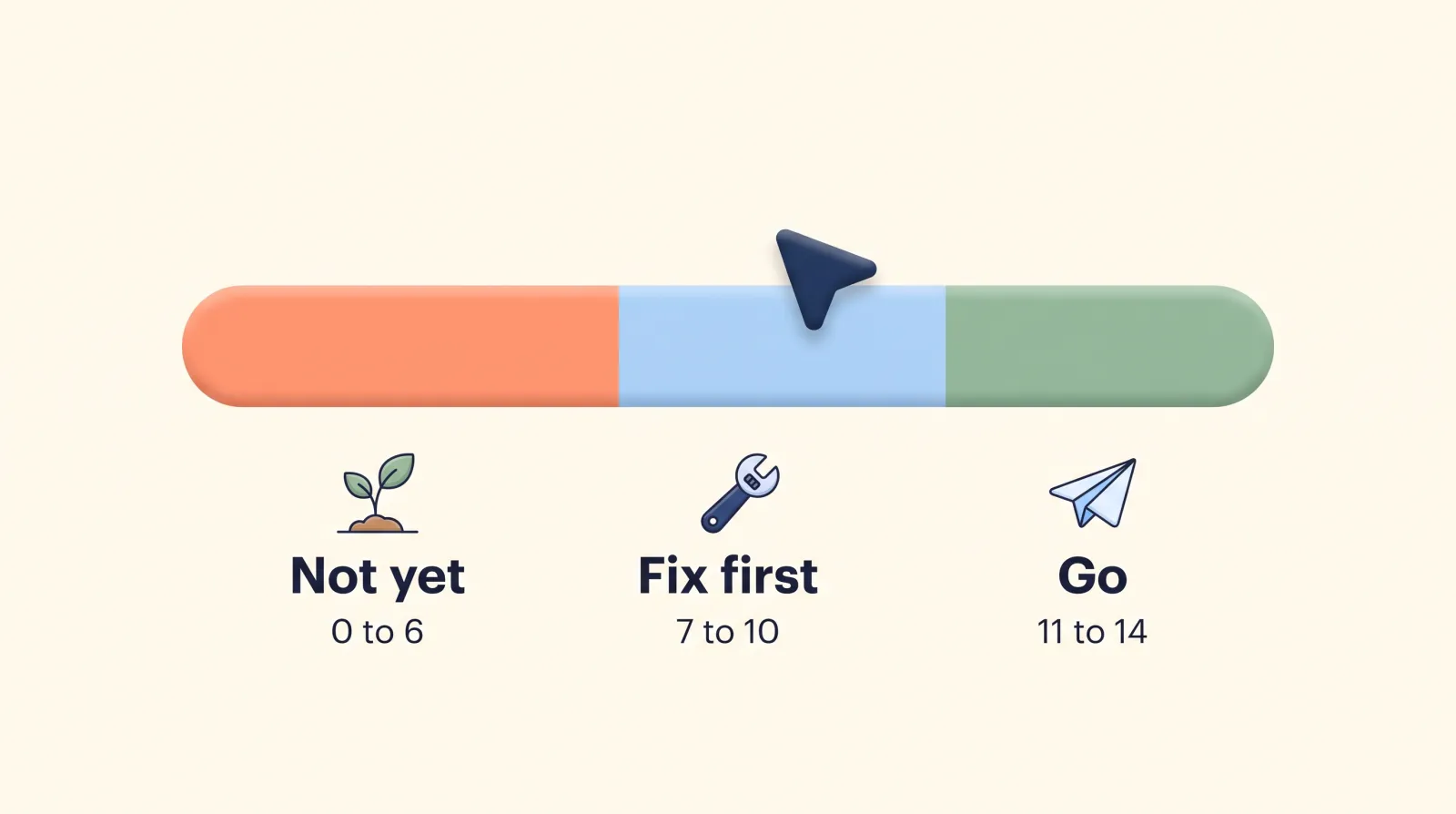
What should you do when the score says "not yet"?
A not yet is a plan, not a rejection, and it's usually a shorter plan than it feels like. Every 0 on the scorecard is a specific thing to build, and most of them take one quarter, not one year.
- Start SAM.gov now, not at the next deadline. Registration is free, renews annually, and the wait is the wait. Do it while nothing depends on it.
- Set a reserve target tied to the grants you want. If the grants you are aiming for pay in arrears, 90 days of the grant's monthly cost is the number. Put it in the budget as a line, not a hope.
- Calculate your true indirect rate once and keep it current. You can't negotiate for what you haven't measured. Your finance lead can build this from last year's audited statements in an afternoon.
- Build the compliance folder. Audit, 990, budget, policies, board list, org chart. One place, one owner, reviewed quarterly.
- Fund the gap from the community you already have. A handful of direct conversations with your closest donors about what they would fund will tell you more than a week of prospect research. Growing nonprofits routinely underestimate what their existing donors, volunteers, and in-kind partners would give to the right ask. A program funded that way is one you would run without the grant, which means it scores 2 on question 1 the next time around.
- Practice on grants that fit your current score. A pattern of smaller local awards, delivered and reported well, is the strongest evidence you can bring to a larger funder later. If a large award you counted on has already shifted, our 90-day diversification plan covers the pivot.
Re-score in 90 days. Teams that start at five or six often reach nine or ten a quarter later, because most of the fixes are quarter-sized, and they arrive at the next application with a case for capacity, not just a case for need.
How do you run the checklist without adding another meeting?
Fold it into the meeting you already have. A weekly development team meeting with a protected block for the one problem that matters most is the natural home for a go/no-go decision. Bring the scorecard, score it live, and record the total and the decision in the same place you track the rest of your pipeline.
Your CRM should already hold the answers to three of these questions. In DonorDock, fund tracking keeps restricted grant dollars separate from unrestricted revenue so question 4 stops being a guess, the forecast dashboard shows the revenue you already have coming in so question 3 has a real number behind it, and document management keeps the audit, 990, and policies attached to the funder record so question 5 is a two-minute check instead of a scavenger hunt. When the score says go, the same funder record carries the deadlines and reports through the life of the award.
Once you have a go, shift to the writing phase. Our guide to finding and writing a compelling grant proposal picks up where this checklist ends, and if the grant is part of a broader push toward larger gifts, the same discipline applies to major gift work: qualify first, then pursue. For the strategic case behind all of this, read why revenue diversification protects your mission when a single stream shifts.
Not every grant deserves a proposal. The teams that raise the most from grants over time are usually the ones that write the fewest bad ones, because they decided on purpose before they decided by deadline. Score the next opportunity before you write a word, and put the answer where your whole team can see it. If you would like the funder records, fund tracking, and forecasts behind that decision in one place, take a look at the DonorDock CRM.