Major donors and grant funders read your nonprofit financial statements as proof you will steward their gift well. They look at restricted versus unrestricted balances, your true cost to operate, receivables and reserves, revenue mix, and whether your fundraising results show up in your books.
You're in a major gift meeting. The conversation is going well, the donor is leaning in, and then the question lands: "How much of my gift actually goes to the program?" Or a foundation program officer asks you to walk through the deficit on last year's audit.
If your answer starts with "Let me check with finance," the momentum stalls. Not because the donor doubts your mission, but because they can't see your stewardship yet.
So what do funders look for in nonprofit financial statements? Evidence that you honor restrictions, know your true cost to operate, can stay solvent while you wait on money you're owed, don't depend on a single source, and can show what your fundraising actually produces. Clean books make every one of those answers easy. Messy books turn every one of them into a scramble.
Why do financial statements matter to fundraisers?
Every gift starts with trust, and right now that trust is harder to earn. Independent Sector's 2026 polling found that 56 percent of Americans highly trust nonprofits, but only 47 percent trust them to use funds responsibly. Meanwhile, the 2026 Give.org Donor Trust Report found that 67.7 percent of people say trusting a charity is essential before they donate.
Your financial statements are where that trust gets tested. A donor can love your story and still hesitate if the numbers behind it are fuzzy. A grant reviewer can admire your outcomes and still score you down if your balance sheet raises questions nobody on your team can answer.
That's why the strongest development teams treat bookkeeping as part of the fundraising foundation, not a back-office chore. Every decision your executive director or finance lead makes rests on the data underneath it. Leadership can't steer by bad numbers, and neither can you.

What do major donors look for in your financials?
Most major donors won't ask for your audit. But they will ask questions your audit answers, and they'll notice whether you can answer them with confidence.
Restricted versus unrestricted balances
Since FASB's ASU 2016-14 took effect, nonprofit statements report two classes of net assets: those with donor restrictions and those without.
Here's what trips organizations up. You can hold millions in restricted funds and still be short on the flexible dollars that pay salaries, rent, and the systems that keep everything running. On paper you look well funded. In practice, your operating budget is stretched thin.
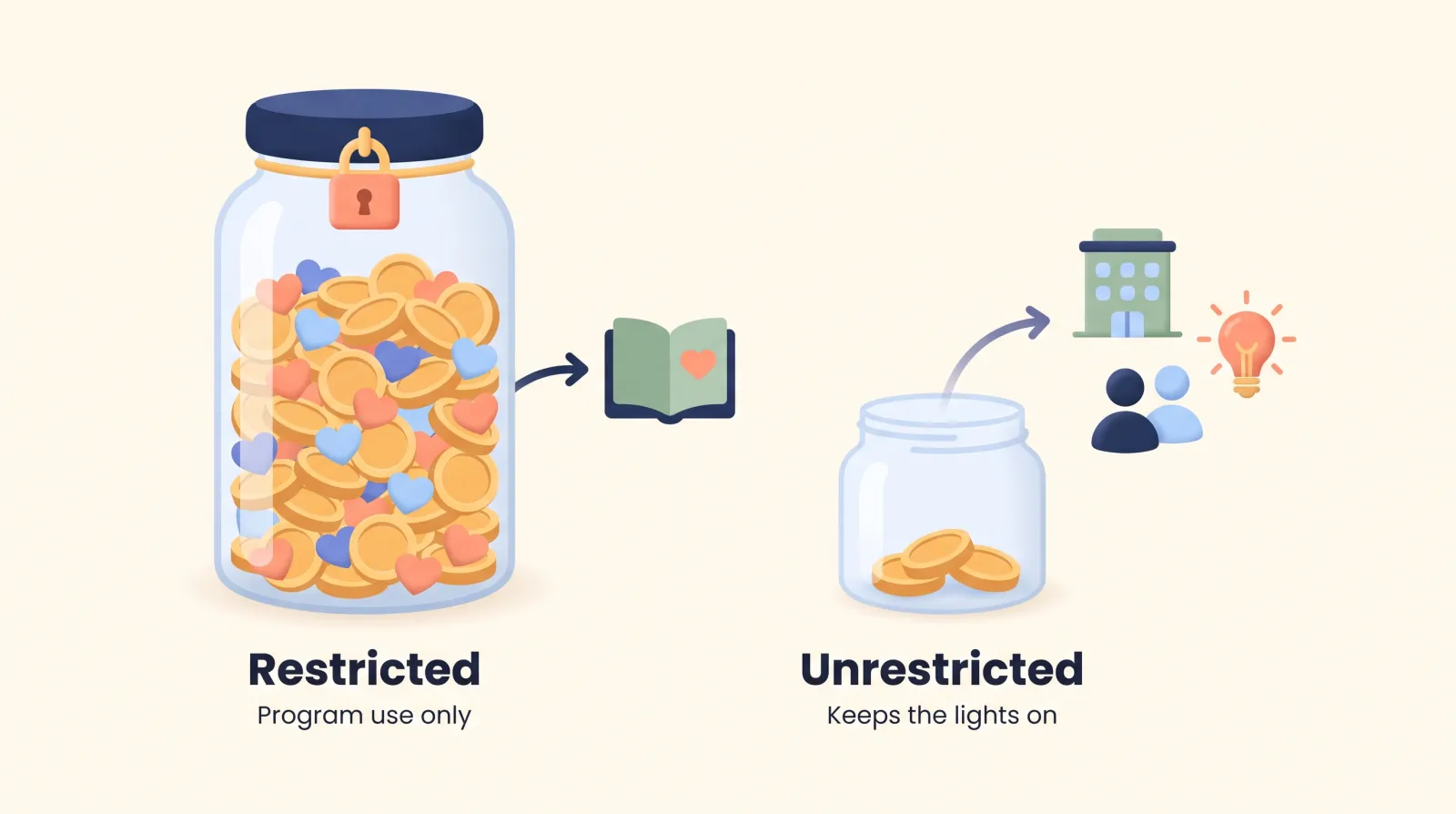
A development director who knows this split can turn it into a better ask: "Our program expansion is fully funded. What we need now is $150,000 in unrestricted support to staff it well." That's specific, honest, and far more compelling than a general appeal. It's also the kind of conversation a strong major gifts strategy is built on.
If you'd like a refresher on how restricted dollars are tracked, our guide to nonprofit fund accounting covers the basics.
Your true cost to operate
Overhead questions aren't going away. The best response isn't defensive, though. It's a confident number.
You need a reasonable estimate of what it takes to run your organization each year (people, facilities, technology, compliance) and a clear explanation of how those costs make the program possible. Staff are usually the largest piece, and without them nothing else happens.
You're in good company making this case. Nonprofit Finance Fund's 2025 State of the Nonprofit Sector Survey found that 81 percent of nonprofits say raising money that covers their full costs is a challenge. Even federal grant rules have moved: the 2024 Uniform Guidance update raised the de minimis indirect cost rate from 10 percent to up to 15 percent of modified total direct costs.
Frame overhead as the cost of delivering results, then show the donor exactly how an unrestricted gift strengthens the whole operation.
What do grant funders check in nonprofit financial statements?
Grant reviewers read your statements with one core question in mind: can this organization manage our money and still be standing when the grant ends? Three areas get the most scrutiny.
Solvency and reserves
Funders want to see that you can cover your expenses without needing their grant to survive. That's a high bar for many teams right now. In NFF's 2025 survey, 52 percent of nonprofits had three months or less of cash on hand, and 18 percent had a month or less.
If your reserves are thin, say so and show your plan to build them. Reviewers respond far better to a credible path than to silence.
Money you've earned but haven't collected
Many government grants reimburse you after you spend. If you haven't invoiced for those costs, or haven't recorded what you're owed, your statements can show a deficit when you're actually waiting on a large payment.
When receivables are recorded carefully, your books tell the true story: money earned, money owed, and when it's expected to arrive.
Multi-year pledges deserve the same care. A pledge that lives only in a development officer's inbox never shows up as money you're owed.
The context behind a deficit
A deficit year isn't automatically a red flag. Address it directly in your narrative. If the period you're reporting on shows a shortfall tied to reimbursement timing, explain it plainly: what you were owed, when it arrived, and how you record receivables now. That context is exactly what the statements alone can't provide.
Before your next application, work through our grant readiness checklist to catch these gaps early.
How does your revenue mix affect funder confidence?
Major donors and foundations both ask a version of the same question: if our support went away, would you survive?
Heavy reliance on one source makes that question uncomfortable. Your statements reveal your revenue mix at a glance. Our guide to nonprofit revenue diversification walks through building that blend, and our practical diversification plan covers what to do when a major source shifts under you.
Can your books show which fundraising efforts are worth it?
ASU 2016-14 also requires nonprofits to present expenses by both their nature (salaries, rent, supplies) and their function (programs, management, fundraising) in one place. That report is one of the most useful tools a development team has, as long as your books are set up to feed it.
When every campaign and event is tracked on its own, leadership can answer the questions that shape next year's plan:
- Which appeal raised the most for every dollar it cost?
- Is the spring event still worth the staff hours it consumes?
- Is one program attracting far more funding than another that's quietly running short?
If your data shows one program is consistently overfunded while another carries a gap, you can point your asks at the real need. That's the heart of needs-based fundraising, and it only works when the books are detailed enough to show it.
If your events and campaigns aren't tracked that way yet, our monthly checklist for reconciling donations with QuickBooks shows how to set it up.
What should a development director know before a major gift meeting?
You don't need to become an accountant. You need a short set of numbers you can speak to with confidence. Before your next major donor or foundation conversation, get these from your finance lead:
- Restricted and unrestricted totals. Roughly how much you hold in each, and what the restricted dollars are already committed to.
- Annual cost to operate. An honest estimate of what it takes to run the organization, including the share that goes to people.
- Months of cash on hand. Your current reserve position and your target.
- Money you're owed. Outstanding grant reimbursements and pledge balances, with expected timing.
- Your largest revenue source. The share of revenue it represents and your plan to reduce dependence on it.
- The specific gap. What this gift closes, in dollars and in outcomes.
Keep a one-page version updated monthly. When a donor asks a hard question, you'll have the answer ready, and you'll build credibility in the moment.
Should a growing nonprofit hire a bookkeeper, a controller, or a CFO?
Growing organizations often reach for a CFO first. That's usually backwards.
A CFO makes high-level strategic decisions, and every one of them depends on the data underneath. If the bookkeeping is unreliable, even a brilliant CFO is guessing. Build from the foundation up:
- Bookkeeper: Records every transaction accurately and closes the books on time each month. This is the non-negotiable starting point.
- Controller: Leads the accounting function, owns internal controls, and manages audits. Worth adding once audits become a regular part of life, for example when you spend $1,000,000 or more in federal awards in a year, the current Single Audit threshold.
- CFO, full-time or fractional: Turns clean financials into strategy through forecasting, scenario planning, and board-level financial leadership.
Whoever you have in place, the year-end crunch goes far smoother when the monthly basics are solid. Our year-end close tips can help you finish the fiscal year strong.
How do development and finance become real partners?
The organizations that get this right don't treat finance as a gatekeeper. They plan together from the start.
- Set goals together during budgeting. Development shouldn't learn the revenue target after it's been locked. Agree on goals, staffing capacity, and how restricted funds will be managed before the year begins.
- Let finance inform donor strategy. Your finance lead knows what each program actually costs, which makes them your best guide to where the real funding gaps are.
- Let development inform the reports. You hold donor context finance doesn't. When a number doesn't match what you know from the relationship side, speak up early.
If you're also evaluating new systems, read how to get finance and fundraising aligned on your CRM.
How DonorDock keeps gift data finance-ready
Your donor database is where most financial trust problems either start or get solved. Every gift recorded with the right fund, campaign, and date makes your finance team's job easier and your statements more accurate.
DonorDock's fund tracking lets donors designate their gifts to specific funds when they give online and can add those designations to their receipts, so restrictions are captured at the source instead of reconstructed later. The Forecast Dashboard brings together scheduled pledge installments, recurring gifts, and open asks weighted by pipeline stage, so you can talk about future revenue with the same confidence as money already in the bank.
Clean books are a fundraising strategy
Your mission earns the first conversation. Your financials earn the second gift, and the third. When your numbers are clean and your team can speak to them, you stop defending your organization and start inviting donors into a plan they can see.
That's what stewardship really looks like: proving, again and again, that you do what you said you would with every dollar entrusted to you. If you're ready for gift data your finance team trusts, see how DonorDock helps development teams build that foundation.