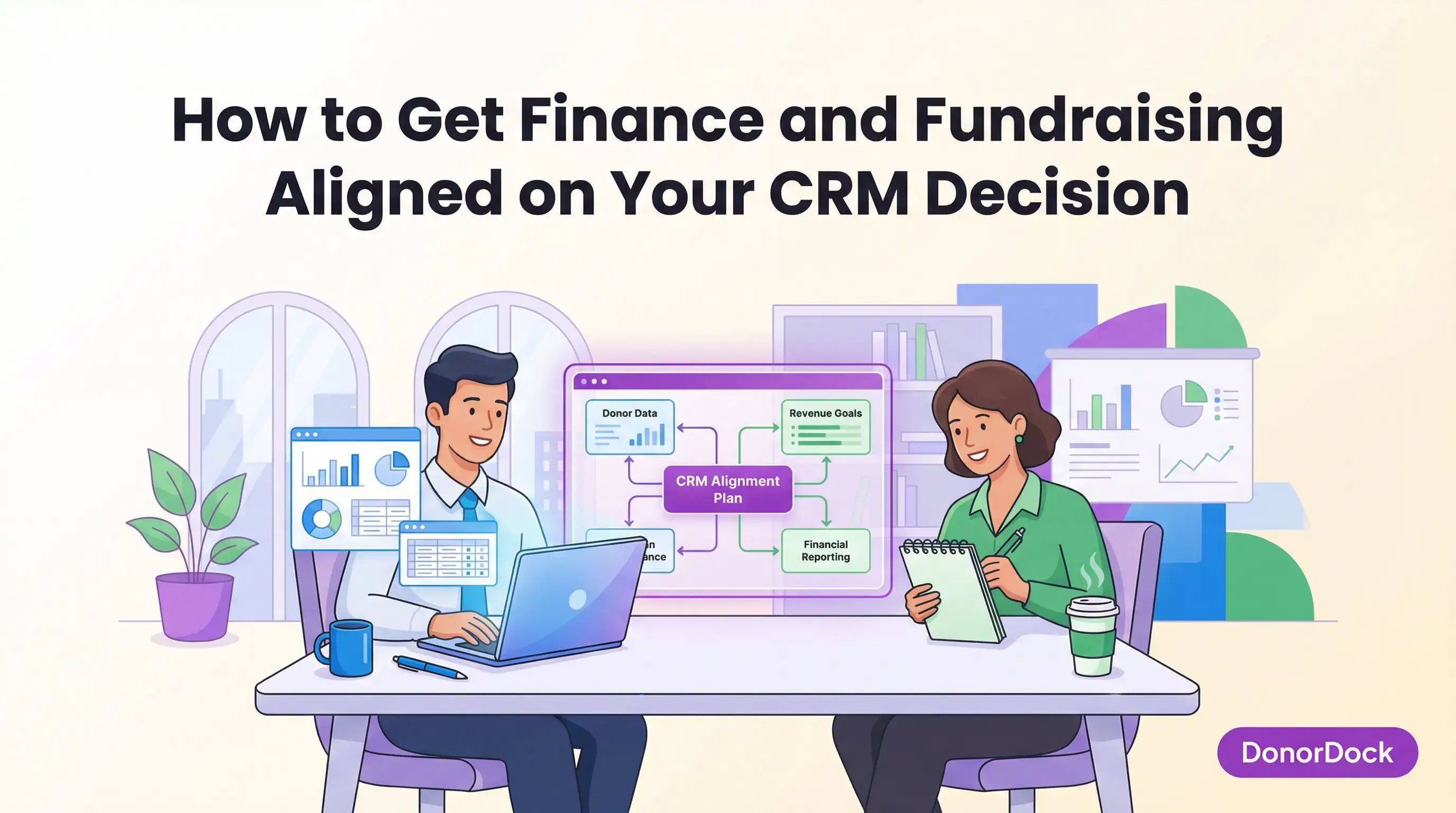
If you've ever been ready to move forward on a new tool like a CRM, only to have the conversation stall because your finance team has concerns, you're not alone. It's one of the most common dynamics we see at DonorDock, and it's not because anyone is doing anything wrong. Finance teams and fundraising teams just see the world through different lenses.
The good news? When you get those two perspectives working together instead of against each other, you end up with a stronger decision and a smoother implementation. Here's how to make that happen.
Why this tension exists (and why it's actually healthy)
Your finance team cares about reconciliation, audit trails, and making sure every dollar is accounted for. Your fundraising team cares about stewardship, donor relationships, and not losing momentum while waiting for approvals. Both of those things matter, a lot.
The friction shows up when finance interprets a technology decision as a process risk, and fundraising interprets a delayed decision as a missed opportunity. Neither side is wrong. But when one side gets veto power without fully understanding the other's goals, the organization stalls.
We've talked to hundreds of nonprofits navigating this exact situation. The fundraising leader is excited about what a modern CRM could do for donor retention and team efficiency. But then the head of finance raises a concern about how gift data will sync with QuickBooks, or how reconciliation will change, and the whole conversation stops.
That concern is valid. But it shouldn't end the conversation. It should shape it.
Start with shared goals, not feature comparisons
Before you demo a single platform or compare pricing spreadsheets, get both teams in a room and answer one question: What does success look like for our organization in the next 12 months?
Finance will probably say something about cleaner reporting, fewer manual entries, and better audit readiness. Fundraising will probably say something about stronger donor retention, faster stewardship, and less time spent on data entry.
Notice how much overlap there is. Both teams want cleaner data. Both teams want less manual work. Both teams want confidence in their numbers. That shared ground is your foundation.
When you frame the CRM decision as "how do we achieve these shared goals?" instead of "fundraising wants a new tool and finance needs to approve it," the power dynamic shifts.
It stops being a gate and becomes a collaboration.
Address the reconciliation question head-on
Nine times out of ten, the finance team's biggest concern is reconciliation. How will gift data flow between the CRM and our accounting system? Will we have to change our processes? What happens to our audit trail?
Don't wait for them to ask. Bring it up first.
A modern donor management platform like DonorDock integrates directly with QuickBooks Online and offers multiple configuration options for how gift data syncs. Some organizations want a detailed line-by-line sync. Others prefer summary journal entries. The right approach depends on your organization's accounting practices, and a good CRM partner will walk through those options with your finance team before you commit.
When finance sees that their concerns are being addressed proactively, not dismissed, their posture shifts from "no" to "let's figure this out."
Make the cost of inaction visible
One of the dynamics we see often is that finance teams focus heavily on the cost of change (migration, training, subscription fees) without fully accounting for the cost of staying put.
Here are some questions worth putting on the table:
- How many hours per month does your team spend manually entering or cross-referencing donor data across spreadsheets and disconnected tools?
- How many donors lapsed last year without anyone noticing until it was too late?
- How much revenue are you leaving on the table because your team can't identify the right donors to follow up with at the right time?
- What's the real cost of a board report that takes five hours to assemble instead of five minutes?
For most growing nonprofits, the answer to each of those questions represents real money, real time, and real missed opportunities.
When you can quantify the cost of your current state, the investment in a better system starts to look like what it is: a path to efficiency, not a risk.
Invite finance into the evaluation, not just the approval
This is the single biggest shift you can make. Instead of asking finance to approve a decision that's already been made, invite them into the evaluation process from day one.
Let them sit in on the demo. Let them ask the hard questions about data migration, reconciliation workflows, and reporting capabilities. Let them talk directly to the CRM provider's team about how other organizations with similar accounting setups have made the transition.
At DonorDock, some of our best discovery calls include both the development director and the finance lead. When finance hears firsthand how the platform handles fund accounting, campaign tracking, and QuickBooks integration, their concerns get addressed in real time instead of becoming secondhand objections that are harder to resolve.
When your finance team feels like a partner in the decision rather than a checkpoint, they become an advocate instead of a blocker.
Reframe the conversation: this is a systems decision, not a tools decision
Every technology conversation is actually a systems conversation. It's not just about features and pricing. It's about how your people, processes, and tools work together to move your mission forward.
When you approach it that way, the question changes from "should we buy this CRM?" to "how do we build a system that helps our entire organization raise more money, steward donors better, and operate more efficiently?"
That's a question finance and fundraising can answer together. And when they do, you end up with a decision that has organizational buy-in.
What to look for in a platform that bridges the gap
If you're evaluating donor management platforms and you want one that both teams can rally behind, here are a few things to prioritize:
- Transparent pricing with no surprises. Finance teams appreciate knowing exactly what they're paying for. One plan, one price, everything included, no hidden module fees or per-contact surcharges.
- Built-in integrations with accounting tools. A direct QuickBooks Online integration with flexible configuration options means finance doesn't have to worry about manual reconciliation or losing their audit trail.
- Reporting that serves both teams. Visual, customizable reports that fundraising can use for strategy and finance can use for board presentations and grant compliance.
- A dedicated onboarding experience. A 90-day success plan with data migration support, custom training, and a team that walks you through the transition reduces risk for everyone involved.
- A money-back guarantee. Nothing says "we're confident this will work for you" like putting real skin in the game. It takes the pressure off both teams to make a perfect decision upfront.
The bottom line
Your finance team isn't the enemy of progress. They're a partner who brings a perspective your fundraising team needs. And your fundraising team isn't being reckless by wanting better tools. They're trying to do more with less, which is exactly what your organization needs.
The organizations that get this right are the ones that stop treating CRM decisions as a tug-of-war between departments and start treating them as a shared investment in the mission.
If you're navigating this conversation right now and want a partner who knows how to work with both sides of the table, book a demo with DonorDock. We'll bring your finance team into the conversation from day one, because we've found that when both teams are aligned, the decision gets easier and the results get better.