
Quick answer: Network for Good is now part of Bonterra, and its pricing is quoted rather than published. The eight Network for Good alternatives worth comparing are DonorDock, Bloomerang, Little Green Light, DonorPerfect, Neon CRM, Givebutter, Keela, and Virtuous. The right one depends on how much you want built in, how fast your donor list is growing, and whether you want to see a price before you take a sales call.
How we compared: We looked at each platform's total cost including platform fees, its contact limits, whether email and texting are built in, and the migration support it offers. Last reviewed October 2026.
People usually start looking for an alternative to Network for Good after something changes. Most often a renewal quote comes in high, or the donor list crosses into a new pricing tier.
Network for Good has been coaching nonprofit fundraisers for more than 20 years, and plenty of organizations are well served by it. This guide is for the teams weighing a move.
What has changed with Network for Good
Network for Good is a Bonterra product. The old networkforgood.com address now redirects to Bonterra, which sells it next to EveryAction, DonorDrive, Mobilize, and its other nonprofit tools.
Bonterra positions Network for Good as coaching-first fundraising software. The platform includes an AI fundraising assistant called Bonterra Que, coaching and playbooks, donor management, donation pages, email, unlimited SMS, events, peer-to-peer, and grant tracking.
- Prices are not published. Network for Good's old pricing page now redirects to Bonterra's demo request form. Bonterra says pricing is based on the size of your contact database and the plan you choose.
- There are three plans: Intelligence, Essentials, and Free. According to Bonterra, Essentials and Free keep a 3% platform fee on donations, and Intelligence removes it.
- Record growth moves the price. Bonterra's fundraising pricing FAQ says it charges a fee when your records move into the next tier.
- Term length matters. The same FAQ says longer contract commitments generally get better pricing, so the renewal term affects what you pay.
If you want to stay with Bonterra, EveryAction is its larger CRM and worth asking about.
The costs to price out before you switch
Get these four numbers in writing, from Network for Good and from every platform you compare:
- The subscription. Quoted against your current contact count and plan level.
- The platform fee. On a plan with a 3% platform fee, $200,000 in online giving means $6,000 a year in platform fees, before card processing.
- Tier jumps. What happens to the price when your list grows past the next contact threshold.
- The contract. The term length, the renewal date, and how much notice you need to give before you leave.
The eight alternatives
#1 DonorDock
Best if you want everything on one published plan
DonorDock is an all-in-one donor management platform for growing and mid-sized nonprofits. One plan covers CRM, email marketing, online giving, text messaging, and automations, with unlimited contacts, so a growing donor list never moves you into a new price tier.
The numbers you can check: DonorDock is rated 4.8 out of 5 on G2 from 151 reviews and 4.8 out of 5 on Capterra from 33 reviews. Pricing is published: $500 per month billed annually, with 5 users and unlimited contacts included, plus a 2% platform fee on online giving. DonorDock is SOC 2 Type 2 compliant, and white-glove migration is typically done in under a week.
For a Network for Good team, the biggest shift is cost you can plan around. The price stays the same as your contact count grows, there are no long-term contracts, and the 2% platform fee is lower than the 3% on Network for Good's Essentials and Free plans. Pledges, moves management, and membership programs all live in the same CRM as your gifts and outreach.
Where it is not the fit: DonorDock does not bundle one-on-one fundraising coaching into the subscription, and the plan includes 5 users, with more as add-ons. If a guided coaching program is the main thing you want, Network for Good was built around that.
- Best for: Growing and mid-sized nonprofits that want CRM, email, texting, online giving, and automations on one published plan with unlimited contacts.
- Not the best fit if: you want fundraising coaching bundled into your donor platform, or need 20 or more user seats on a database under 2,000 contacts, where the unlimited users at Bloomerang or Little Green Light cost less.
#2 Bloomerang
Best for retention analytics and unlimited users
Bloomerang is a well-regarded donor management platform known for its retention analytics, and it includes unlimited users on every plan, which matters for larger teams.
Published starting prices are $125 per month billed annually for Bloomerang CRM, $242 per month for The Giving Platform, and $119 per month for Bloomerang Volunteer. Pricing rises with your record count, which is the same contact-tier math some teams are trying to leave.
Where it is not the fit: the product line is modular, so you buy CRM, fundraising, and volunteer tools separately, and text fundraising comes with Bloomerang Fundraising rather than the CRM on its own.
- Best for: Teams that want retention-focused analytics and unlimited users on every plan.
- Not the best fit if: you are leaving Network for Good to get away from pricing that climbs with your record count, or want one product rather than separate CRM, fundraising, and volunteer apps.
#3 Little Green Light
Best if you want the lowest published price
Little Green Light publishes every price: $45 per month up to 2,500 records, $90 at 20,000, and $135 at 50,000, then $15 per month for each additional 10,000. It is a clean, reliable donor database with unlimited users, no contracts or setup fees, and online gifts carry only processing costs.
Where it is not the fit: built-in email has monthly send limits tied to your record tier, and there is no texting or marketing automation. Teams used to running email and SMS campaigns from Network for Good will end up adding tools around LGL.
- Best for: Organizations with a few thousand records and a firm budget ceiling that want fully published pricing and unlimited users.
- Not the best fit if: you run regular email and text campaigns today and want them in the same system as your donor records.
#4 DonorPerfect
Best for reporting depth
DonorPerfect has been in the category for decades and is known for deep, query-based reporting. Core starts at $99 per month, and Plus and Pro are quoted. Every plan includes a Constant Contact account for email, and Moves Management, QuickBooks integration, and batch gift entry sit on Plus or higher.
Where it is not the fit: reporting is query-driven, which is a real learning curve for teams that liked Network for Good's guided approach.
- Best for: Teams that want deep, query-based reporting from a long-established vendor.
- Not the best fit if: you need Moves Management, QuickBooks integration, or batch gift entry on the entry-level Core plan, since those start at Plus.
#5 Neon CRM
Best if events and member portals run your calendar
Neon One's suite ties CRM, events, memberships, websites, and payments together. Its edge is member self-service portals and built-in event registration. Neon's pricing page lists Neon CRM from $99 per month, Neon Fundraise from $158 per month, and Neon Websites from $69 per month, so model the whole suite.
Where it is not the fit: if your work is mainly donor management and email, with no ticketing or member logins, you would be paying for a suite built around those.
- Best for: Organizations where event registration and member self-service portals are central to the work.
- Not the best fit if: events and member portals are not central to your work, so that side of the suite would go unused.
#6 Givebutter
Best for campaigns, events, and peer-to-peer
Givebutter is fast to launch and strong on peer-to-peer, events, ticketing, and campaign pages. The model is donor-funded: leave optional donor tips on and the platform fee is 0%, or turn tips off and a flat 3% platform fee plus standard processing applies. A paid Givebutter Plus tier, priced by contact count, adds deeper CRM and engagement tools.
Where it is not the fit: the CRM underneath is lighter. If you manage year-round donor relationships rather than campaign to campaign, you will feel the ceiling.
- Best for: Event, peer-to-peer, and campaign-page fundraising that needs to launch fast.
- Not the best fit if: year-round donor development is the main job, since the deeper CRM features sit in the paid Givebutter Plus tier.
#7 Keela
Best for Canadian and cross-border organizations
Keela offers native CRA receipting and bilingual support, with donor management, email marketing, donation forms, and marketing automation in one login. Texting is a paid add-on.
Pricing is published and contact-based, from $164 per month for up to 1,000 contacts to $438 per month at 10,000, with unlimited forms, emails, and donations on every plan.
Where it is not the fit: if you are US-only, its main advantage does not apply, and the contact tiers bring back the same growth math.
- Best for: Canadian and cross-border organizations that need CRA-compliant receipting and bilingual support.
- Not the best fit if: you are a US-only organization with a growing list, since pricing rises with each contact tier.
#8 Virtuous
Best if you are ready to adopt responsive fundraising
Virtuous pairs a CRM with marketing automation and events, and adds modules for online giving, volunteer management, and wealth screening, all built around its responsive fundraising model. Pricing is quote-based, with "Request Pricing" on every tier.
Where it is not the fit: it is a real implementation commitment, and if quoted pricing is part of why you are leaving Network for Good, Virtuous works the same way.
- Best for: Organizations ready to adopt the responsive fundraising model, with staff time to implement it.
- Not the best fit if: you want published pricing or a lighter implementation, since Virtuous quotes every plan.
Compare them at a glance
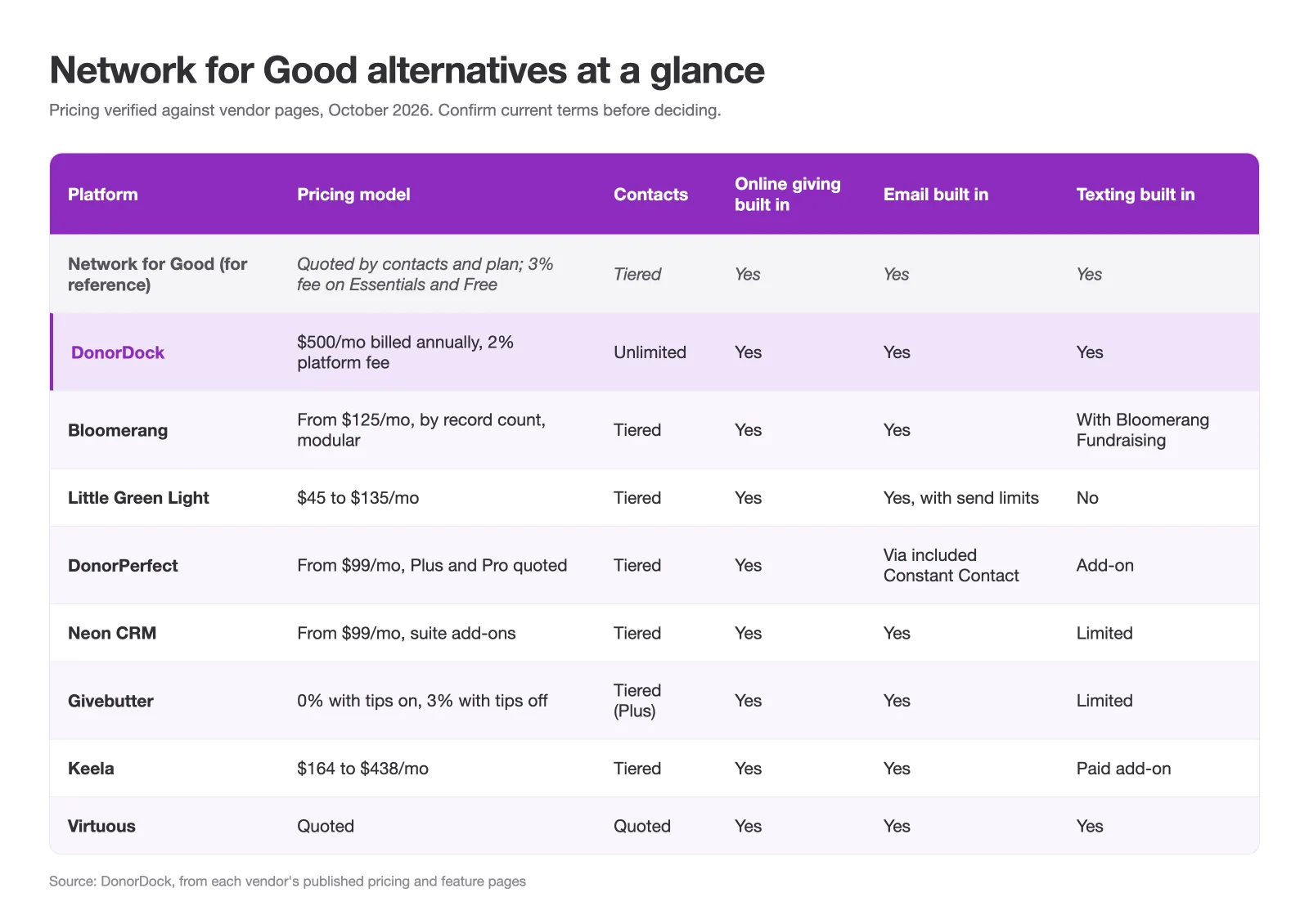
Pricing verified against vendor pages in October 2026.
How to move your data out of Network for Good
Start with contacts and gifts. Both export the same way: open Contacts or Giving, select all records, choose Export from the Bulk Actions menu, pick your fields, and download the finished file under Settings, Exports. DonorDock's help center walks through it field by field in its guide to exporting data from Network for Good.
Whichever platform you choose, this order keeps the move manageable:
- Check your contract first. Find your renewal date and notice period before you book demos, so the timeline is yours.
- Export contacts and gifts. Confirm the record counts in each file match what you see in Network for Good.
- List what lives outside those two exports. Recurring gift schedules, event and peer-to-peer records, email templates, and saved segments. Export or document each one.
- Ask how recurring gifts move. Every vendor handles this differently, and it is the part donors notice.
- Rebuild only the reports people use. Ask which reports anyone actually read last year, and leave the rest behind.
- Ask every vendor the same three questions. Who does the migration, how long does it take, and what does it cost?
Where DonorDock fits
DonorDock is built for growing and mid-sized nonprofits that want their fundraising in one place, on one plan that does not change as the donor list grows. For Network for Good teams, that means email, texting, online giving, and automations without a contact-tier conversation at every renewal.
Our team handles the migration for you: white-glove, typically under a week, with no long-term contracts and a 90-day money-back guarantee. DonorDock is trusted by 7,600+ users, with $6B+ in gifts tracked since 2017.
For the full feature list, see the DonorDock nonprofit CRM page. The Network for Good vs DonorDock comparison puts the two platforms side by side, and our roundups of Kindful alternatives and Blackbaud alternatives cover the same field from different starting points.
Talk to us about moving from Network for Good and we will walk through your actual data.