
TL;DR: A case for support is the master document explaining why someone should give to your nonprofit now. Build it in seven steps: gather voices, define the need, name outcomes, prove them, draft the core case, adapt it by channel, and test it with trusted readers.
You have a grant narrative due Friday, website copy your designer needs by Monday, and a board member asking for "a one-pager we can hand out." Each one starts from a blank page. Each one describes your work a little differently. What's missing is the one document they should all pull from: a case for support.
Here's how to write a case for support that fixes it: collect raw material from the people closest to your programs, then build one master document around seven building blocks. The need, why now, your approach, outcomes, proof, what a gift does, and the invitation. Then, every appeal, grant, and major gift conversation pulls from that one source, so your team stops starting over.
What is a case for support?
A case for support is the internal master document that makes the full argument for giving to your organization. It explains the problem you exist to solve, how you solve it, what changes as a result, and exactly what a donor's gift makes possible.
You'll also hear "case statement." Most teams use the two terms interchangeably. When a team does separate them, the case for support is the internal master and the case statement is an external piece built from it, like a campaign brochure. The core case is the long, complete version your team works from. The shorter pieces you share with donors, often called case expressions, are adapted from it for a specific audience and channel.
Why does this matter so much right now? Donors want to be sure before they give. In the Give.org 2026 Donor Trust Report, 67.7% of U.S. adults said they have to trust a charity before they donate, yet only 18.3% reported high trust in charities. Your case for support is where you close that gap, on purpose, before you ever make the ask.
What should a case for support include?
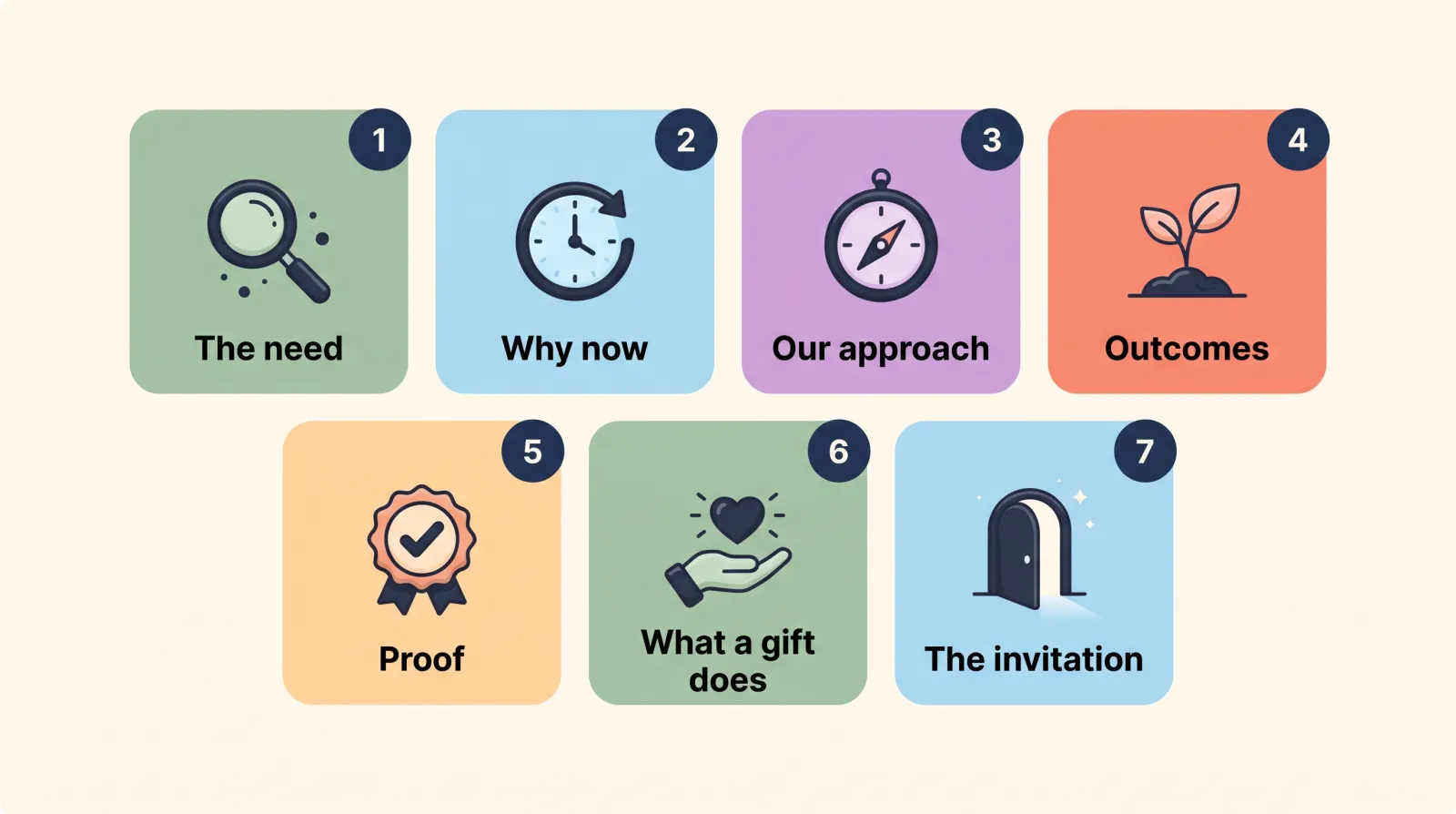
Strong cases share the same seven building blocks.
- The need. The problem, who it affects, and one number that makes it concrete.
- Why now. What makes this year different: a waiting list, a new opportunity, a window that will close.
- Our approach. What you do and why it works better than the alternative.
- Outcomes. What changes for those affected, including the changes that are hard to see.
- Proof. Data, participant voices, and outside validation that show it's real.
- What a gift does. Specific, tangible examples of what a donor's money accomplishes.
- The invitation. The future you're building and how the donor becomes part of it.
How do you write a case for support, step by step?
Split the work into seven steps.
Step 1: Gather raw material before you write a word
The best language in your case won't come from the development office. It will come from program staff and the people you serve. Block time for short interviews before you open a blank document.
- Talk with three to five program staff for 30 minutes each. Ask what changes for people, what they'd stop doing without funding, and the moment they knew a participant had turned a corner.
- Hear from participants, with their consent. Their words carry more weight than yours. Ask what was different before and after, and what they'd tell someone thinking about joining.
- Pull the numbers. People served, your cost per participant, the size of your waiting list, and whatever outcome data you already collect.
Keep everything in one shared folder. You'll gather far more material than you use, and that's good because you can use it in the future.
Step 2: Define the need and the "why now"
Write the need so plainly that a donor could repeat it to a friend. Anchor it with a local figure and a clear reason this year matters.
"Why now" is where many cases go soft. Urgency doesn't mean panic. It can be a waiting list that doubled, a new location, a partner ready to match gifts, or demand that keeps climbing. If nothing about this year is different, say what a gift today prevents or makes possible tomorrow.
If your organization also sells services or runs a social enterprise, add one sentence here that explains what those sales cover and what gifts cover.
Step 3: Name the outcomes, including the ones donors can't see
Outputs are what you do: classes taught, meals served, sessions held. Outcomes are what changes: a parent who now reads with her kids every night, a family that stopped skipping meals, a senior who can stay safely in her own home.
Some of your most important outcomes are invisible from the outside. Trust. Belonging. Hope. Stability. Donors can't see them, so your job is to make them visible, usually through a participant's own words or a quick before-and-after measure. Our guide to fundraising around intangible outcomes goes deeper on how.
Whatever you name, make it specific. In one experiment published by Cryder, Loewenstein, and Scheines, people who read one concrete example of Oxfam's work, bringing clean water to villagers in West Africa, gave an average of 88 cents of their $2 study payment, compared with 48 cents from people who read that Oxfam provides a broad range of aid. Tangible details help donors believe their gift will matter.
Step 4: Assemble proof donors can trust
Proof is what turns a moving story into a credible one. Build a mix of three kinds:
- Numbers. Two or three outcome figures with the time frame and where they came from.
- Voices. Short quotes from participants, staff, and partners, used with permission.
- Validation. Evaluations, accreditations, awards, or respected partners who vouch for your work.
If you don't have outcome data yet, start with a short end-of-program survey. Three to five questions is plenty: a couple of before-and-after ratings on the change you care about most, one question on what helped, and one open question asking what they'd tell a friend. Run it every cycle and you'll have fresh numbers and quotes all year.
Transparency and lived experience build trust, too. Independent Sector's 2026 trust research found that 74% of Americans say their trust would rise if nonprofits were transparent about how they use their funds, and 62% say it would rise if a board included people who had used the organization's services.
Step 5: Draft the core case from the template
Now you write. Use the template below and fill it in block by block, pulling from your raw material. A few rules keep the draft on track:
- Make the donor the difference-maker. The people you serve are the hero, and your organization is the guide. "Your gift puts a tutor beside a first-grader" beats "we provide tutoring services." Our guide to donor-centric fundraising shows how to frame it.
- Lead with one person, then widen the lens. Open a section with a single participant's experience before you share the bigger numbers.
- Write in plain language. If a board member would have to ask what a sentence means, rewrite it.
- Keep one idea per paragraph. Your core case will be read in pieces, so every paragraph should make sense on its own.
For major donors, the core case also becomes the backbone of a bigger investment conversation. Our guide to building a major donor pitch that tells the whole story shows how to layer in the budget and the plan.
Step 6: Turn one core case into every expression
This is where the case earns its keep. Instead of writing each piece from scratch, you pull the right blocks for each channel.
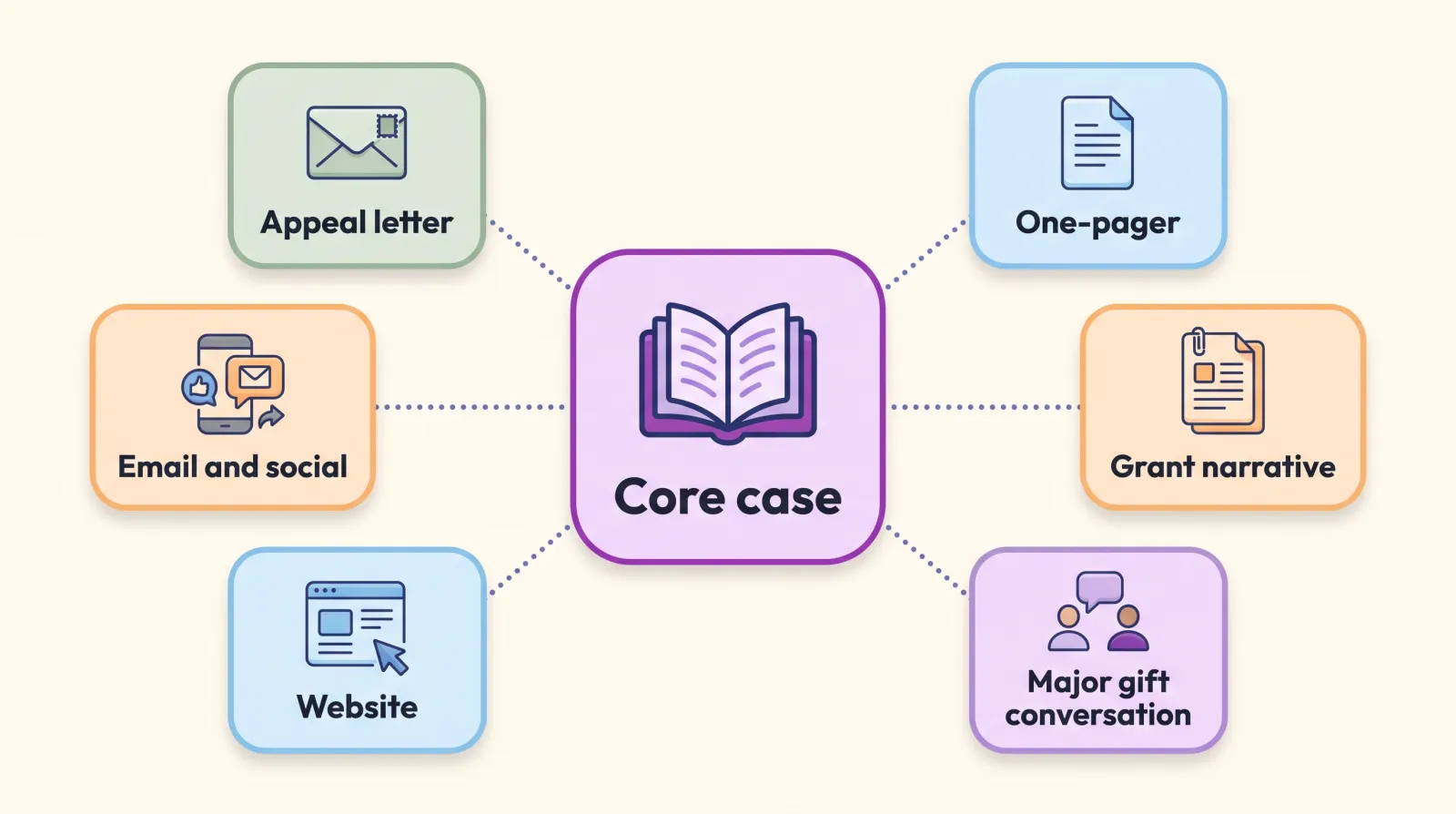
- Appeal letter: the need, one participant story, and what a gift does.
- One-pager: the need, your approach, three outcomes, and a clear way to give.
- Grant narrative: the need, your approach, your outcomes, and your evaluation proof. A finished case makes every grant proposal faster to write.
- Major gift conversation: why now, the vision, and the specific opportunity you're inviting them into.
- Website: the need, a story, your outcomes, and a clear path to give. Your About page is the place to show donors the difference they make.
- Email and social: one story, one number, one link.
Match the depth of evidence to the audience. In a direct mail experiment run by Karlan and Wood, swapping the last paragraph of a beneficiary story for a note on rigorous impact evidence made no difference across the full mailing. Donors who had previously given $100 or more gave more when they saw the evidence, while donors who had given less were slightly less likely to respond.
Lead with story in broad appeals, and bring the evidence forward in major gift conversations and grant narratives.
Once your expressions exist, keep them where the whole team can reach them. DonorDock's email and letter templates with merge tags let you build an appeal once and personalize it for every donor.
Step 7: Test it with a few trusted readers, then keep it alive
Before you roll the case out, put the draft in front of a few people who know you well, such as a loyal donor, a newer donor, a board member, and someone on your front-line staff. Ask three questions. What stood out? What was confusing? What would make you give?
Then keep it alive. Name one owner, review it twice a year, and refresh the numbers and stories each time. The outcomes you promise in the case are the same ones you report back after a gift, which is the heart of what we call Smart Stewardship.
Case for support template you can copy
Paste this outline into a document and replace the brackets. Write long first. You'll trim when you build each expression.
- The need. "Every year, [number] [people] in [community] face [problem]. Without [what you provide], [consequence]."
- Why now. "This year, [what changed: waiting list, opportunity, new partner]. With [amount] by [date], we can [specific milestone]."
- Our approach. "[Organization] [does what] by [how]. What makes it work is [the distinctive element]."
- Outcomes. "After [program], [share or number] of participants [measurable change]. Just as important, they [harder-to-see change]. In their own words: '[short quote]'."
- Proof. "[Survey or evaluation result]. [Partner, accreditation, or award]. [Years of work and people served]."
- What a gift does. "[Amount] provides [specific unit of impact]. [Larger amount] provides [larger unit of impact]."
- The invitation. "Join [the community of supporters] who believe [vision]. [One clear next step]."
How long should a case for support be?
Long enough to be complete, short enough that your team will actually read it. As a working range, we recommend:
- Core internal case: four to eight pages. Completeness matters more than polish here.
- Campaign case: 8 to 16 designed pages for a capital campaign, heavier on vision and giving opportunities.
- One-pager: one page, front side only if you can manage it.
- Digital expressions: 150 to 400 words for an email, and less for social.
Who should write the case for support?
One person should own the pen, usually your development director or the fundraiser who will use the case most. Program staff, participants, and your executive director contribute. The board reviews. Nobody writes by committee.
If you bring in outside help, hand them your raw material and the seven blocks, and agree up front on who signs off on the final draft. Aim for one shared, true story your whole team can tell.
Put your case to work this week
A case for support won't raise a dollar sitting in a folder. It works when every appeal, grant, and donor conversation pulls from the same source. Start with Step 1: book three 30-minute interviews with program staff. If you want a head start on the language, bring DonorDock's Define Your Messaging worksheet to those conversations.