Why Your Nonprofit Needs a CRM in 2026
If you're still managing donor relationships with spreadsheets, sticky notes, or a patchwork of disconnected tools, you're leaving money and relationships on the table.
A nonprofit CRM (Constituent Relationship Management) centralizes every interaction you have with supporters: donations, emails, event attendance, volunteer hours, and conversations into one place.
But here's the challenge. There are dozens of nonprofit CRMs on the market, ranging from free open-source platforms to enterprise systems costing thousands per month. How do you choose the right one?
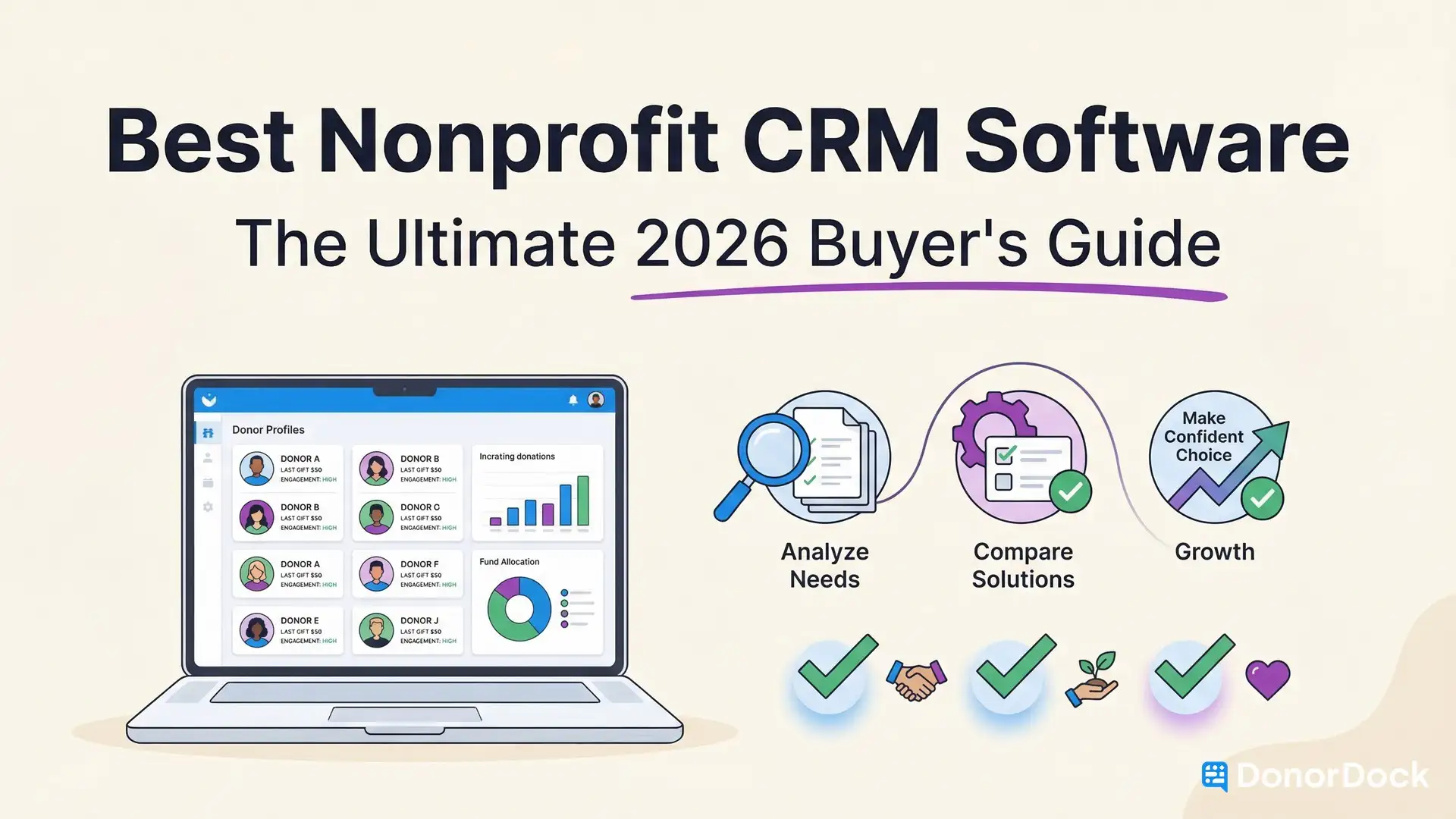
This guide breaks down the top 11 nonprofit CRMs for 2026 by comparing features, pricing, strengths, and ideal use cases so you can make a confident decision.
What to Look for in a Nonprofit CRM
Before diving into individual platforms, here are the features that matter most for growing nonprofits. If you want to see how these capabilities work together in practice rather than as a checklist, our nonprofit CRM page walks through each one.
Donor Management. The foundation. You need rich contact profiles that track giving history, communication preferences, relationships, and engagement over time. Look for household linking, custom fields, single source of truth, and donor timelines.
Online Giving. Built-in donation pages save you from paying for a separate giving platform. Look for customizable forms, recurring giving support, and low processing fees.
Email and Communication Tools. Donor stewardship requires consistent, personalized outreach. The best CRMs include email marketing with templates, segmentation, and automation, not just basic email.
Reporting and Analytics. You need to answer questions like "Who are our lapsed donors?" and "What's our retention rate?" without hiring a data analyst. Look for pre-built reports, custom filtering, and dashboard views.
Automation. Automated thank-you emails, task reminders, and stewardship workflows save your team hours every week. This is what separates a modern CRM from a glorified spreadsheet.
Ease of Use. If your team can't learn the platform quickly, they won't use it. Period. Prioritize platforms with intuitive interfaces and fast onboarding.
Support Quality. When something goes wrong (or you just have a question), responsive support matters. Some platforms charge extra for premium support; others include it.
Pricing Transparency. Watch out for per-user fees, per-record charges, and add-on modules that can double or triple an advertised price. The best platforms offer predictable, transparent pricing.
The Top 11 Nonprofit CRMs for 2026
1. DonorDock
Best for: Growing nonprofits who want an all-in-one platform that's easy to use
Pricing: One transparent price of $500/month for growing organizations. Unlimited contacts on every plan.
DonorDock is a purpose-built nonprofit CRM that bundles donor management, online giving, email marketing, text messaging, automations, and project management into a single platform. It's designed for organizations that want one login, one bill, and one place for all their data.
What nonprofit teams tend to love most is the Action Board, which acts like a virtual fundraising coach. It automatically surfaces daily tasks: donors to thank, lapsed supporters to re-engage, and milestones like birthdays and giving anniversaries. Smart Nudges work alongside the Action Board to highlight high-priority actions at just the right moment. Otto AI works alongside your team to draft personalized donor communications and surface insights from your data, turning donor data into daily action.
Everything is included. Drag-and-drop email builder, text messaging, unlimited Giving Pages, project management boards, custom automations, and Stewardship Journeys.
Unlimited contacts means your price doesn't increase as your donor list grows. Transparent pricing with no contracts and a 90-day money-back guarantee. Rated #1 on G2 for easiest setup, best support, and easiest to use.
Integrations: QuickBooks, Stripe, PayPal, GoFundMe Pro, OneCause, Fundraise Up, Point Volunteer, Zapier, and 100+ tools via Integration Builder.
Limitations: No native auction management and limited peer-to-peer capabilities. Best suited for organizations that want an easy-to-use, consolidated platform. Enterprise orgs with highly complex needs may want more customization options.
2. Bloomerang
Best for: Organizations where donor retention is the top priority
Pricing: Starts at $125/month (up to 1,000 records). Fundraising add-on starting at $40/month. Volunteer management is a separate product starting at $119/month.
Bloomerang has built its reputation around donor retention analytics. Its proprietary Engagement Score predicts which donors are likely to lapse, giving your team actionable data to intervene before it's too late. The platform includes unlimited users (no per-seat charges) and a constituent timeline showing complete interaction history.
The trade-off is modular pricing. CRM, Fundraising, and Volunteer are separate products, so total cost rises as you add capabilities. Online giving is not included in the base CRM and requires the Fundraising add-on. Contact-based pricing means costs increase as your database grows. See our full Bloomerang comparison.
3. Neon CRM (Neon One)
Best for: Membership-based organizations, associations, museums, and arts groups
Pricing: Essentials at $99/month; Impact at $209/month; Empower at $409/month. Pricing scales by revenue tier.
Neon CRM natively includes CRM, online fundraising, email marketing, event management, membership management, peer-to-peer fundraising, and volunteer management. All of this is included without third-party integrations. If your organization manages members (not just donors), Neon CRM's native membership management is superior to bolting membership tracking onto a donor-centric CRM.
The user interface has been noted as less intuitive than some competitors, and customer support response times can lag. The learning curve is steeper for smaller teams, and the full feature set requires the higher-tier plans.
4. DonorPerfect
Best for: Established nonprofits with complex fundraising operations
Pricing: Three tiers starting at $99/month, $199/month, and $649/month. Record-based pricing with add-on modules.
DonorPerfect has been in the nonprofit market for decades, serving 75,000+ professionals. It offers deep fundraising history tracking, donor scoring, and integrated Constant Contact email marketing. Event and auction management modules are available as add-ons.
The interface feels dated compared to newer platforms. Add-on pricing can escalate total cost significantly, and some users find reporting complex to navigate. Premium support tiers cost extra. See our full DonorPerfect comparison.
5. Givebutter
Best for: Growing Nonprofits focused on campaign-based fundraising, events, and auctions who want to start with minimal upfront cost
Pricing: Core fundraising tools are available at no platform cost when donor tips are enabled. Without tips, a 3% platform fee applies. Givebutter Plus (advanced CRM features, automations, enhanced reporting) starts at $29/month and scales by contact count.
Givebutter has made a name for itself as an accessible entry point for nonprofits that need fundraising tools without a big upfront investment. It offers online giving pages, events, auctions, peer-to-peer fundraising, and basic donor management. The tip-based model means nonprofits can get started collecting donations without paying platform costs, as long as donors opt in to tipping.
Where organizations tend to outgrow Givebutter is when they need deeper CRM capabilities. Donor management, reporting, and automation features are more limited than purpose-built CRMs on this list. Givebutter Plus adds some of those features, but contact-based pricing means costs grow with your database. The platform is also limited to 5 users, and automations top out at 6 workflow actions.
If your team is focused on campaign-level fundraising and events, Givebutter is worth a look. If you're moving toward year-round donor relationship building with robust stewardship workflows, you'll likely need a platform with more CRM depth. See our full Givebutter comparison.
6. Little Green Light
Best for: Budget-conscious growing nonprofits that need core donor management done well
Pricing: $45/month (up to 2,500 records), scaling to $90/month for 20,000 records. 10% discount for annual billing.
Little Green Light has earned a loyal following among small development shops by focusing on doing donor management well at a very reasonable price. It's the most affordable dedicated nonprofit CRM on this list, with responsive customer support consistently praised in reviews.
The trade-off. No built-in email marketing (requires Mailchimp or Constant Contact integration), no online giving, and limited automation capabilities. You'll need separate tools for email and donations, which adds complexity.
7. Keela
Best for: Growing Nonprofits who want smart donor insights without enterprise complexity
Pricing: Scales by contact count. Approximately $225/month for 2,500 contacts. Unlimited users, unlimited emails, no transaction fees on donations.
Keela is a Canadian-built nonprofit CRM with a standout "Smart Ask" feature that uses wealth screening and giving history to recommend personalized donation amounts for each donor. The clean, modern interface and no-transaction-fee model are appealing for smaller organizations.
Higher per-contact pricing for larger databases, a smaller market presence with fewer third-party integrations, and limited event management capabilities are the main considerations.
8. Virtuous
Best for: Data-driven nonprofits ready to invest in responsive fundraising
Pricing: $$$ | Custom pricing based on organization size.
Virtuous positions itself as a "responsive fundraising" platform. It uses data signals, automation, and personalization to treat every donor as an individual. It features predictive analytics with suggested gift asks, social profile enrichment from hundreds of public sources, and marketing automation triggered by donor behavior.
The higher starting price and requirement for organizational buy-in to the responsive fundraising methodology are considerations.
9. Salesforce Nonprofit Cloud
Best for: Large enterprise nonprofits with dedicated IT staff
Pricing: Enterprise at $60/user/month; Unlimited at $100/user/month (billed annually). Eligible nonprofits get 10 free licenses. Implementation typically costs $10,000–30,000+.
Salesforce is the world's largest CRM platform, and its Nonprofit Cloud adapts that enterprise power for the social sector. It offers virtually unlimited customization, a massive app ecosystem (AppExchange), and enterprise-grade security and reporting.
The reality: it's free like a puppy. Implementation costs are significant, it requires technical expertise (often a dedicated admin or consultant), and the 6-12 month implementation timeline doesn't work for teams that need to be operational this quarter. Per-user pricing gets expensive as your team grows. See our full Salesforce comparison.
10. Network for Good (Bonterra)
Best for: Growing Nonprofits getting started with professional fundraising
Pricing: $$ | Custom pricing (contact Bonterra for a quote). All packages include unlimited users, campaigns, emails, and peer-to-peer pages.
Bonterra's Network for Good platform is an entry-level fundraising CRM that combines donor management, communications, and online giving. The guided fundraising approach and included peer-to-peer pages make it a solid starting point for first-time CRM buyers.
No publicly listed pricing means you can't easily evaluate cost. As part of the Bonterra conglomerate (which has acquired many brands), product consolidation is an ongoing concern. Reporting and automation are less sophisticated than alternatives.
11. CiviCRM (Open Source)
Best for: Tech-savvy nonprofits who want full control and zero licensing costs
Pricing: Free (open source). You pay only for hosting, maintenance, and hired developers. Hosting typically runs $20–100/month.
CiviCRM is the only fully open-source CRM on this list. Built for nonprofits, civic organizations, and advocacy groups, it integrates with WordPress, Drupal, and Joomla. The platform is completely open source and has no licensing costs. You're responsible for hosting, maintenance, security, and updates. The interface is functional but not modern, and there's no dedicated support team.
How to Choose: Use-Case Recommendations
"We're a growing nonprofit and cost is the deciding factor" Little Green Light. If budget is extremely tight, LGL at $45/month is hard to beat for basics. If you want a complete platform (CRM, giving, email, text, automation) without piecing together multiple tools, DonorDock delivers dramatically more value.
"We're growing fast and need to scale" DonorDock. DonorDock's unlimited contacts ensure costs don't spike as you succeed and its all-in-one platform keeps you moving quickly with confidence in your data.
"We need to start fundraising online with minimal cost" Givebutter. Get online fundraising and giving pages running with no platform costs when tips are enabled.
"Donor retention is our biggest challenge" Bloomerang or DonorDock. Bloomerang's Engagement Score and retention dashboard are purpose-built for this problem. DonorDock's Action Board and Smart Nudges help you know what to take action on today.
"We manage members, not just donors" Neon CRM. Native membership management beats bolting membership tracking onto a donor-centric CRM.
"We want advanced automation and personalization" DonorDock or Virtuous. DonorDock's Stewardship Journeys and Otto AI deliver sophisticated personalization without enterprise pricing. Virtuous takes a responsive fundraising approach that's powerful if you have the data maturity to leverage it.
"We're a large enterprise nonprofit" Salesforce Nonprofit Cloud. If you have dedicated IT, a consulting budget, and complex multi-department workflows, Salesforce's customization is unmatched.
"We have tech talent and want total control" CiviCRM. Zero licensing costs with complete data ownership. If you have developers to manage it.
5 Questions to Ask Before Choosing a Nonprofit CRM
1. What's the TRUE total cost? Add up the base subscription, per-user fees, per-contact overages, add-on modules, implementation costs, and premium support. The advertised price is rarely the full picture.
2. What happens as we grow? Some CRMs penalize growth with contact-based pricing that increases as your database expands. Look for platforms with unlimited contacts or flat-tier pricing.
3. How long until we're up and running? Some platforms take weeks (DonorDock, Little Green Light), others take months (Bloomerang, Neon CRM), and some take upwards of a year (Salesforce). Match the implementation timeline to your team's capacity.
4. Do we need one platform or a best-of-breed stack? If you want ease of use, choose an all-in-one platform. If you have specialized needs (like advanced events or membership), a specialized CRM plus targeted integrations might be the way to go.
5. What does support actually look like? Ask to speak with the support team during your trial. Test response times. Read recent reviews about support quality. This is the relationship you'll rely on when things go wrong.
Want to go deeper before you shortlist? Our nonprofit CRM buyer's guide covers 12 questions to ask a vendor, and why nonprofit CRM implementations fail is worth reading before you sign anything.
The Bottom Line
There's no single "best" nonprofit CRM, there's only the best CRM for your organization. A $45/month platform that your team actually uses will outperform a $1,600/month platform that sits idle because it's too complicated.
That said, if we had to make one recommendation for the majority of growing nonprofits, it would be DonorDock. It's the only platform on this list that bundles CRM, online giving, email marketing, text messaging, automations, project management, and AI tools into a single subscription. Unlimited contacts means your costs don't increase as you grow. And it's rated #1 on G2 for easiest setup and support quality.
The best way to decide? Try before you buy. Most platforms on this list offer demos. Demo 2–3, involve your team in the evaluation, and choose the one that feels right for how your organization works.
Your donors deserve a nonprofit that knows them. The right CRM makes that possible.
Ready to see how DonorDock works for your team? Book a demo →