TL;DR: To identify planned giving prospects, filter your database for loyalty, not wealth: donors with ten or more years of consistent giving and longtime monthly donors. Then invite them to raise their hands with legacy checkboxes, a survey campaign, and plain-language conversations.
You do not need a wealth screening budget to find your next legacy donors. If you are wondering how to identify planned giving prospects, the answer is that most of them are already in your donor database, hiding in plain sight as your most loyal, most ordinary givers.
What you need is a repeatable way to surface them and let them tell you they are interested. This playbook walks through six steps: pull a loyalty-based list, fix your language, add checkboxes everywhere, run a survey campaign, use the brochure pass in meetings, and steward the hand-raisers well.
Who counts as a planned giving prospect?
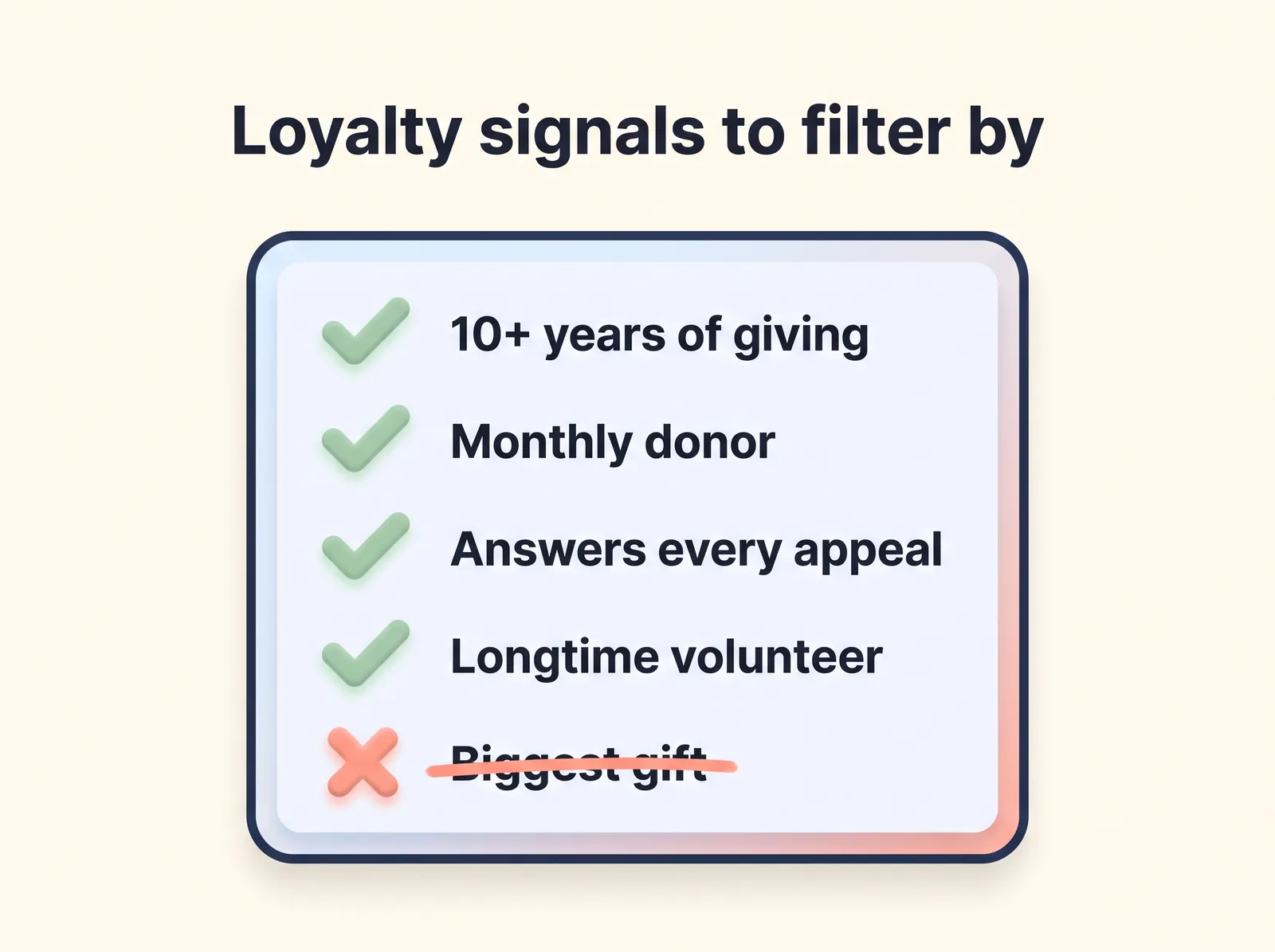
Anyone with a long, consistent relationship with your mission. Loyalty is the signal that matters, and we broke down the research behind that in our companion piece on planned giving strategies and why loyalty beats wealth. For list-building purposes, translate loyalty into filters like these:
- Longevity: donors giving in most of the last 10 or more years, at any amount
- Monthly donors: anyone on a recurring gift for 5 or more years
- Frequency without size: people who respond to nearly every appeal, even at $25
- Involvement: longtime volunteers, event regulars, and board alumni who also give
- Age and life stage: donors likely to be updating estate plans, often 55 and older
Notice what is not on the list: gift size. A donor who has quietly renewed a modest gift every year since the Obama administration often holds more legacy potential than a one-time major donor, because much of their generosity lives in their home and retirement accounts rather than their checking account.
Step 1: Pull a loyalty-based prospect list from your CRM
Start with a saved segment you can refresh anytime. In DonorDock, build a saved segment filtering on first gift date, giving frequency, and recurring status, and it becomes a living legacy prospect list that updates itself as donors cross your loyalty thresholds.
Keep the first list tight, 50 to 150 names for most growing nonprofits. You are not mailing this list tomorrow. You are choosing who gets your best attention this year.
One caution: do not disqualify anyone for giving too little. The entire point of this approach is that the signal lives in the pattern, not the amount.
Step 2: Swap the jargon before you say a word
"Planned giving" is insider language. Donors do not use it, and plenty of nonprofit professionals cannot define it cleanly either. If your materials lead with jargon, your best prospects will nod politely and move on.
Say exactly what you mean instead:
- Say "a gift in your will" instead of "a planned gift" or "a bequest"
- Say "a gift from your IRA" or "a gift from a retirement account" instead of "a qualified charitable distribution"
- Say "a gift of stock" or "a gift from your donor-advised fund" instead of "non-cash assets"
The same directness applies to the ask itself. A strong major gift ask is specific: the amount, the project, the impact. A strong legacy ask is just as plain: "Would you consider a gift in your will to keep this work going?" Donors should never need to do mental gymnastics to figure out what you are asking for.
Step 3: Put a checkbox everywhere a donor can reply
Hand-raisers are the easiest planned giving prospects to identify because they identify themselves. Your job is to make raising a hand nearly effortless, which means folding one small checkbox into every piece of donor outreach you already send:
- Reply slips on direct mail appeals
- Your online donation form confirmation page
- Gala and event response cards
- Your email newsletter footer
- Annual surveys and impact report reply cards
Keep the copy warm and low-pressure: "I have included [your organization] in my will" or "Please send me information about leaving a gift in my will." That is the whole checkbox.
The evidence for asking this consistently is striking. Research highlighted by the Stanford Social Innovation Review found that when people were simply asked about including a charity in their estate plans, the share who did so doubled from 5 percent to 10.4 percent, and adding social-proof framing pushed it past 15 percent, with gifts roughly twice as large.
Step 4: Run a legacy giving survey campaign
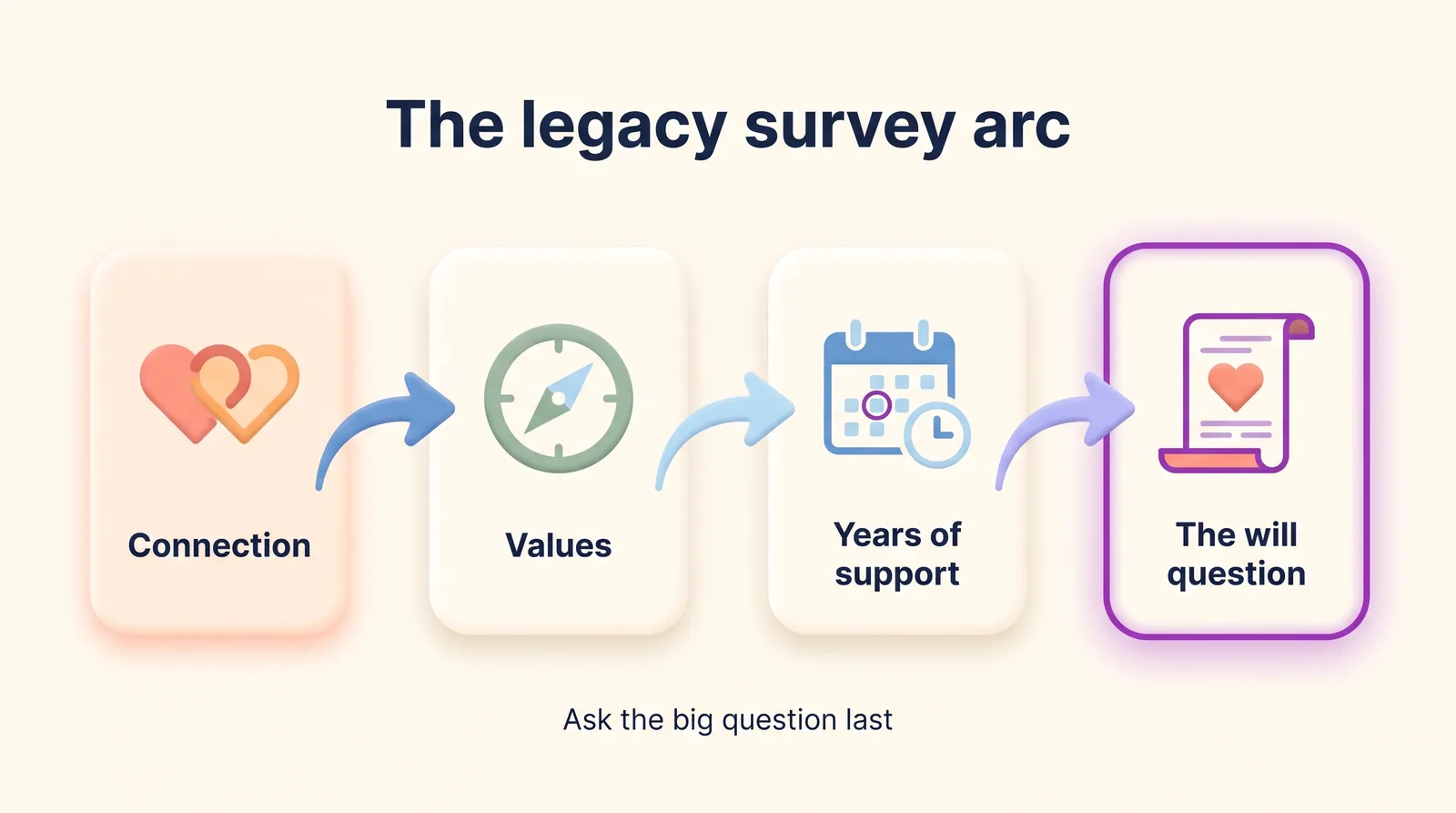
A survey is the single most effective hand-raiser tool because it lets donors qualify themselves while walking through the psychology of a legacy decision. The order of the questions does the work: connection first, values second, the will question last.
A version you can adapt:
- How did you first get connected to our mission?
- What part of our work matters most to you personally?
- How long have you been supporting causes like ours?
- Which of your values does your giving express?
- Have you created a will or estate plan?
- Would you consider including a gift to our mission in your will? (Yes / Maybe someday / No / I already have)
By the time a loyal donor reaches question six, they have just retold themselves the story of a relationship that spans years. Some will check "I already have," and that answer alone justifies the campaign: the same SSIR analysis notes that fewer than 25 percent of people who include a charitable bequest ever tell the organization.
On logistics, keep it easy on yourself. An email with an online form works well for most of your list, and a printed version with a reply envelope serves donors who still give by mail. Keep it under ten questions, put a real person's name on the invitation, and promise to share what you learn. Response rates climb when donors believe someone is actually listening.
Send it to the loyalty segment from Step 1, position it as listening rather than asking, and follow up personally with every "yes" and "maybe someday."
Step 5: Use the brochure pass in one-to-one meetings
For donors you meet in person, you need a way to open the topic without turning a relational visit into a pitch. The brochure pass does exactly that.
Create one good legacy giving brochure focused on the why: the future your organization is building and the people it will serve. Skip the mechanics of estate law. Then, near the end of a visit, hand it over and ask for feedback: "We are refreshing how we talk about gifts in wills. Would you look this over and tell me what resonates?"
Their reaction is your answer. Genuine curiosity means you continue the conversation over the next few visits, no yes-or-no pressure required. A firm "that is not for me" means you thank them warmly, record it in your database, and never burn the relationship by re-asking. Both outcomes are wins, because both replace guessing with knowledge.
Step 6: Record every signal and steward the long timeline
A legacy decision rarely resolves in one season. Donors typically consider a gift in their will for years, then act when a milestone like retiring or a change in the family prompts them to revisit their estate plan. Your systems have to be ready to remember longer than any one staff member will.
Record every hand-raise, survey response, and brochure reaction where the whole team can see it. DonorDock’s Action Board turns those signals into scheduled follow-up tasks, so a "maybe someday" from this spring gets a warm touchpoint next spring instead of vanishing into a spreadsheet nobody reopens.
What should the record include? The signal itself, the date, the exact language the donor used, and the next step you promised. "Maybe someday, wants to talk after retirement next year" is a plan. A star next to a name is a mystery for whoever inherits the portfolio.
Stewardship for legacy prospects looks like stewardship for everyone else, done consistently: fast thank-yous, specific impact updates, an occasional handwritten note. If your donor communications have gotten sporadic, start with our guide to donor retention strategies that stop the erosion, because a leaky annual program undermines every legacy conversation you start.
How long does it take to find planned giving prospects?
Faster than you think, and slower than your board wants. The identification work in Steps 1 through 4 can produce your first hand-raisers within one or two campaign cycles, often inside 90 days. The gifts themselves take years to mature, which is why the recording and stewardship in Step 6 matter more than any single campaign.
Half the battle is simply being present when the will gets updated. Research from Dr. Russell James shows 46.3 percent of Americans over 50 already have a will or trust. The question is not whether your loyal donors will make an estate plan. It is whether your mission is in the room when they do.
If you have not formalized the program side yet, gift acceptance policies and the basics, work through our step-by-step guide to building a planned giving program alongside this playbook, and see our tips for making planned giving feel natural in conversation.
And resist the urge to over-engineer the start. You do not need a legacy society, custom letterhead, or an estate attorney on retainer to begin. You need a list, a checkbox, a survey, and the discipline to follow up. Everything else can be added once real hand-raisers exist.
Your legacy pipeline is not somewhere out there waiting to be bought. It is sitting in your database, giving $25 at a time, waiting to be noticed. Pull the list this week, add the checkbox this month, and let your most loyal donors tell you what they have been quietly considering all along.