
Quick answer: The Little Green Light alternatives worth evaluating are DonorDock, Bloomerang, Neon CRM, DonorPerfect, Keela, Givebutter, Virtuous, and Aplos. Be warned that this comparison usually goes differently than people expect. Little Green Light is inexpensive, so the real question is not "what is cheaper," it is "what am I already spending on the tools I bolted onto it.".
How we compared: We looked at each platform's total cost including platform fees, its contact limits, whether email and texting are built in, and the migration support it offers. Last reviewed October 2026.
Let us start with something most comparison articles will not say: Little Green Light is a good deal, and for a lot of lean organizations it is the right answer.
Its pricing is completely public, which almost nobody else in this category does. It runs $45 per month for up to 2,500 constituent records, scaling by tier to $135 per month at 50,000 and adding $15 per month for each additional 10,000 above that. Unlimited users on every plan. No platform fee of its own on donations, just your processor's rate starting around 2.2% plus $0.30. No setup fees, no cancellation fees, no contracts.
When teams do outgrow it
Three patterns show up.
The stack got expensive. LGL is a donor database first. Its built-in email has monthly send limits tied to your record tier, it does not send texts, and it has no marketing automation. So many organizations run LGL plus Mailchimp or Constant Contact, plus a giving tool, plus maybe a texting service. Each one is affordable. Together they are often more than a consolidated platform, and that is before counting the time spent moving data between them.
The seams start costing time. Every tool boundary is a place where a donor's history splits in half. Someone emails a lapsed donor from Mailchimp, and the record in LGL does not know. Reporting on "what did we actually do for this person" becomes a manual assembly job.
Growth changes the math. LGL's tiers rise with your constituent count, same as most of the category. At 20,000 records you are at $90 per month, at 50,000 you are at $135, and the bolt-ons scale with list size too, usually faster than the database does.
None of that is a criticism of LGL. It is doing exactly what it says it does, at a fair price. It is a description of when a different shape of tool starts making sense.
The eight alternatives
#1 DonorDock
Best when consolidation is needed
DonorDock has one plan at $500 per month billed annually, with unlimited contact records and email marketing, online giving, text messaging, and automations all included. Ease of use runs 9.6 on G2, with 9.5 for setup. For a line-by-line look, see the Little Green Light vs DonorDock comparison.
The numbers you can check: DonorDock is rated 4.8 out of 5 on G2 from 151 reviews and 4.8 out of 5 on Capterra from 33 reviews. Pricing is published: $500 per month billed annually, with 5 users and unlimited contacts included, plus a 2% platform fee on online giving. DonorDock is SOC 2 Type 2 compliant, and white-glove migration is typically done in under a week.
The comparison to LGL is really a comparison of totals. LGL plus an email platform plus a texting tool, with each priced by list size, versus one plan where list size never changes the price. For an organization at 2,500 records, LGL almost certainly wins on cost. Somewhere as your list and your communications grow, the lines cross, and the consolidated option starts winning on both money and hours.
The other difference is direction. LGL stores your data well. DonorDock's Action Board and Smart Nudges tell you who to follow up with today, which is a different job entirely.
Where it is not the fit: if you are at a few thousand records and email once a quarter, DonorDock costs meaningfully more and you will not use what you are paying for. Also, LGL includes unlimited users while DonorDock includes 5, so a large volunteer-heavy team should do that math carefully.
- Best for: Growing and mid-sized nonprofits paying for LGL plus separate email and texting tools that want one plan with unlimited contacts.
- Not the best fit if: you have a few thousand records and email rarely, where LGL costs less, or a large volunteer team needs more than the 5 included users.
#2 Bloomerang
Best for retention analytics with a big team
Retention-focused reporting, and unlimited users on every plan, which is the one thing LGL teams most often want to keep. Published pricing starts at $242 per month billed annually for The Giving Platform and $125 per month for Bloomerang CRM, priced by record count. Fundraising and volunteer management are separate products on top of the CRM, so price the bundle you actually need rather than the entry line.
Where it is not the fit: modular product line, and text fundraising comes with Bloomerang Fundraising rather than the CRM on its own, so you may be rebuilding a stack you were trying to escape.
- Best for: Teams that want retention-focused analytics and unlimited users on every plan.
- Not the best fit if: you are leaving LGL to stop stacking tools, since Bloomerang sells CRM, fundraising, and volunteer management as separate products.
#3 Neon CRM
Best if events now drive your calendar
If the reason you are outgrowing LGL is a serious event calendar, or a membership program that needs member self-service portals, Neon is built for that specifically. If you just need to track members, levels, and renewals, an all-in-one CRM like DonorDock covers that without the suite.
Neon One's suite also includes websites, forms, and payment processing designed to work as one system, which is the appeal for organizations whose events outgrew a database plus a forms tool.
Where it is not the fit: add-on percentages for events and memberships plus processing make the total less predictable than LGL's published tiers.
- Best for: Organizations where events and member self-service portals have become central to the work.
- Not the best fit if: events and member portals are not central to your work, so that side of the suite would go unused.
#4 DonorPerfect
Best for deeper reporting
Core from $99 per month with Plus and Pro quoted, and reporting depth well beyond LGL's. The Constant Contact integration is included across plans, and the query builder can answer questions LGL's reporting cannot. Budget from a real quote, though, since batch gift entry and scheduled reports sit above the entry tier.
Where it is not the fit: Moves Management, QuickBooks, and crowdfunding sit on Plus or higher, and the learning curve is steeper. Coming from LGL's approachability, that adjustment takes time and dedicated staff.
- Best for: Organizations that need deeper reporting than LGL offers.
- Not the best fit if: you want to keep LGL's approachability, since reporting is query-driven and key features start at the Plus tier.
#5 Keela
Best for Canadian organizations
All-in-one with native CRA receipting and bilingual support, which consolidates the stack while handling Canadian compliance properly. Email marketing, donation forms, and marketing automation ship with the CRM, with texting as a paid add-on, so it bundles much of what LGL leaves out.
Published pricing is contact-based, from $164 per month for up to 1,000 contacts to $438 per month at 10,000, so the consolidation comes at a meaningfully higher price than LGL alone.
Where it is not the fit: US-only organizations do not get the benefit.
- Best for: Canadian and cross-border organizations that need CRA-compliant receipting and bilingual support.
- Not the best fit if: you are US-only and cost is the deciding factor, since Keela starts at $164 per month against LGL's $45.
#6 Givebutter
Best if events and campaigns drive giving
Strong on peer-to-peer, events, ticketing, and campaign pages, and free to start: with optional donor tips on, the platform fee is 0%, and with tips off, a flat 3% platform fee plus standard processing applies. For an LGL team whose real gap is modern giving pages rather than the database itself, that free tier is the draw.
Where it is not the fit: the CRM is lighter than LGL's in some respects, so this can be a lateral move rather than an upgrade if donor management is your real need.
- Best for: Organizations where events and campaigns drive most of their giving.
- Not the best fit if: donor management is the real need, since the core CRM is lighter and deeper features sit in the paid Givebutter Plus tier.
#7 Virtuous
Best for a step change in how you fundraise
Personalization and automation at scale, for organizations ready to adopt the responsive fundraising methodology. The CRM ships with marketing automation and events, plus modules for online giving, volunteer management, and AI-driven wealth screening. Pricing is quote-based and aimed at mid-size and larger shops.
Where it is not the fit: a large jump in cost and implementation effort from a $45 to $135 per month tool. This is two steps up, not one.
- Best for: Organizations planning a step change into responsive fundraising, with the capacity to implement it.
- Not the best fit if: you want a modest step up in cost and effort from LGL, since Virtuous is quote-only and implementation-heavy.
#8 Aplos
Best if accounting and donors should live together
Aplos pairs fund accounting with donor management, which is unusual. Fund accounting is the core of the platform, with donor management, online giving, and reporting layered on top, so gifts and the general ledger reconcile by design. For organizations whose real pain is getting giving data into the books, that combination solves a problem no pure CRM does.
Where it is not the fit: if your accounting is already handled in QuickBooks and working fine, you are paying for overlap.
- Best for: Organizations that want fund accounting and donor tracking in one system.
- Not the best fit if: your accounting already runs well in QuickBooks.
Compare them at a glance
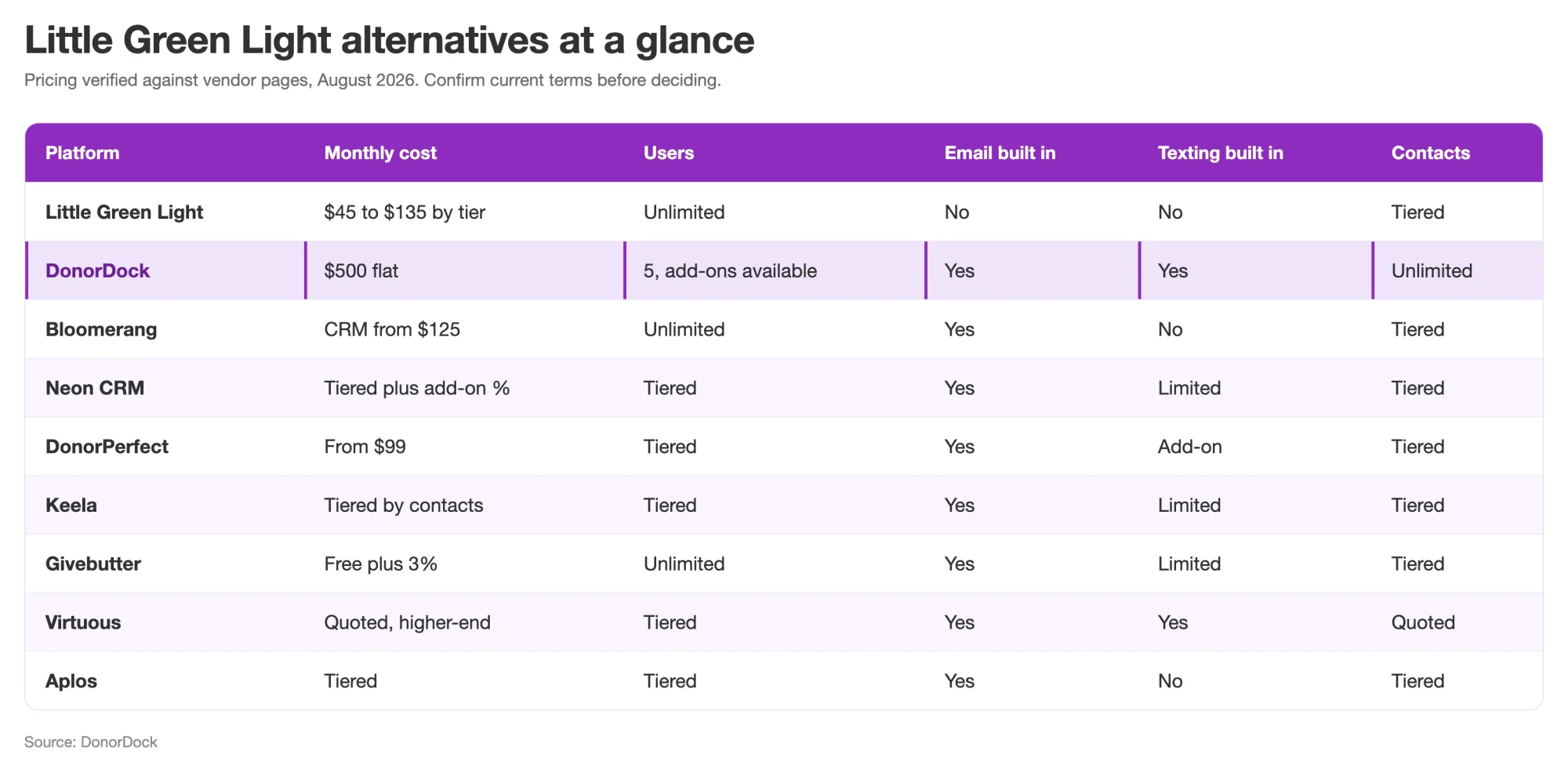
Pricing verified against vendor pages in September 2026.
Run this before you switch
Take five minutes and write down what you actually pay each month:
- Little Green Light subscription
- Email marketing platform
- Texting service, if any
- Online giving or form tool, if separate
- Anything else that touches donor data
Add it up. Then add a rough hour count for moving information between those tools each month and multiply by what an hour of your team's time is worth.
If the total is comfortably under a consolidated platform, stay on LGL. That is a genuinely good outcome, and switching would cost you money and a migration for no gain.
If the total surprised you, or if the hours line was the bigger number, that is your signal.
Where DonorDock fits
DonorDock is built for the organization that has outgrown the assembled stack. One plan, one price, unlimited contact records, with CRM, email, online giving, texting, and automation in one place instead of four.
It is the right move when your bolt-ons cost more than your database, when donor history is scattered across tools, or when growth keeps raising your bill in three places at once. It is the wrong move if LGL plus a light email tool genuinely covers you, and we would rather tell you that than sell you something you do not need.
Trusted by 7,600+ users, with $6B+ in gifts tracked since 2017. White-glove migration, typically under a week, with a dedicated specialist for your first 90 days. No contracts, and a 90-day money-back guarantee.
For the full feature list, see the DonorDock nonprofit CRM page. If you are ready to plan the move, DonorDock's help center has a step-by-step guide to migrating from Little Green Light.