
Quick answer: The strongest Bloomerang alternatives in 2026 are DonorDock, Little Green Light, Neon CRM, DonorPerfect, Keela, Virtuous, Givebutter, Blackbaud eTapestry, and Salesforce Nonprofit Cloud. Which one is right depends less on feature checklists than on two questions: how many contact records you keep, and how many separate tools you are willing to pay for. Bloomerang prices by record count and sells fundraising, CRM, and volunteer management as separate products, so the teams who go looking for alternatives are usually either growing out of a tier or tired of stacking modules.
How we compared: We looked at each platform's total cost including platform fees, its contact limits, whether email and texting are built in, and the migration support it offers. Last reviewed October 2026.
Bloomerang has earned its reputation. The retention-first idea it was built on, that keeping a donor is cheaper than finding a new one, reshaped how a lot of organizations think about their database. Plenty of nonprofits are happy there and should stay.
But "is this a good platform" and "is this the right platform for us" are different questions. If you are reading this, you are probably asking the second one. Here is a look at the field.
Why teams look for a Bloomerang alternative
Three reasons come up again and again.
Pricing moves with your database. Bloomerang prices based on the number of records you track. That is a common model, and it means a good year of growing your audience has a cost attached. When you run a strong acquisition campaign and add 4,000 new contacts, your renewal quote reflects it. Some teams find themselves pruning records just to stay in a tier, which is a strange incentive for a donor database to create.
The product line is modular. Bloomerang Giving Platform starting at $242 per month billed annually, Bloomerang CRM starting at $125 per month, Bloomerang Fundraising starting at $40 per month (which must be bought alongside CRM), and Bloomerang Volunteer starting at $119 per month. If you need the CRM plus fundraising plus volunteer management, you are assembling a bundle of connected, but separate apps.
Some capabilities live elsewhere. Text messaging is the one that surprises people most often. Text fundraising comes with Bloomerang Fundraising or the Giving Platform bundle, not the CRM on its own, so a CRM-only team that wants to text donors has to add a module.
To be fair to Bloomerang: unlimited users are included on every plan, which is genuinely generous and better than what several platforms on this list offer, DonorDock included. If you have a fifteen-person team and a small database (under 2,000 contacts), that alone may keep you put.
The nine alternatives
#1 DonorDock
Best for growing teams who want one plan and no growth penalty
DonorDock is one platform at $500 per month billed annually, with unlimited contact records, email marketing, online giving, text messaging, and automations included. Growing your database never changes the price, which removes the "can we afford to acquire donors" math entirely.
The numbers you can check: DonorDock is rated 4.8 out of 5 on G2 from 151 reviews and 4.8 out of 5 on Capterra from 33 reviews. Pricing is published: $500 per month billed annually, with 5 users and unlimited contacts included, plus a 2% platform fee on online giving. DonorDock is SOC 2 Type 2 compliant, and white-glove migration is typically done in under a week.
The design philosophy is the clearest difference from Bloomerang. Bloomerang leans analytical and shows you how retention is trending. DonorDock's Action Board and Smart Nudges lean operational and tell you who to call today. If your problem is that you know your numbers and still cannot find the hour to act on them, then DonorDock will be a better fit.
Where it is not the fit: the plan includes 5 users, with additional seats as add-ons. If you need seats for 20 people and your database is small (under 2,000), Bloomerang or Little Green Light will cost you less.
G2 ratings: 4.8 out of 5, with 9.6 for ease of use, 9.5 for ease of setup, and 9.8 for quality of support make DonorDock a highly rated option. Migration is white-glove and includes a dedicated specialist for 90 days. No contracts, and a 90-day money-back guarantee. For a line-by-line look, see the Bloomerang vs DonorDock comparison.
- Best for: Growing and mid-sized nonprofits that want CRM, email, texting, online giving, and automations on one plan, with unlimited contacts.
- Not the best fit if: you need 20 or more user seats on a database under 2,000 contacts, where the unlimited users at Bloomerang or Little Green Light cost less.
#2 Little Green Light
Best for tight budgets and transparent pricing
Little Green Light publishes its entire price list, which almost nobody in this category does. It runs $45 per month for up to 2,500 constituent records and climbs by tier to $135 per month at 50,000, with unlimited users on every plan and no platform fee on donations beyond what your processor charges. No setup fees, no contracts.
For an organization with a few thousand records and a real budget ceiling, LGL is a good option.
Where it is not the fit: LGL is a donor database first. Its built-in email has monthly send limits tied to your record tier, and there is no built-in texting or automation. Once you are paying for LGL plus a texting tool and a marketing automation platform, the total may not be much cheaper.
- Best for: Organizations with a few thousand records and a firm budget ceiling that want fully published pricing and unlimited users.
- Not the best fit if: you want texting and marketing automation in the same system as your donor records.
#3 Neon CRM
Best if events and member portals drive your calendar
Neon One sells a connected suite: Neon CRM alongside websites, giving, and payments. If event registration and member self-service portals are core to how you operate, this is a good option.
Neon layers add-on percentages on top of the subscription for things like events and memberships, plus payment processing. The subscription line is not the whole cost. Neon does not make its pricing easy to read publicly, so ask for a quote that models your actual event and membership volume.
Where it is not the fit: if events and member portals are not central to your work, you are paying for architecture you will not use. Tracking members, levels, and renewals alone does not require the suite; DonorDock handles that inside the CRM.
- Best for: Organizations where event registration and member self-service portals are central to the work.
- Not the best fit if: events and member portals are not central to your work, so that side of the suite would go unused.
#4 DonorPerfect
Best for deep reporting and long institutional history
DonorPerfect has been at this for decades and it shows in the reporting depth. Core plans start at $99 per month, with Plus and Pro quoted on request.
Read the tier chart carefully. Moves Management, QuickBooks integration, crowdfunding, batch gift entry, and scheduled reports sit on Plus or higher. Several of those are things teams assume are standard.
Where it is not the fit: the interface carries its history. Teams switching from a modern tool often describe a learning curve, and reporting requires building queries.
- Best for: Teams that want deep, query-based reporting from a long-established vendor.
- Not the best fit if: you need Moves Management, QuickBooks integration, or batch gift entry on the entry-level Core plan, since those start at Plus.
#5 Keela
Best for Canadian and cross-border organizations
Keela is an all-in-one nonprofit CRM with unusually strong Canadian coverage, including CRA receipting and bilingual support. If you operate in Canada, or on both sides of the border, that is an advantage that US-first platforms cannot match without workarounds.
It is a real consolidation play beyond the border question: email marketing, donation forms, and marketing automation ship with the CRM, and texting is available as a paid add-on. Published pricing is contact-based, from $164 per month for up to 1,000 contacts to $438 per month at 10,000, which means the record-count math you are doing with Bloomerang applies here too.
Where it is not the fit: for a US-only organization, Keela's biggest differentiator does not apply to you.
- Best for: Canadian and cross-border organizations that need CRA-compliant receipting and bilingual support.
- Not the best fit if: you are a US-only organization with a growing list, since pricing rises with each contact tier.
#6 Virtuous
Best for organizations committed to a responsive fundraising model
Virtuous is opinionated in a way most CRMs are not. It is built around "responsive fundraising," a philosophy about listening and personalizing at scale, and the platform assumes you are adopting the methodology, not just the software.
When an organization buys in fully, the results can be excellent. When it buys the software without the philosophy, the platform can feel like more than it needs.
Where it is not the fit: it sits at the higher end in price and expects real capacity to implement.
- Best for: Organizations ready to adopt the responsive fundraising model, with staff time to implement it.
- Not the best fit if: you want published pricing or a lighter implementation, since Virtuous quotes every plan.
#7 Givebutter
Best for events and campaign-first fundraising
Givebutter is fast to start, strong on events, peer-to-peer, and campaign pages, and its free-to-start model is genuinely attractive early on. With optional donor tips on, the platform fee is 0%; with tips off, a flat 3% platform fee plus standard processing applies. Deeper CRM and engagement features live in the paid Givebutter Plus tier, priced by contact count.
Where it is not the fit: the CRM is secondary to the fundraising tools. Organizations tend to outgrow it at the point they need year-round donor development rather than campaign-by-campaign fundraising.
- Best for: Event, peer-to-peer, and campaign-page fundraising that needs to launch fast.
- Not the best fit if: year-round donor development is the main job, since the deeper CRM features sit in the paid Givebutter Plus tier.
#8 Blackbaud eTapestry
Best for organizations that want the Blackbaud ecosystem at a smaller scale
eTapestry is Blackbaud's entry-level donor management product, and it connects to the broader Blackbaud world if you already use Financial Edge or plan to grow into Raiser's Edge NXT. It covers the fundamentals: gift and pledge tracking, email, online donation forms, and dashboards, all hosted by Blackbaud.
Where it is not the fit: Blackbaud's products are built for larger organizations and usually need dedicated staff to maintain. Blackbaud does not publish pricing, so every conversation starts with a sales call and a quote. Budget for implementation separately.
- Best for: Organizations already using Blackbaud products like Financial Edge, or planning a move to Raiser's Edge NXT.
- Not the best fit if: you want to see pricing before a sales call, since Blackbaud quotes every deal and prices implementation separately.
#9 Salesforce Nonprofit Cloud
Best for organizations with technical capacity
If you have a Salesforce administrator, or budget for a consulting partner, Salesforce will bend to almost any process you can describe. Nothing else on this list is as customizable.
Pricing is published: Nonprofit Cloud runs $60 per user per month for Enterprise and $100 for Unlimited, billed annually, with nonprofit discounts through Salesforce's Power of Us program. The license is rarely the real cost, though. Implementation and ongoing administration are.
Where it is not the fit: that flexibility is a staffing commitment. Without someone who owns the system and can manage it ongoing, Salesforce implementations drift, and the consulting cost frequently exceeds the license cost.
- Best for: Organizations with an in-house Salesforce administrator or a consulting budget that need heavy customization.
- Not the best fit if: nobody on staff will own the system day to day, since implementation and administration often cost more than the license.
Compare them at a glance
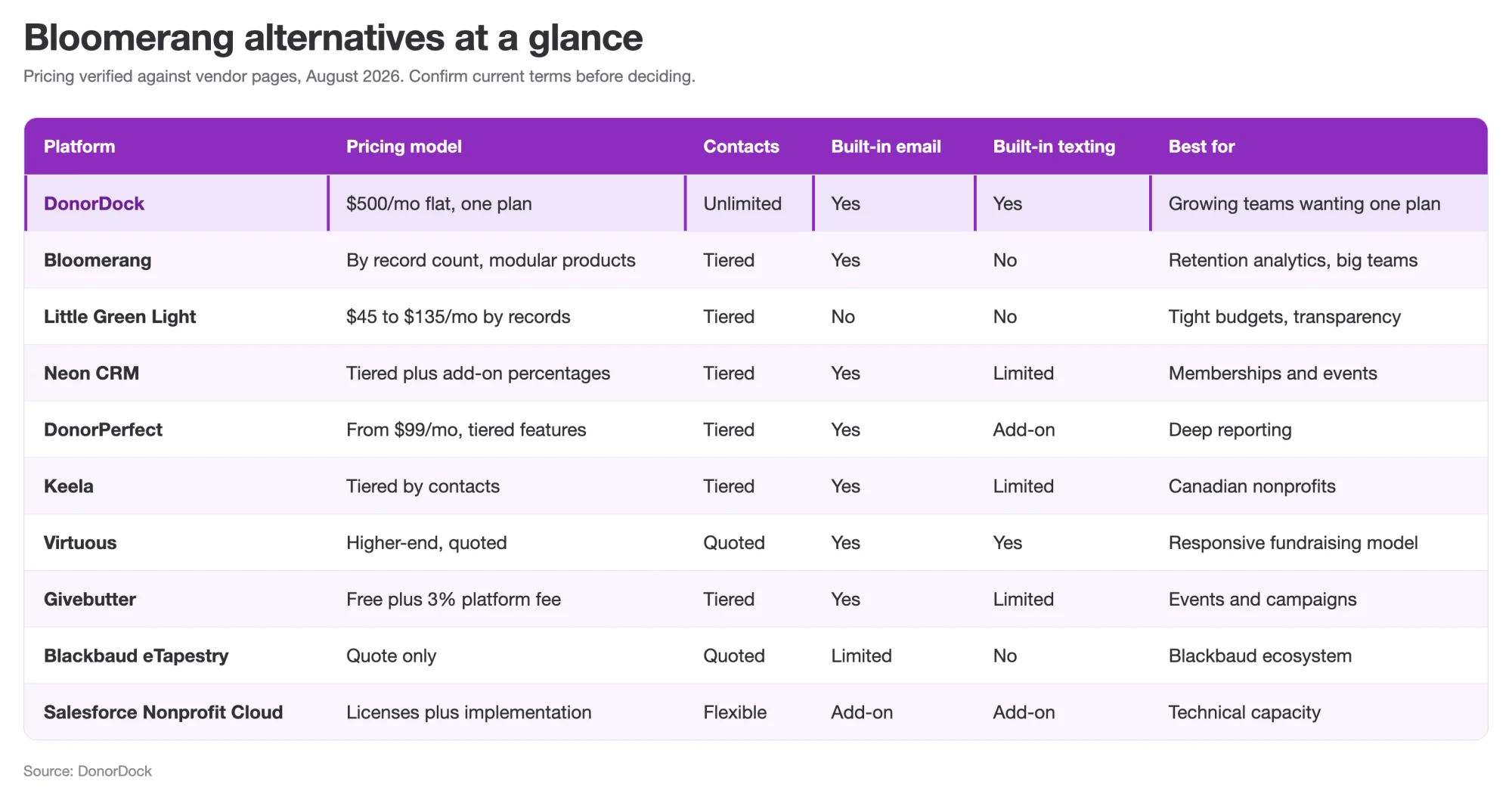
Pricing verified against vendor pages in September 2026. Models change, so confirm before you sign.
How to actually choose
Skip the feature matrix for a minute and answer these four questions:
- What happens to your bill when you add 5,000 contacts? If the answer makes you hesitate to run an acquisition campaign, that is an opportunity cost, and it is not on any pricing page.
- How many separate logins does your stewardship actually touch? Count them. Then add up what you pay. All-in-one only wins if it genuinely replaces all or most of the stack.
- Is your problem information or action? If you already know your retention rate and still cannot get the follow-ups done, buy a platform that tells you what to do next, not one that tells you how you are doing.
- Who will own the system? Be realistic. The most powerful platform your team will not use is worth less than the plain one they will.
Where DonorDock fits
DonorDock is built for growing nonprofits that have outgrown duct-taped systems but do not want enterprise weight or enterprise pricing. One plan, one price, unlimited contacts, and everything in one place: CRM, email, online giving, text messaging, and automation.
It is the right call if you are stitching together three or four tools, if contact-based pricing is capping your growth, or if your team needs daily direction rather than another dashboard. It is the wrong call if you need 20 seats on a small database.
Trusted by 7,600+ users, with $6B+ in gifts tracked since 2017.
For the full feature list, see the DonorDock nonprofit CRM page. If you are ready to plan the move, DonorDock's help center has a step-by-step guide to migrating from Bloomerang.
See DonorDock in action and bring your real questions.