
A development team meeting produces decisions when it protects one long block of problem-solving time. Run 60 minutes: five for check-in, seven for a five-metric scoreboard, eight for initiative status, 35 for solving the single highest-priority issue, and five to assign owners and dates.
You know the meeting. It starts four minutes late. Everyone gives an update nobody needed out loud. Someone raises a real problem at minute 48, the room agrees it is important, and then the hour ends and it goes on next week's agenda, where the same thing happens again.
Nothing was decided. Nobody was slacking. The meeting just was not built to decide anything.
This is a fixable design problem, and the fix is not a new tool or a longer meeting. It is a fixed agenda with one protected block of problem-solving time and a rule about what happens when you run out of it. Here is the version that works for growing development teams, minute by minute.
Why do most nonprofit team meetings produce updates instead of decisions?
Because the agenda treats every item as equal, and equal items get equal time, which means nothing gets enough time.
Watch a typical hour. Seven issues on the list, so roughly eight minutes each. Eight minutes is enough to describe a problem and not nearly enough to solve one. The team leaves having discussed everything and resolved nothing, and the list is the same length next week. Add a few weeks of that and the meeting itself starts to feel like the problem.
The cost is not just the hour. It is the backlog of unmade decisions that pile onto whoever is closest to the work.
The UnderDeveloped study from CompassPoint and the Evelyn and Walter Haas, Jr. Fund, based on a survey of more than 2,700 executive directors and development directors, found that half of development directors expected to leave their jobs within two years, and 40 percent were not committed to a career in development at all. The same research found that nearly one in four organizations had no fundraising plan in place and one in five had no fundraising database. Those two findings are related. People leave roles where decisions never get made and the systems never get built.
The staffing math has not gotten easier. Urban Institute analysis found that 46 percent of staffed nonprofits had employee vacancies in 2025, that 72 percent said those vacancies hurt their ability to pursue their mission, and that the share of nonprofit leaders naming staff burnout as their top concern doubled from 2024 to 2025.
When your team is short-staffed, a meeting that does not decide anything is not neutral. It is one of the few hours you had, spent.
What does the 60-minute development meeting agenda look like?
Same day, same time, every week. Start on time whether or not everyone is there. End on time whether or not you are finished. Those two rules do more work than the agenda itself.
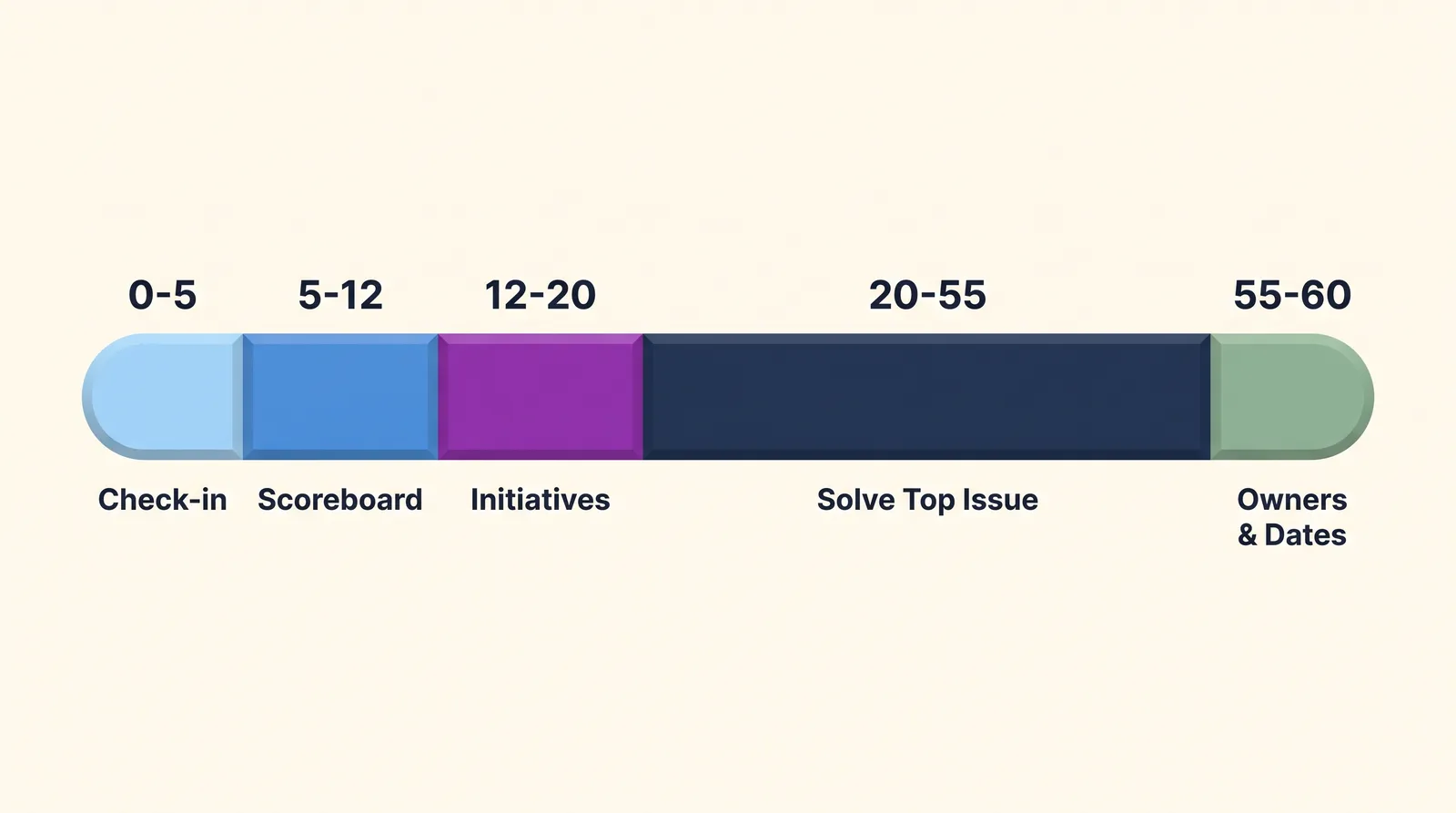
Minutes 0 to 5: Check-in
One sentence per person. A win from the week and anything the team needs to know. Not a status report. If someone starts narrating their calendar, cut it politely and move on. Five minutes, hard stop.
Minutes 5 to 12: The scoreboard
Read the five numbers out loud. Mark each one on track or off track. Do not solve anything here. The only question in this block is which numbers moved and which did not.
The discipline that makes this work is refusing to fix things in the moment. A number is red, someone has a theory, and seven minutes later the meeting is 20 minutes off course. Note it, add it to the issues list, keep going.
Minutes 12 to 20: Initiatives on track or off track
Whatever your two or three major pushes are this quarter, the year-end campaign, the CRM migration, the major gift portfolio build. One line each: on track or off track. Anything off track goes onto the issues list. Again, no solving.
Minutes 20 to 55: Solve the top issue
This is the meeting. Everything before it exists to fill this list and protect this block.
Take the highest-priority issue and work it until it is genuinely resolved or until you hit minute 55. Go deep. Get into the weeds if the weeds are where the answer is. If 35 minutes on one issue is what it takes, that is a successful meeting, even if the other six items never came up.
Minutes 55 to 60: Owners and dates
Every decision gets a name and a date attached before anyone leaves. A decision without an owner is a suggestion. Write them where the team will actually see them during the week, not in a document that only opens on meeting day.
Which five numbers belong on your scoreboard?
Five is the cap, and it is a real cap. Six numbers becomes ten numbers becomes a report nobody reads.
The numbers should be things your team can influence in a week, not lagging annual totals. A useful starting set for a growing development team:
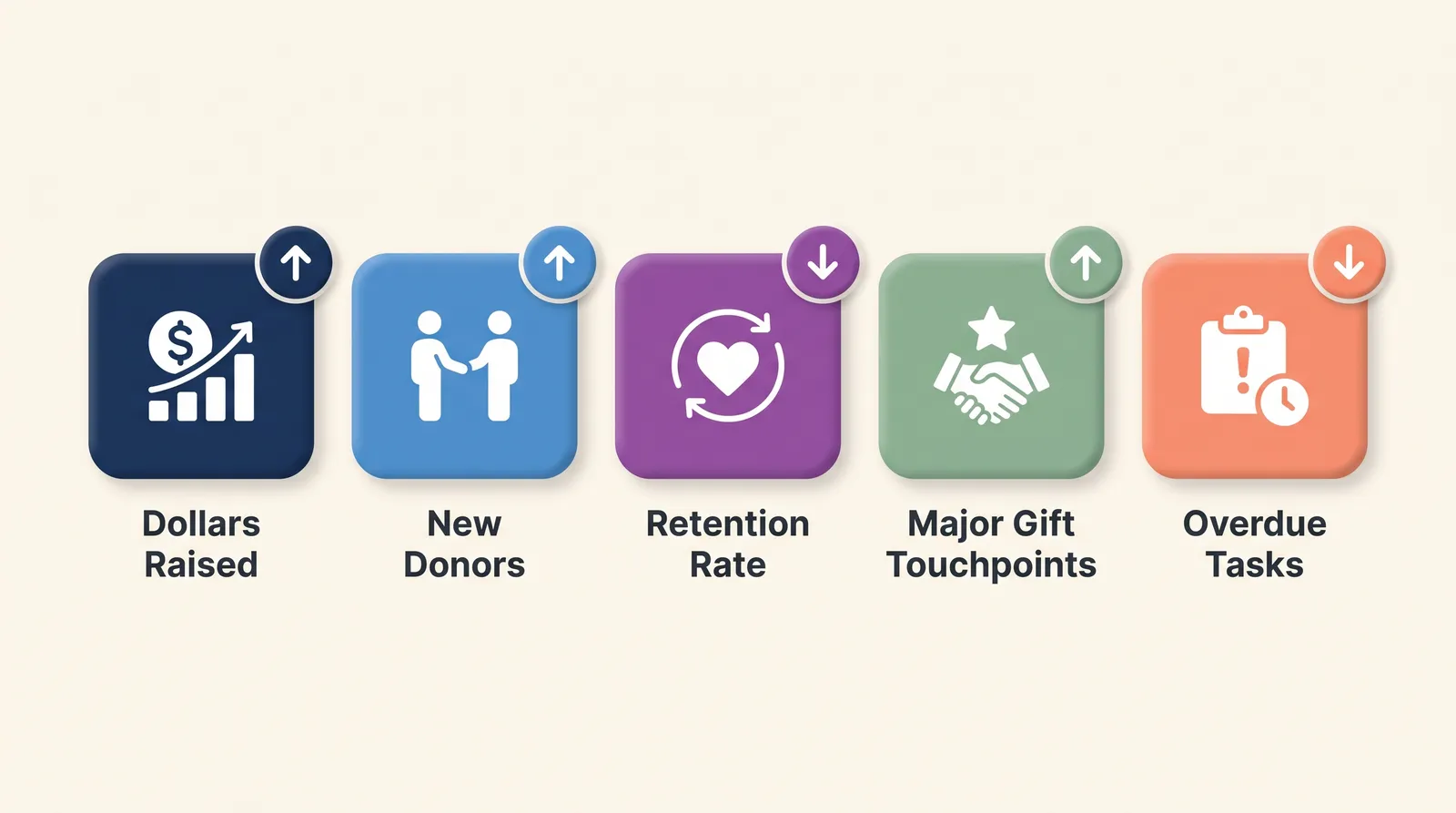
- Dollars raised against the period goal. The one everybody already tracks. Keep it, but do not let it be the only one.
- New donors acquired this period. Leading indicator for next year's base.
- Donor retention rate, or second-gift rate for first-time donors. The number that quietly determines whether the other four matter.
- Major gift touchpoints completed. Meetings held, calls made, visits scheduled. This is the activity metric that predicts the revenue metric.
- Overdue stewardship tasks. Thank-yous not sent, follow-ups past due. This one is uncomfortable on purpose.
Two rules about these numbers. First, they have to come from one place. If pulling the scoreboard takes 40 minutes of exporting and reconciling across three systems, it will not get pulled, and the meeting degrades back into anecdote. This is the practical argument for keeping donor records, activity, and reporting in a single donor management platform rather than a spreadsheet stack. DonorDock's Action Board surfaces overdue stewardship tasks without anyone building a report for it, which is what makes metric five sustainable past the third week.
Second, the scoreboard is not your board report. Board reporting answers a different question on a different cadence. If you need both, keep them separate on purpose so the weekly numbers stay operational and honest.
How do you prioritize the issues list?
Before you discuss anything, rank the list. This takes about 90 seconds and it is the highest-leverage habit in the entire meeting.
Ask one question of each item: if this is still unresolved in 30 days, what does it cost us? Rank by that answer, not by who raised it or how loudly.
Then work strictly from the top. Item one gets solved. If time remains, item two. Items three through seven roll to next week, where they get re-ranked against whatever is new. Some items will roll for a month. A few will roll forever, which is useful information: an issue that never rises to the top in six weeks was never actually a priority, and it can come off the list.
The instinct to work through all seven is strong and it is worth naming. Getting through the list feels productive. It is the single most reliable way to make sure none of the seven gets solved.
What do you do when a real fire will not wait until next week?
Schedule a separate meeting for it. Do not stretch the weekly one.
This sounds like more meetings, and technically it is. In practice it is fewer, because the alternative is an hour that runs long every week and slowly loses the authority to start and end on time. Protect the weekly rhythm and handle genuine emergencies in their own container with only the people who need to be there.
The same logic applies to the days when half your staff is out sick and a strategic conversation is not realistic. Skip the deep block, run the scoreboard, and get back to it next week. A shortened meeting that still starts and ends on time keeps the habit intact. A cancelled one costs you two weeks.
How do you keep the meeting from decaying after six weeks?
Most teams get this right for a month and then drift. Three things cause the drift, and all three are preventable.
The scoreboard gets stale. Someone stops pulling the numbers because it is tedious, and the block turns into a verbal guess. Fix it by making the numbers automatic. If a metric cannot be pulled in under two minutes, either change how it is tracked or change the metric.
The issues list stops getting ranked. The team slides back into working top to bottom by arrival order. Fix it by making the ranking an explicit spoken step, not an assumption.
Decisions stop getting owners. The last five minutes get eaten by the discussion, and the meeting produces good thinking and no assignments. Fix it by treating minute 55 as immovable. Stop mid-sentence if you have to.
None of this is complicated, and that is roughly the point. The teams that run this well are not more disciplined by nature. They just built the discipline into the structure so it did not have to come from willpower every Tuesday. That is the same principle behind treating fundraising operations as a system rather than a series of heroics, and it is why development director turnover is usually a system problem rather than a hiring problem.
Worth watching if this is landing: our conversation on building a development team that does not burn out covers the structural side in more depth.
Start with next week
Do not redesign your entire operating rhythm. Take next week's existing meeting and change three things: pick your five numbers, rank the issues before discussing any of them, and protect 35 uninterrupted minutes for the top one.
Run it that way four times before you judge it. The first week will feel awkward and the fourth will feel obvious.
And when the meeting starts producing decisions, those decisions become the material for a very different conversation with your donors. We wrote about that in turning your strategic plan into a stewardship tool.
If pulling your five numbers is currently the hardest part of this, that is a systems problem worth solving. See how growing development teams structure the work, or take a look at what DonorDock puts on one screen.