
TL;DR: The most effective planned giving strategies start with loyalty, not wealth. Decades of research show that years of consistent giving predict legacy gifts better than net worth does, and donors who add a charity to their will increase their annual giving by about 77 percent afterward.
Ask most development teams to name their best legacy giving prospects and they will sort the database by largest gift and start at the top. It feels logical. According to the best research we have, it is also the wrong list.
The planned giving strategies that actually produce bequests start somewhere less glamorous: the donor who has given $100 a year, every year, for a decade. In this article we will look at what the data says about who leaves legacy gifts, why the timing has never been better, and how to make the case to a board.
What predicts whether a donor will leave a legacy gift?
Consistency. When researcher Dr. Russell James analyzed decades of longitudinal data on actual charitable estate gifts, he ranked 32 statistically significant predictors. The single strongest was the percentage of years a donor gave $500 or more. Wealth measures ranked only 10th through 13th.
Read that again, because it should change how you build your prospect list.
The strongest legacy signal is not capacity. It is the habit of showing up.
Think about what that means for the size of your opportunity. Most organizations have a handful of donors who could make a major gift this year, and hundreds who have given steadily at modest levels for years. If loyalty is the signal, your legacy pipeline is not a short list of wealthy names. It is the widest, most overlooked pool in your database, and it includes your monthly donors, your longtime event attendees, and the people who never miss an annual appeal.
There is a practical reason behind the data. Many of your most loyal donors are asset-rich and cash-modest. A retired teacher who has given faithfully for fifteen years may own a home that has tripled in value since she bought it. She cannot write a five-figure check today. She can absolutely leave one later.
This is also why your donor database matters more here than a wealth screening budget. DonorDock's donor timeline shows a decade of giving at a glance, so a ten-year loyalist stands out the moment you open their record.
Do bequest donors give more in annual gifts?
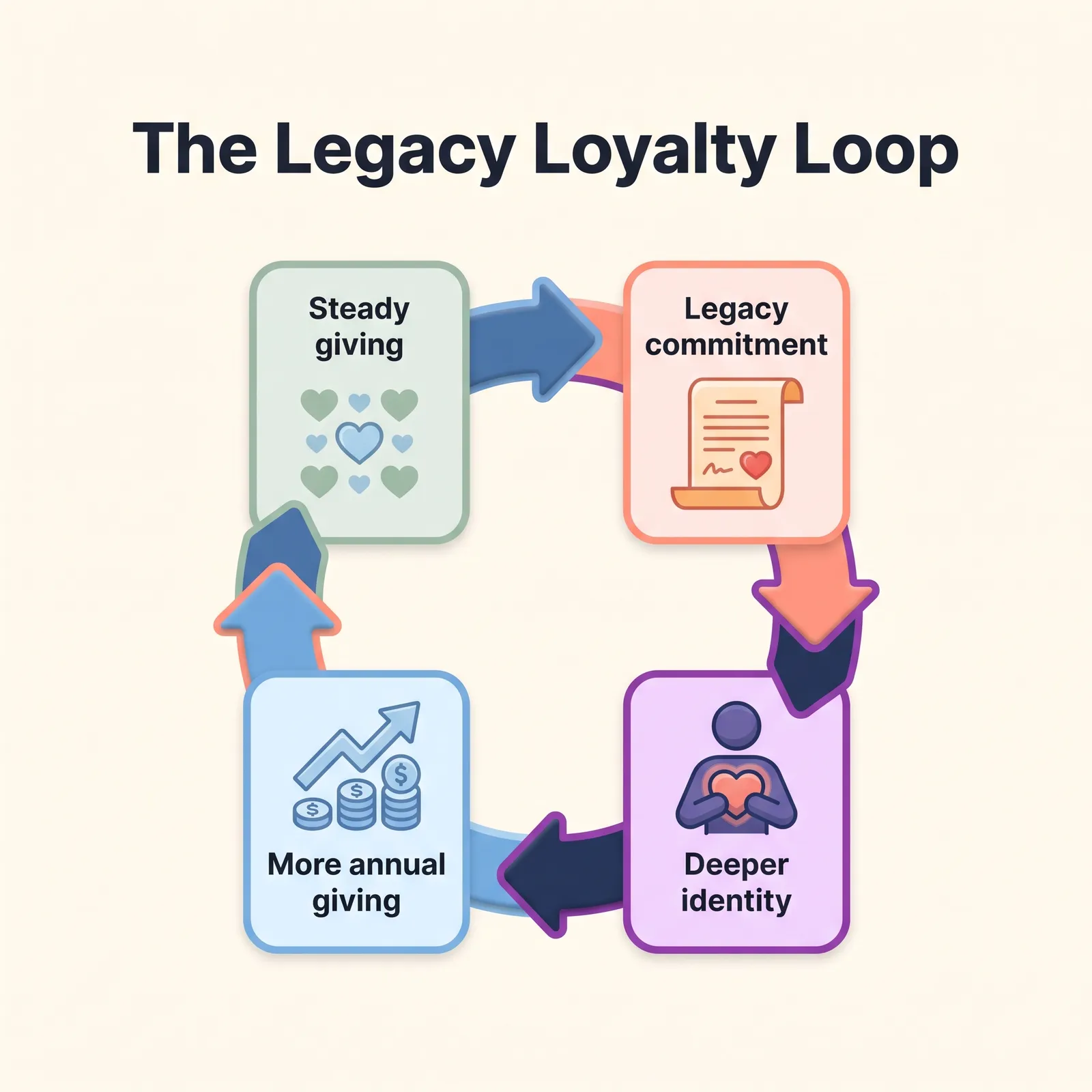
Significantly more. The common fear runs the other way: if a donor commits a gift in their will, they will ease off their annual support. The data says the opposite happens.
In a study published in the UC Davis Law Review, Dr. Russell James tracked thousands of donors before and after they added a charitable component to their estate plans. Their inflation-adjusted annual giving rose about 77 percent afterward, from $4,355 to $7,699 on average. The share giving $1,000 or more each year climbed from 51.5 percent to 61.8 percent.
The reason is identity. Once someone writes your mission into their will, they have claimed it as part of their story. That commitment reaffirms their annual support rather than replacing it. If you have promised a piece of your legacy to a cause, you want it thriving today.
So legacy giving is not an either-or trade against annual revenue. It is a both-and, and the annual lift arrives years before the estate gift does.
It helps to understand why the timelines differ. In our experience, a major gift conversation usually resolves within a year or two. A gift in a will tends to take several years, because the decision is not complete until the donor next updates their estate plan, and people update wills around life events: a retirement, a birth, a loss. Your job in the meantime is not to push. It is to stay present, so that when the life event arrives, your mission is already part of how they think about their legacy.
Should growing nonprofits invest in planned giving now or wait?
Now, and the numbers are not subtle.
Bequest giving reached $62.19 billion in 2025, up 19.7 percent, the largest increase of any giving source in the Giving USA 2026 report. Behind that surge sits the largest wealth transfer in history: Cerulli Associates projects $124 trillion will change hands through 2048, with roughly $18 trillion going to charity.
Yet most of that generosity never gets pointed at a specific mission. As the Stanford Social Innovation Review reports, more than 90 percent of Americans give during their lifetimes, but fewer than 6 percent include a charitable bequest in their estate plans. Among Americans over 50, only 5.2 percent have made provisions for any charity in a will or trust.
That gap is the absence of an ask. Most donors have simply never been invited to think about their giving this way, and the organizations that extend the invitation first will be the ones written in.
Every year you wait, loyal donors are updating their wills after retirements, births, and losses, and your mission is not in the room.
How do you make the board case for a five-year payoff?
A gift in a will typically takes years to surface, because donors rarely rush to a lawyer after one conversation. They consider, then act when a life event prompts a will update. Meanwhile your board is asking what you raised this quarter. Here is the case that survives a budget cycle.
Lead with the both-and. The 77 percent annual giving lift means legacy work pays this year, not just in a decade. You are not diverting effort from annual revenue. You are deepening it.
Frame it as retention, because it is. The Fundraising Effectiveness Project puts overall donor retention at 43.3 percent for 2025. Nonprofits keep fewer than half their donors year over year. A legacy commitment is the deepest retention play that exists, because a donor who has written you into their will is not going anywhere.
Be honest that stewardship never stops. In the same UC Davis research, 61 percent of people whose estates ultimately gave to charity had reported, at some point in their final five years, having no charitable component in their plans. Estate intentions move. The organizations that stay close, keep thanking, and keep showing impact are the ones still in the will at the end.
Point to the pattern. Look at the organizations in your community with the steadiest revenue and you will almost always find an established legacy program behind it. Some publish how much of their income arrives through estates, partly because that transparency doubles as social proof for the next legacy donor. You are not proposing an experiment. You are proposing a discipline the strongest organizations already practice.
If your board hears anything, it should be this: legacy giving is not a side project competing with this year’s goals. It is the compounding return on the stewardship you should be doing anyway.
How do you track legacy asks alongside everyday giving?
A gift in a will is an ask, just like a major gift ask: a named prospect, a real dollar amount, and a relationship that moves through stages. But because it plays out over years while everyday donations keep arriving, it usually lives in one fundraiser's memory or a spreadsheet nobody reopens. When that person moves on, the pipeline goes with them.
This is moves management work, and it deserves a real pipeline. DonorDock's Ask Boards give every big ask a visual pipeline that sits on top of your everyday giving. Each prospect is a card with an estimated amount, a probability, a next action, and an owner, and you drag cards through the stages as the relationship progresses.
Build a dedicated planned giving Ask Board and the whole program becomes visible. Set stages that match the legacy journey, such as Legacy Prospects, Introduced to Legacy Giving, Committed, and Legacy Gift Received, and give each stage a probability. DonorDock then calculates a weighted pipeline value, which solves the board problem above: instead of asking your board to trust that this pays off someday, you can show them a legacy pipeline worth real dollars, updated live as prospects move.

The same approach works for your major gift pipeline on its own Ask Board, so your biggest asks of every kind are tracked in one place while daily gifts keep flowing underneath. And because each card carries a next action with a due date, follow-ups surface on the right team member's Action Board on the right morning, so a legacy conversation scheduled for next spring never falls through the cracks.
When you are ready to move from why to how, we have walked through the mechanics in our guide to building a planned giving program step by step, and our playbook on finding legacy giving prospects already in your database shows you exactly who to talk to first.
The donors most likely to leave you a transformational gift are already in your database, quietly renewing every year. They are not waiting for a wealth screen. They are waiting to be asked. Steward them like it matters, because to them, it already does.