
A donation impact statement translates a gift amount into a concrete outcome a donor can picture, like "$50 equips a mentor with a full year of training and support." Build them in six steps: price your work into units, turn units into outcomes, write statements at your gift levels, deploy them everywhere donors decide, and refresh annually.
Ask a development director what a $100 gift accomplishes and you will often get a pause, then something like "it all goes into the annual fund." True, and completely forgettable. Donation impact statements fix that. They are short, concrete sentences that connect a specific gift amount to a specific outcome, and they are some of the hardest-working copy your team will ever write.
This guide walks through the full process: how to do the math, how to write the statements, and how to handle the tricky case where your work does not produce countable meals or beds. Grab your program budget and a blank doc. This is a working session.
What is a donation impact statement?
A donation impact statement is a single sentence that pairs a gift amount with the tangible difference it makes: "Your $25 sends a student home with a weekend of meals." "Your $500 trains a crisis volunteer for a year of answering calls." It is not an impact report, a testimonial, or a mission statement. It is the smallest complete answer to the donor's question: "What does my money actually do?"
The formula is easy to remember: gift amount + concrete unit of work + human outcome. Most organizations can write a full set for their common gift levels in an afternoon once they have done the unit math.
Why do impact statements increase giving?
Because tangibility, not size, is what moves donors. In studies summarized by Carnegie Mellon researchers, people donated nearly twice as much to a global charity when its work was framed tangibly ("donations provide clean water to villagers") versus generally, and the same research found donors gave over 25 percent more to a housing campaign simply because they were told the recipient family had already been selected. The donors never learned the family's name. Concreteness alone did the work.
The effect compounds when you anchor on a single unit. In the "unit asking" studies published in Psychological Science and later replicated in Judgment and Decision Making, donors who were first asked what they would give to help one child gave 1.65x to 4.44x more in total than donors asked for a lump sum. And impact statements feed the single biggest trust signal donors look for: in BBB Give.org's Donor Trust Report, "accomplishments shared by the organization" ranked as the top signal of charity trustworthiness at 44 percent, ahead of third-party ratings, and 74 percent of donors said knowing how spending translates to programs is very important to deserving support.
In short: donors give more, trust more, and return more often when you make the outcome concrete. Here is how to build that, step by step.
Step 1: Price your work into gift-sized units
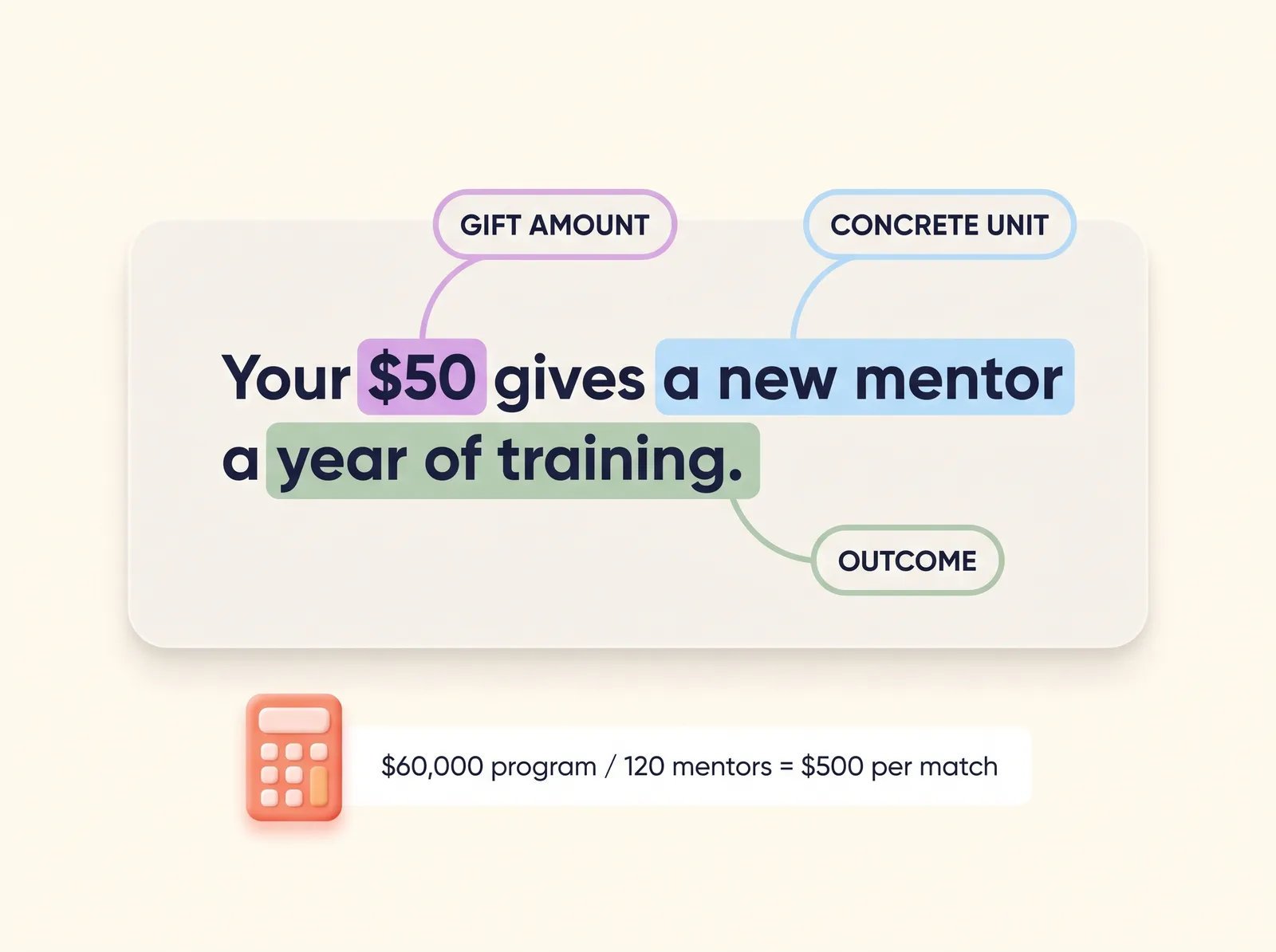
Open your program budget and find the natural units your work already comes in: a tutoring session, a training delivered, an acre restored, a night of safe shelter. Then do rough division. If your mentorship program costs $60,000 a year and supports 120 mentor-youth matches, a match costs about $500, a month of a match about $42.
Three rules keep the math honest:
- Use fully loaded costs. Include staff time and overhead in the unit price. Underpricing your work teaches donors your mission costs less than it really does.
- Round to friendly numbers. $42 becomes "about $40." Impact statements are representative illustrations, not invoices.
- Build a range. You want units that land near your common gift amounts: something like $25, $50, $100, $250, $500, and a monthly amount.
Step 2: Translate units into outcomes a donor can picture
A unit of service is not yet an outcome. "One training session delivered" is your accounting. "A mentor who walks into their first meeting knowing exactly how to build trust with a nervous teenager" is what the donor is buying. Push every unit through one more question: what changes for a person because this unit happened?
Keep the language at kitchen-table level. If your statement includes an acronym, a program name, or the word "capacity," it is not done. Your donor should be able to repeat it to a friend without notes.
Step 3: Write statements for your common gift levels
Now assemble the set. Use the formula, keep each statement under 20 words, and lead with the donor:
- "Your $25 sends a student home with a weekend of meals."
- "Your $50 gives a new mentor a full year of training and support."
- "Your $100 keeps the helpline answered for an entire evening."
- "Your $250 restores a quarter acre of wetland habitat."
- "Your $500 walks one family through their first month in stable housing."
- "Your $10 a month keeps a child matched with their mentor all year long."
Write the monthly statement with extra care. Recurring gifts are where impact framing pays off longest: M+R's Benchmarks study found monthly giving made up 31 percent of all online revenue in 2024 and grew 5 percent while one-time revenue stayed flat. A monthly impact statement that describes an ongoing outcome ("keeps a child matched all year") gives that commitment something to attach to.
Step 4: What if your impact is hard to count?
Capacity-building organizations, advocacy groups, research funds, and coalitions often stall here, because their work produces stronger systems rather than countable beds. The mechanics still work. You just count the enabling unit and name the ripple.
Instead of the direct-service pattern ("your gift feeds a family"), use the multiplier pattern: "Your $75 trains a coach who will mentor a dozen kids this season." "Your $200 equips a rural food pantry to serve its whole county safely." The donor-facing outcome is one step downstream, and that is fine, as long as the chain is real and short. For the deeper strategic thinking on this, see our piece on fundraising around intangible outcomes; this step is the tactical version of that argument.
If even enabling units are hard to price, anchor to time instead: "Your $100 funds an hour of policy research that moves clean water legislation forward." Time-based units are honest, easy to calculate, and surprisingly vivid.
Step 5: Put statements everywhere a donor decides
An impact statement in a desk drawer raises nothing. Deploy the set at every decision point:
- Giving pages: pair each suggested amount with its statement so the ask explains itself. DonorDock's suggested giving amounts let you attach impact language directly to each button on your online giving page.
- Appeals: one story plus one impact statement per gift level beats three paragraphs of program description. Our guide to campaign giving pages shows the pairing in action.
- Thank-yous and receipts: restate the impact of the exact gift the donor just made. Automatic thank-yous make that instant, and asking donors how they want to be thanked tells you where the statement should show up next.
- Confirmation screens: the moment after giving is peak attention. Use it to tell the donor what just became possible.
Then secret-shop your own donor experience and check: does a donor meet a concrete outcome at every step, or do they hit a wall of program language somewhere between inspiration and receipt?
Step 6: Keep them honest and current
Two integrity rules protect you. First, frame statements as representative unless you truly restrict funds: "represents the average cost" language in your footer or FAQ covers you, and most donors intuitively understand that $50 flows to the mission, not literally to one training invoice. Never let an impact statement become a restricted-fund promise you did not intend to make.
Second, put a recurring task on the calendar to re-run the unit math when your budget changes each year. Stale numbers erode the trust you built. This is stewardship work, not marketing work, and it belongs in your Smart Steward Method rhythm alongside thank-yous and updates.
What are the most common impact statement mistakes?
Teams that stall on impact statements usually trip on one of five patterns. Check your drafts against this list before anything ships:
- Leading with the organization. "We can train a mentor with $50" buries the donor. Start with "you" or "your gift" every time.
- Stacking numbers. "Your $50 provides 3 sessions for 2 of our 118 mentors across 4 counties" is math homework, not motivation. One number for the gift, one for the outcome, done.
- Writing in program language. If the statement mentions your logic model, a grant deliverable, or an internal program name, translate it again. Donors fund outcomes, not initiatives.
- Promising precision you cannot deliver. A statement that reads like a contract invites disappointment when funds are pooled. Representative framing keeps you honest and flexible.
- Inconsistency across channels. If your giving page says $50 trains a mentor and your appeal letter says $50 feeds a family, donors notice, and the statements cancel each other out. Keep one source of truth for the set and update it everywhere at once.
None of these is fatal, and all of them are fixable in a single editing pass. The teams that get the most from impact statements treat the set like a living document: owned by one person, reviewed once a year, used by everyone.
One last connection: impact statements tell donors what their gift does, but pairing them with the right story tells donors who they are in it. That is the strategic half of this skill, and we cover it in why your fundraising story is about the wrong hero. Write the statement, wrap it in the story, and every gift on your giving page starts to feel like what it actually is: a real outcome, waiting on a yes.