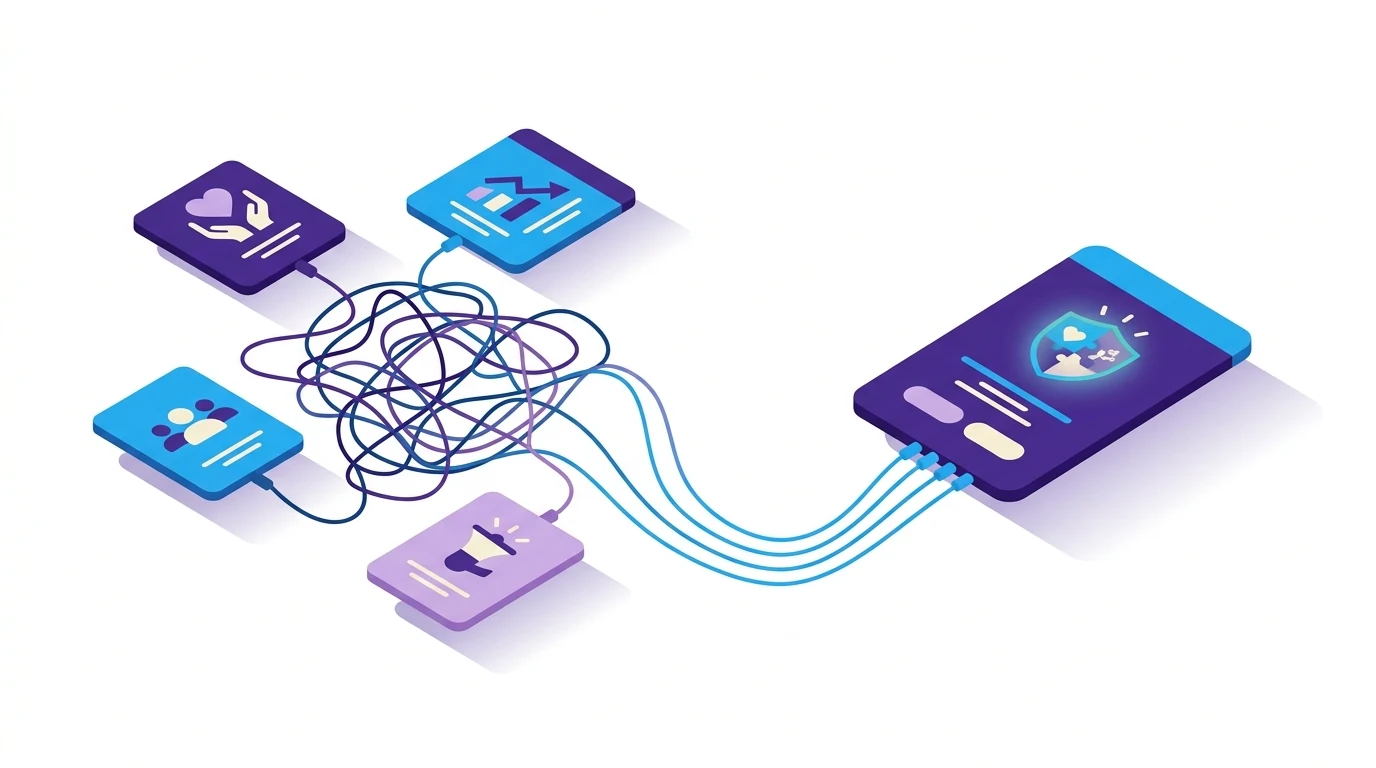
Donor-centric fundraising reframes your communications so the person you serve is the hero, your donor is the one who makes the outcome possible, and your organization is the guide. Nonprofits that make this shift build more trust, write warmer appeals, and keep more of their donors.
You know your programs inside and out. You can explain your logic model, your budget lines, and the ins and outs of every initiative. So when it is time to write the appeal, the newsletter, or the thank-you letter, the organization naturally takes center stage. That instinct is exactly what donor-centric fundraising asks you to unlearn.
Your donors are not giving to your budget. They are giving to the young person who finally has a caring adult in their corner, the forest that stays standing, the neighbor who gets through a hard season. When your story stars your organization, you are asking donors to care about the middleman.
What is donor-centric fundraising?
Donor-centric fundraising is an approach to donor communications that centers the donor's role in creating change rather than the organization's activities. Researcher Penelope Burk popularized the closely related term "donor-centered fundraising" to describe communications built around what donors actually want: prompt, personal acknowledgment and clear evidence that their gift did what you said it would. In practice, it means writing every appeal, update, and thank-you to answer the donor's main question: "What did my gift make possible?"
It's not about flattering donors, and it's definitely not about handing them the hero's cape. The most effective framing gives everyone the right role in the story. That distinction matters, so let's break it down.
Who is the real hero of your fundraising story?
Your beneficiary is the hero. Not your organization, and not your donor. The people (or animals, or places) you serve are the ones on the journey, facing the obstacle, experiencing the change. Donald Miller's StoryBrand framework puts it plainly: the organization's job is to be the guide, not the hero. Guides do not get the spotlight. They make sure the hero gets there.
Your donor is the difference-maker. They are the reason the story moves. Without them, the mentor never gets trained, the habitat never gets protected, the family never gets the fresh start. Donor-centric communication connects the donor directly to the hero's outcome, with your organization as the trusted bridge between them.
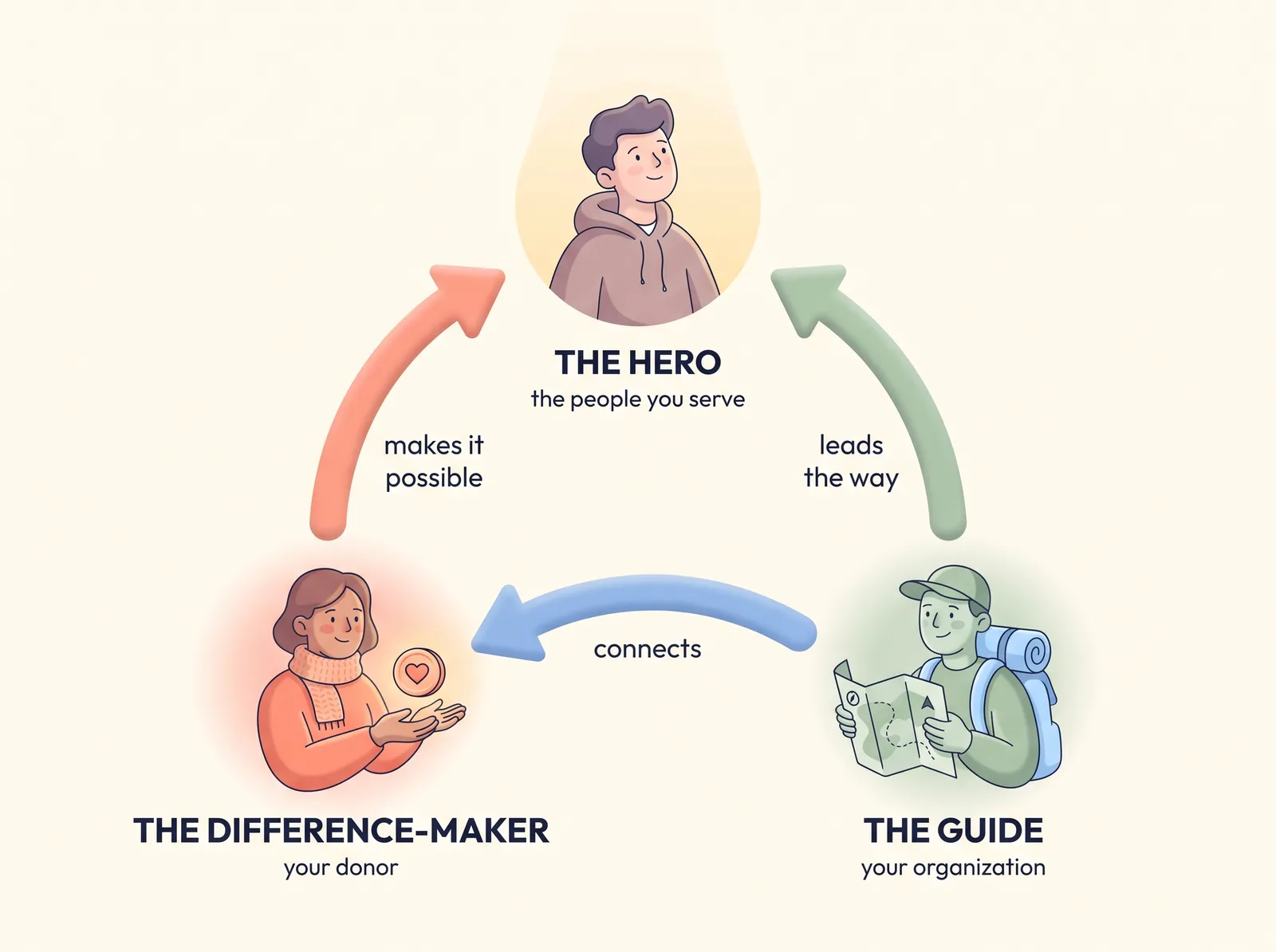
Watch what this does to a sentence. Organization-centric: "Last year, we served 400 students through our tutoring program." Donor-centric: "Last year, you helped 400 students walk into class ready to learn." Same fact, different star. One reads like an annual report. The other reads like a receipt for a life changed.
The pattern holds even when your beneficiary is not a person. Donors to environmental and animal welfare organizations respond to the same framing, as we explored in our piece on storytelling for nonhuman philanthropy. The hero just has fur, feathers, or foliage.
Why do donors stop giving?
Mostly because nothing gave them a reason to stay. The Fundraising Effectiveness Project found overall donor retention sat at just 43.3 percent in 2025, while total donor counts fell for the fifth consecutive year. The steepest drop-off happens right after the first gift: FEP's retention data by donor type shows only 18.9 percent of first-time donors gave again, compared to 59.3 percent of repeat donors. Roughly four out of five new donors never make a second gift.
Now layer on the trust problem. BBB Give.org's 2026 Donor Trust Report found 67.7 percent of Americans say trusting a charity is essential before donating, yet only 18.3 percent report high trust in charities. Donors want to believe you. Organization-centric communication, with its program acronyms and budget percentages, gives them very little to believe in.
Donor-centric framing attacks both problems at once. When a donor sees the specific outcome they made possible, they get proof their gift mattered, which builds trust. And when they feel like a difference-maker instead of an ATM, they have an identity worth returning to. That is the heart of the Smart Steward Method, and it is why relationship-first fundraising consistently beats chasing new donors.
What's the difference between donor-centric, donor-centered, and community-centric fundraising?
You will hear all three terms, and they are not interchangeable. Donor-centered fundraising is Burk's research-backed standard for the donor experience: fast, personal thank-yous and clear impact reporting. Donor-centric fundraising, as most fundraisers use the term today, extends that into how you frame every communication: the donor's role in the outcome stays front and center.
Community-centric fundraising (CCF) emerged as a thoughtful critique of both. CCF practitioners argue that putting donors on a pedestal can distort priorities and quietly diminish the dignity of the communities being served. It is a fair warning, and worth sitting with.
Here is the good news: the hero framing resolves most of the tension. If your beneficiary is the hero and your donor is the enabler, nobody is being diminished. The community's strength and agency stay at the center of the story, and the donor is honored for standing behind it. You do not have to pick a side in the debate to write communications that are both dignified and effective.
How do you tell beneficiary stories ethically?
Donor-centric does not mean dignity-optional. The classic "sad puppy" appeal, all deficit and despair, might spike a one-time gift, but it trades your beneficiary's dignity for it, and it frames your community by what it lacks rather than what it is building. Asset-based storytelling shows the hero mid-journey: capable, striving, and worth investing in.
Specificity is what makes ethical storytelling work financially. In research summarized by Carnegie Mellon researchers Cynthia Cryder and George Loewenstein, people were willing to donate over 75 percent more when the person needing help was identified by name, age, and photo, and gave 60 percent more in studies involving real money. One vivid, specific hero moves people in a way statistics never will.
Specificity also raises the ethical stakes, so hold these lines:
- Get real consent. A story is a gift your beneficiary gives you. Treat it that way, and give them control over what gets shared.
- Use composites transparently. If no one can safely share their full story, a composite character is fine, as long as you say so ("Maria's story reflects the experiences of several families we serve").
- Disclose AI. Give.org's research on AI-generated charity appeals found 55 percent of people would be discouraged from giving if an appeal used an AI-generated image that no staff member had verified. Undisclosed synthetic stories and images are a trust time bomb.
- Protect the vulnerable. Some stories should not be told, no matter how compelling. Our guide to trauma-informed ways to bring donors into your work covers how to show impact without putting participants on display.
For a deeper look at why narrative beats numbers, our nonprofit storytelling guide pairs well with our video on ethical storytelling and donor trust.
What does donor-centric communication look like in practice?
Start with the smallest unit: the sentence. Audit your last appeal and count how many sentences start with "we" or your organization's name versus "you." Then rewrite the "we" sentences:
- "We provide job training to 200 adults" becomes "You can put a job offer within reach for someone starting over."
- "Our organization expanded into three new counties" becomes "Because of donors like you, families in three new counties now have somewhere to turn."
- "We are grateful for your support" becomes "You did this. Here is what happened because you gave."
Then move up a level to the system. Donor-centric framing is not a one-time writing trick; it is a rhythm of communications matched to where each donor is in their journey, which is why mapping your donor journey matters. A first-time donor needs proof their gift landed. A loyal donor needs to see the arc of what they have built. A major donor needs an investment story, not a transaction.
This is where your donor outreach tools either help you or fight you. DonorDock's Stewardship Journeys automate the follow-up sequence after a gift, so every donor gets a timely, personal thank-you and an outcome update without your team tracking it by memory. The donor timeline keeps every interaction in one place, so the next message can pick up the story where the last one left off.
One more practical move: pair every story with a concrete statement of what a gift accomplishes. We cover that skill step by step in how to write donation impact statements. The story makes the donor feel the outcome; the impact statement makes it tangible.
How do you know the framing is working?
Donor-centric fundraising is measurable, and the metrics are ones you already track. Watch three numbers over the next two or three campaign cycles.
First, your second-gift rate. Because the steepest retention cliff sits between the first and second gift, this is where reframed thank-yous and outcome updates show up soonest. Second, your overall donor retention rate against your own baseline, not just the sector's. Third, the soft signals: replies to your emails, donors mentioning specific outcomes back to you, unprompted notes. When donors start repeating your impact language in their own words, the story has landed.
Give the shift a fair test window. Framing compounds the way relationships compound, gift by gift and update by update, so judge it in seasons rather than sends. And resist the temptation to measure only dollars per appeal; a donor who gives $50 twice a year for a decade is worth far more than a one-time $300 gift that never returns.
Where should you start?
Don't overhaul everything at once. Pick the next thing you were already going to send, and recast it: beneficiary as hero, donor as difference-maker, organization as guide. Read it back and ask one question. If a donor read only this, would they know their gift mattered?
Then build the habit into your systems so it survives busy seasons. That is what DonorDock is built for: a platform where the story, the data, and the follow-up live in one place, so donor-centric communication becomes your default instead of your aspiration. If you want to see what that looks like, come see DonorDock in action.
Your mission deserves donors who stay. Give them the right story, and they will.