
To find donors ready to give more, score the ones you already have on five signals: years of repeat giving, recurring gift tenure, affinity match, non-gift touchpoints, and rising gift size. Rank by total score. Work the top of the list first.
Most major gift prospecting starts in the wrong place. It starts with a wealth screening, a board brainstorm, or a list of names somebody found at a luncheon, and it treats the donor file as a place to record results rather than a place to find leads.
Using donor data to identify major gifts works in the opposite direction. The people most likely to give you a larger gift next year are, overwhelmingly, already in your database giving you a smaller one. They have raised their hand repeatedly. Reading that signal has just never been anybody's actual job.
Below is a five-signal audit you can run this week, an easy way to score it, and what to do with the names that rise to the top. If you want the full argument for why these supporters deserve the attention, we made that case separately in the importance of recurring donors. This piece is the mechanics.
Why start with the donors you already have?
Because the odds aren't close.
In 2025, first-time donors were retained at 18.9 percent, while repeat donors were retained at 59.3 percent. A supporter with a history is more than three times likelier to still be with you next year than someone who just arrived.
The revenue split points the same way. M+R's 2026 Benchmarks report found that new donors accounted for 31 percent of online revenue in 2025. The other 69 percent came from people who were already on the list.
And yet this data mostly sits untouched. In NTEN's 2025 Data Empowerment Report, only 21 percent of organizations said they always use data to analyze constituent engagement or actions, while 39 percent said they do it only sometimes. In the same survey, 54 percent named tools that are not aligned with their workflow as a barrier to adopting technology.
The gap is not missing data, but unread data.
What are the five signals that predict upgrade readiness?
Every signal below is something you can pull from records you already keep. Score each donor on all five, then add the points up. Use this interactive scorecard as a starting point. You can download the results into a .csv to continue using.
Signal 1: Years of repeat giving (3 points)
This is the strongest single predictor available to you, and you already have everything you need to measure it.
Gift frequency tracks almost linearly with whether someone sticks around. Frequency isn't a nice-to-have attribute. It's one of the most dependable predictors you have, and it costs nothing to look up.
Pull every donor with three or more consecutive years of giving, at any amount. Award 3 points for four or more consecutive years, 2 points for three, 1 point for two. Consecutive matters more than total, because an unbroken streak is a habit and a scattered history is a coincidence.
Signal 2: Recurring gift tenure (3 points)
Next, isolate anyone on an active recurring gift and sort by how long it has been running, not by how much it is for.
A supporter eighteen months into a fifteen-dollar monthly gift has demonstrated something a single large gift never does. They set up a commitment, and then they kept it through every month they could have cancelled.
Award 3 points for more than two years of recurring tenure, 2 points for one to two years, 1 point for six to twelve months. Anything under six months is too new to read.
One caution. Do not ask a long-tenured monthly donor to simply increase their monthly amount and call that an upgrade. That is the smallest possible version of the opportunity. These are the people best positioned for a distinct, specific, restricted ask.
Signal 3: Affinity match (2 points)
This is the signal almost nobody checks, and it is usually already sitting in your database in a field somebody stopped maintaining years ago.
Look for anything that records what a supporter actually cares about, as opposed to what bucket they belong to. Program interest. Event history. Volunteer assignments. Which fund they chose when your form gave them a choice. Notes from a site visit. Membership in a specific affinity group. In DonorDock these live in custom fields.
Award 2 points when a donor's recorded interest lines up with something you are actively raising for right now. Award 1 point when you have interest data but no current match.
Two things to watch. First, belonging to a program is not the same as caring about it, so treat a match as a conversation opener rather than a conclusion. Second, an empty affinity field isn't evidence of no affinity. It's evidence that nobody asked the question.
Signal 4: Non-gift touchpoints (2 points)
Money is a lagging indicator. Attention comes first.
Count the ways a supporter shows up that have nothing to do with a transaction. Event attendance. Opening and clicking your email consistently. Replying to anything. Attending a tour. Following up on a newsletter. Bringing a guest. DonorDock's activity tracking keeps these on a single donor record so the picture is not scattered across three inboxes and somebody's notebook.
Award 2 points for three or more non-gift touchpoints in the last twelve months, 1 point for one or two.
The pattern worth watching is a donor whose engagement is climbing while their giving stays flat. That combination usually means willingness has outrun the invitation.
Signal 5: Rising gift size (1 point)
Last, look at each donor's giving trajectory against their own history rather than against your averages.
A donor who moved from 50 dollars to 100 to 250 has told you something, even though every one of those gifts would land at the bottom of a top-donors report. Retention rises with gift size too, from 31.3 percent for donors giving 100 dollars or less up to 66.9 percent in the 5,000 to 50,000 dollar range. A donor climbing through those bands is becoming more likely to stay, not just more likely to give more.
Award 1 point for any upward movement across their last three gifts. Keep this one weighted lightly, because a single unusual gift can create a trend that is not really there.
How do you score and rank the list?
Add the five signals and you have an 11-point scale. No statistics background required, and no wealth screening budget either.
Sort descending. In most databases the distribution falls out something like this:
- 8 to 11 points. These are your upgrade-ready donors. Usually a much shorter list than people expect.
- 5 to 7 points. Strong candidates who are missing one dimension, most often affinity data you have never collected.
- 2 to 4 points. Healthy supporters who aren't signaling readiness yet. Steward, don't solicit.
- 0 to 1 point. Either genuinely disengaged or too new to score.
Two rules keep this honest. Never let the score override what a development officer already knows about a person, because the score can't see a job loss or a divorce or a difficult board meeting. And write the score down somewhere durable so you can compare it to last quarter, since the movement between audits is more informative than any single number.
What should you do with the top of the list?
A ranked list that nobody acts on is just a cleaner version of the same problem. Split the top group three ways.
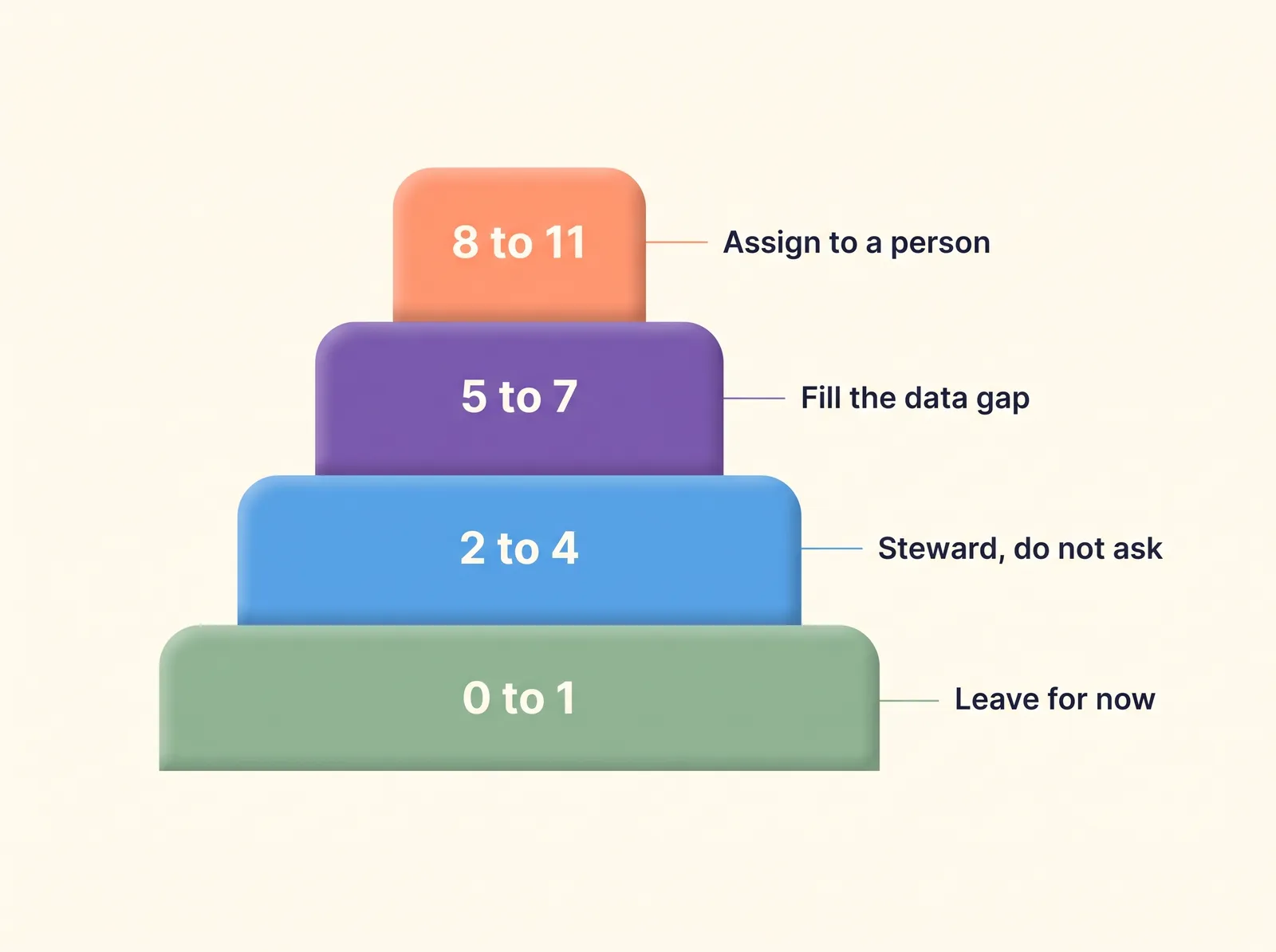
Assign the 8-to-11 names to a person. Not to a campaign, not to a mail segment. A person, with a due date. These names are few enough to work by hand, which is the entire advantage of scoring in the first place. DonorDock's moves management is built for exactly this handoff, moving a supporter through defined stages instead of leaving them in somebody's memory.
Fill the gap on the 5-to-7 names. Most of them are missing affinity data, so ask. A short, genuine question about what drew them to your work does double duty: it fills the field and it is a legitimate reason to make contact without an ask attached.
Leave the 2-to-4 names alone, deliberately. The failure mode here is soliciting everyone the audit touched. Resist it. This group's job this year is to keep giving and feel appreciated, and stewardship on a limited weekly budget is a solved problem.
If board members are part of your cultivation strategy, run the top group through a relationship mapping workflow before anyone picks up the phone. Occasionally the warm introduction is already sitting in your boardroom.
How often should you run this audit?
Quarterly is plenty, and twice a year is genuinely fine.
Signals like recurring tenure and consecutive-year giving move slowly by definition, so a monthly rerun produces churn rather than insight. What you want is a standing calendar entry, ideally about eight weeks ahead of whatever your next significant ask cycle is, so the list is ready before the campaign needs it rather than after.
The one thing worth doing more often is capturing affinity data, because that is the signal that stays empty until somebody makes collecting it part of the normal rhythm. If you are not sure which fields to prioritize, these ten donor data points are a reasonable starting set.
Start with the file you already have
The donors who will fund your next significant project are, statistically speaking, already giving you money. They have been consistent, they have been paying attention, and nobody has run the query that would surface them.
Run the audit once and you will have a ranked list of names. Run it three times and you will have a pipeline.
For a broader look at how identification connects to the rest of the cycle, our video on identifying, engaging, asking, and stewarding covers the full arc, and you can explore major gift management in DonorDock if you want to see the pipeline side in practice.