
Recurring donors are the most undervalued group in most nonprofit databases. They stay far longer than one-time givers, and their value compounds quietly across years. The reason they go unnoticed is that almost every fundraising report ranks people by gift size instead of consistency.
Ask your team to name your most valuable supporters and you'll usually hear a short list of names attached to large numbers. The importance of recurring donors almost never comes up. The person giving twenty dollars a month isn't on anyone's radar, isn't in anyone's portfolio, and shows up in your reporting as a rounding error.
That instinct is understandable. It's also expensive.
The supporters who give modest amounts on a steady schedule behave differently from everyone else in your database. They stay longer, they lapse less, and over a long enough horizon they quietly out-earn the one-time gifts that get all the attention. Most teams are not ignoring them on purpose. They are simply measuring the wrong thing.
Why are recurring donors important?
Start with the number that shapes everything else in fundraising: almost nobody sticks around.
Overall donor retention sat at 43.3 percent in 2025, according to the Fundraising Effectiveness Project's full-year 2025 report, essentially flat against the year before.
For every ten people who gave to you last year, fewer than five gave again. Everything you build on top of acquisition is being poured into a leaky container.
Retention inside individual donor-size segments has been performing worse than that topline suggests. As lower-retention groups shrink, the overall average can look calmer than the underlying picture actually is.
Now look at what happens when giving becomes a habit instead of an event. Nonprofit Quarterly, drawing on Adrian Sargeant's research on donor attrition, reports that sustaining donors show annual attrition of roughly 20 to 30 percent, while about half of cash and annual donors are lost between their first and second gift.
The revenue picture backs it up. Nearly a third of online giving now comes from the group most development plans treat as background noise.
So the case isn't sentimental. Consistency is one of the most reliable signals you have about whether someone will still be with you in three years, and it's sitting in your database right now.
The measurement problem hiding in your reports
Here is the mechanism that keeps this group invisible.
Almost every default view in fundraising sorts by amount. Top donors this year. Largest gifts this quarter. Biggest increases. Every one of those reports is a gift-size report wearing a different hat, and every one of them pushes the steady twenty-dollar-a-month supporter to the bottom of the page.
Change the sort and the same list tells you something completely different.
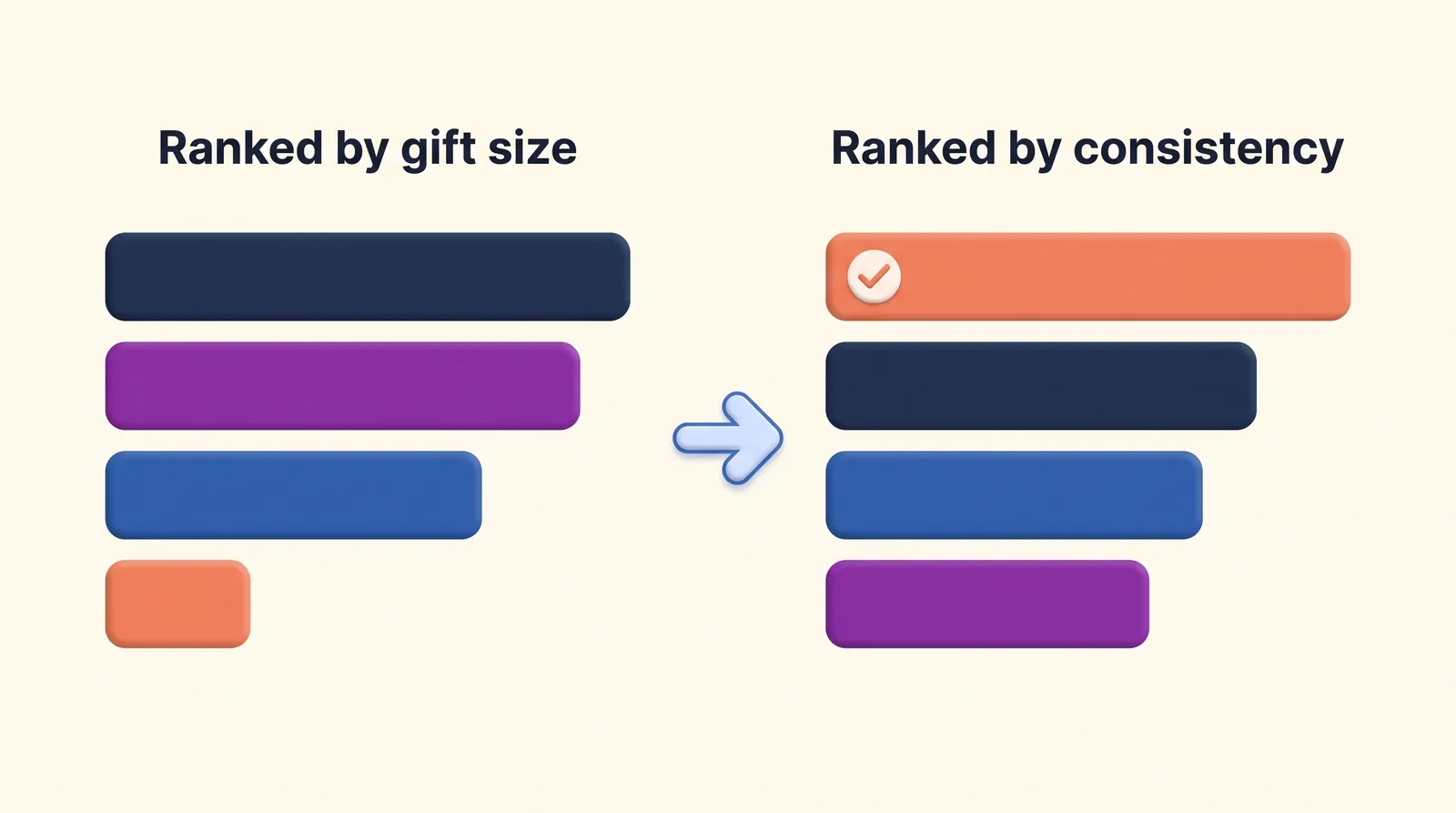
The donor who looks least important on a gift-size report is often the one with the longest unbroken giving history. Same people, same data, entirely different priorities. Nothing about the donors changed.
The second half of the problem is structural. Portfolios get assigned by capacity, so your development officers take the supporters with the largest apparent potential. Whoever is left over becomes somebody's secondary responsibility, usually the person also running the annual appeal, the newsletter, and the acknowledgment queue.
That is how the highest-retention group in your database ends up as the one group nobody is actually accountable for.
What does consistent giving actually predict?
Retention is not just a satisfying metric. It is a multiplier.
A 10 percent improvement in attrition can produce up to a 200 percent increase in projected lifetime value. Small movements in whether people stay produce enormous movements in what a relationship is eventually worth. That is the compounding nobody sees on a quarterly report, because compounding never looks impressive in a single quarter.
It also explains something teams notice anecdotally but rarely plan around. When a significant gift arrives from someone who was not on any prospect list, it usually turns out they were not new at all. They had been giving quietly for years. The relationship was already there.
This is the same pattern underneath most legacy giving as well. The supporters who eventually make the largest commitments tend to be the ones with the longest histories, not the ones with the largest single gifts, which is why building a planned giving program starts with looking at tenure rather than capacity.
Consistency, in other words, is not a consolation prize for donors who cannot give more. It is frequently an early signal from donors who eventually will.
The math your budget conversation is missing
If the retention argument feels abstract, the dollars are not.
Repeat donors who stayed with an organization made up 37 percent of all donors but delivered 60.8 percent of all fundraising dollars. Newly acquired donors were the larger group at 40.6 percent of the file, and they produced just 19.2 percent of the money.
Roughly a third of your people. Nearly two thirds of your revenue. That is the ratio most annual plans are missing.
Set that next to the trend line and it gets sharper. The number of donors fell an estimated 3.6 percent in 2025, the fifth consecutive year of decline, while total dollars rose 5 percent. The Fundraising Effectiveness Project attributes that growth almost entirely to the largest donor segments.
Put simply, the sector is raising more money from fewer people. That can look like a good year on a revenue report and still be a structural problem, because a shrinking base concentrates your risk in fewer relationships. The group that holds steady through all of it is the repeat base, and the most reliable slice of that base is the people giving on a schedule.
Why do nonprofits overlook recurring donors?
None of this is secret. Most organizations already run the program. Nonprofit Tech for Good reports that 59 percent of nonprofits now offer monthly giving.
But having a program and having a strategy are not the same thing.
A recurring giving program is easy to launch and easy to leave alone. The gifts arrive on their own. The receipts send themselves. Nothing breaks, nobody complains, and no board member asks about it. Compare that to a gala with a countdown or a campaign with a thermometer, and it is obvious why attention flows elsewhere.
Quiet revenue is not the same as healthy revenue, though, and treating it as self-managing is how it erodes. If you are thinking about where your income actually comes from and how exposed you are, this belongs in that conversation alongside revenue diversification. A base of steady monthly supporters is one of the few revenue streams that does not swing with one event, one grant cycle, or one major donor's circumstances.
How should you steward recurring donors?
Reframing this group requires deciding they're somebody's actual job.
That is the thinking behind the Smart Steward Method, our framework for putting stewardship on a schedule instead of leaving it to whatever time is left over on a Friday afternoon. Three shifts get you there.
The first shift is measurement. If your reporting only answers "who gave the most," add a view that answers "who has given the longest without a break." Those are different questions, and the second one is a better predictor of next year's revenue than the first.
The second shift is what you reach out for. With a monthly supporter, the answer is usually that you are not asking for anything. You are telling them what their steadiness made possible. That is a genuinely different kind of communication than an appeal, and it is worth reading why retention outperforms acquisition before you decide how much of your calendar it deserves.
The third shift is making the follow-through automatic, because the reason stewardship slips is never that teams stopped caring. It is that stewardship has no deadline. DonorDock's Stewardship Journeys exist for exactly this gap, letting you set the follow-up sequence once so it keeps running whether or not this week got away from you.
Smart Nudges in the Action Board handle the other half, surfacing the supporter you have not spoken to in too long before they quietly disappear. Neither of those replaces the relationship. They just stop the relationship from depending on somebody remembering.
If your recurring program itself needs work, from giving page to gift options, that is a separate project and we have covered how recurring donations work in more detail. This piece is about the supporters you already have.
The line item that deserves a plan
The supporters giving modest amounts month after month are not a lesser tier of donor. They are the group most likely to still be here in five years, most likely to compound in value, and most likely to surprise you eventually.
They're also the easiest group to take for granted, because nothing goes visibly wrong when you do. The gifts keep arriving right up until they stop.
If you want to see how other teams built this group deliberately rather than accidentally, our video on building a recurring donor base from scratch is a good place to start, and you can always see DonorDock in action if you want to watch the stewardship side work for you.