
TL;DR: Volunteers rarely become donors because most organizations run volunteer programs and development programs on separate tracks. The fix is not a better ask. It is treating volunteers as a constituency with an owner, a single record, and a stewardship plan of their own.
Turning volunteers into donors is one of the most reliable growth moves available to a development team, and one of the most consistently botched. The failure point is almost never the ask itself. It is that volunteers sit in a different system, report to a different staff member, and never appear in anyone's stewardship plan.
That makes this a design problem, not a persuasion problem. And design problems are fixable.
Why does the volunteer-to-donor handoff keep failing?
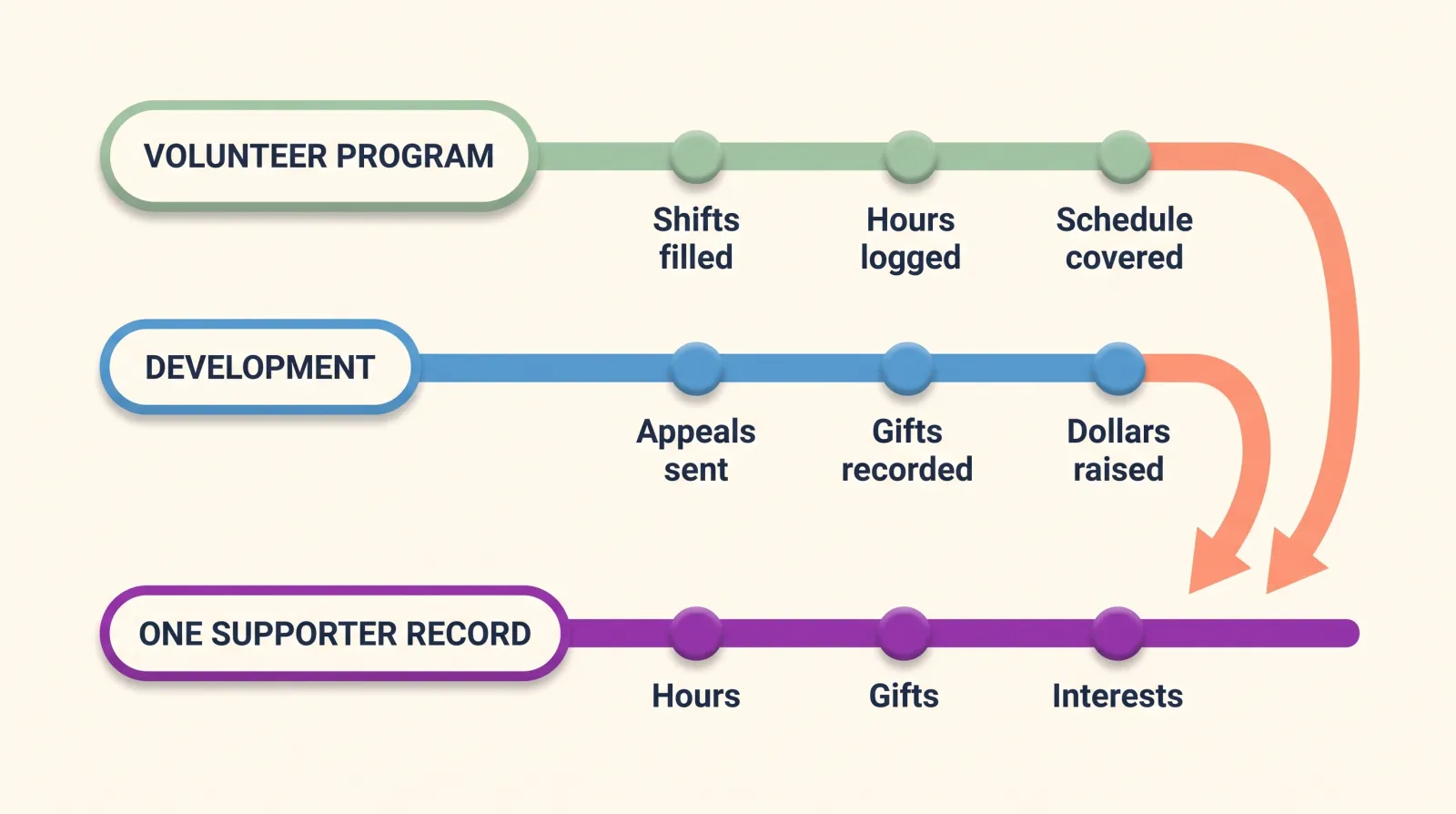
Walk into most growing nonprofits and you will find two parallel operations that almost never touch.
The volunteer program lives with programs or operations. Its success metric is coverage: shifts filled, hours logged, no gaps on the schedule. The development program lives with development. Its success metric is dollars, and its working list starts with people who have already given money.
Two owners. Often two systems. Two definitions of a good week.
So the handoff between them never actually gets built. It gets improvised, usually in November, when someone exports the volunteer list and drops it into a year-end appeal alongside donors who have been cultivated all year. The volunteers on that list have given dozens or hundreds of hours to the mission and have received, in return, exactly one piece of mail: a request for money.
The predictable result is a low response rate, which then gets read as evidence that volunteers do not give. It is not evidence of that at all. It is evidence that nobody stewarded them.
Are volunteers actually a better prospect than a cold list?
The research says the overlap is not marginal.
In Fidelity Charitable's Time and Money research, 87 percent of volunteers reported an overlap between their volunteer work and their financial support, and half of volunteers said they give more financial support because they volunteer. That survey dates to 2014, and its direction has not been seriously contested since.
Read that second number carefully, because it inverts the usual framing. Volunteering is not a warm-up act before the real gift. For a large share of people, hands-on involvement is what makes the gift bigger.
There is also an argument hiding in the labor itself. Independent Sector and the Do Good Institute put the value of a volunteer hour at $36.14, up 3.9 percent, based on 2025 data. A volunteer who gives you four hours a month is contributing more than $1,700 a year in work you would otherwise have to pay for.
You would never let a $1,700 donor go a year without a phone call. Most organizations let that volunteer go a year without one.
Why is this the wrong decade to leave that group untouched?
Because the money is getting more concentrated, and concentration is fragile.
The Fundraising Effectiveness Project reported that total charitable dollars grew an estimated 5 percent in 2025, the sector's strongest revenue growth in five years. In the same year, the number of donors fell an estimated 3.6 percent, extending a decline that started in 2021. Overall retention moved barely, from 43.1 percent to 43.3 percent, and retention of brand-new donors stayed essentially flat.
Strip the good news out and the shape is clear. The sector is raising more money from fewer people, and most of the growth came from the largest gifts. That is a revenue line that looks healthy right up until two or three households change their plans.
The obvious counterweight is broad participation, which every development plan calls for and few know where to find. Here is where it actually is: AmeriCorps and the U.S. Census Bureau found that 28.3 percent of Americans, more than 75.7 million people, formally volunteered through an organization, contributing over 4.99 billion hours.
The broad base that development teams say they cannot find is standing in your building on a Tuesday morning, wearing a name tag you printed.
What is the difference between feeling welcome and feeling like you belong?
This distinction does more work than any script you could write.
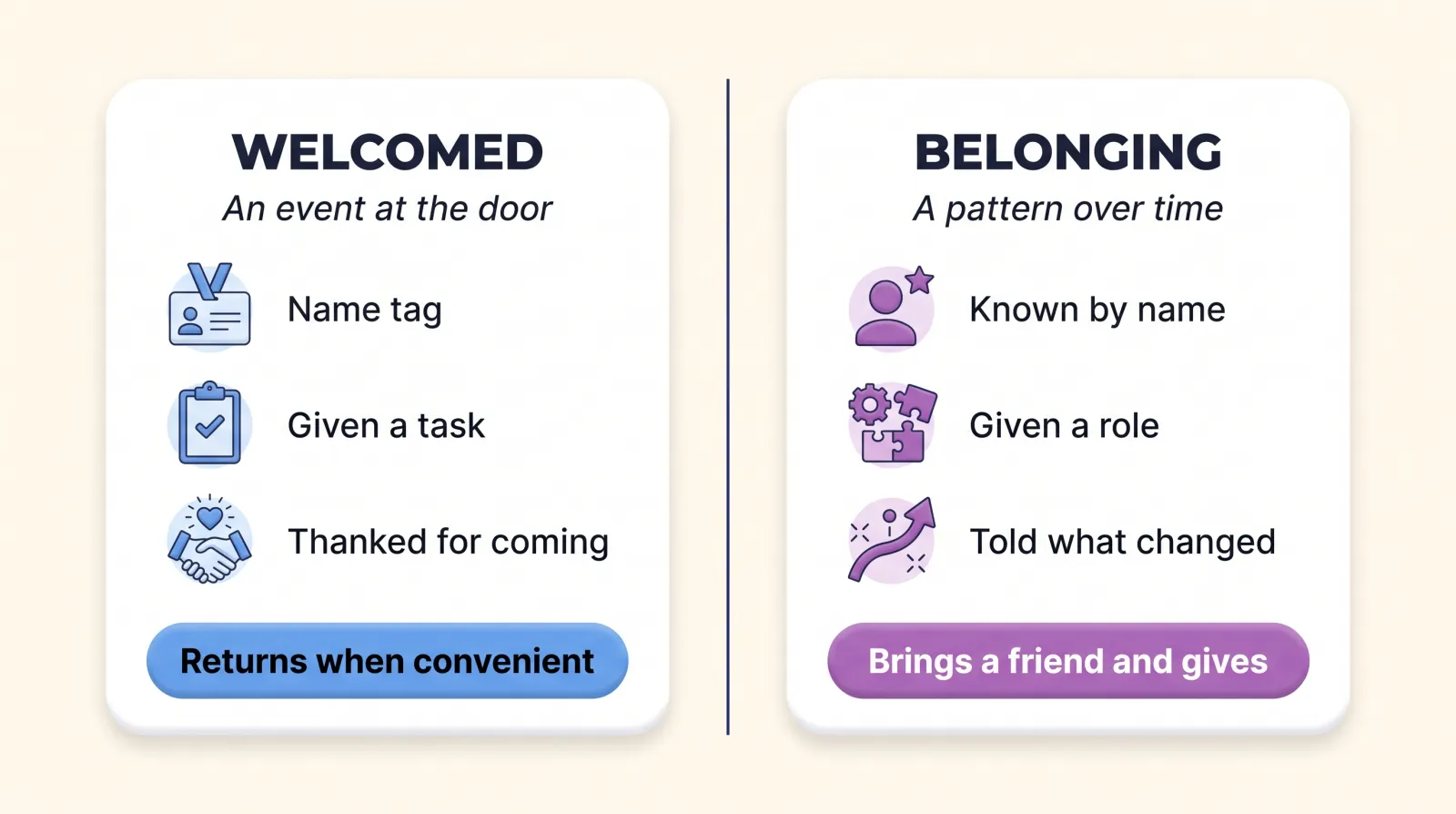
Welcome is an event. It happens at the door. A name tag, coffee, clear directions, someone who says thank you for coming. Welcome is hospitality, and most nonprofits are genuinely good at it.
Belonging is a pattern. It means being known and being needed across time. The organization remembers what you did last time, why you came in the first place, and what you actually care about. You are given a role rather than a task.
The behavioral difference between the two is stark. Welcomed volunteers return when it is convenient. Volunteers who belong bring a friend, ask what else is needed, and say yes when you eventually talk about money.
Notice that belonging is partly a record-keeping problem. You cannot remember someone's history at scale with goodwill alone. If a volunteer's hours, interests, and giving history live in three different places, your team will keep meeting the same person for the first time, over and over, and the relationship will never compound. This is the same mechanic behind the relationship loop that drives donor retention, applied to a group most organizations leave out of it.
What does a volunteer stewardship plan actually cover?
Not a campaign. A plan, built the same way you would build one for major donors or monthly donors. Four parts carry most of the weight.
A named owner. Someone on staff is responsible for the relationship, not just the schedule. Without a name attached, stewardship becomes everyone's job and therefore nobody's.
One record per person. Volunteer hours, giving history, event attendance, and stated interests belong on a single supporter profile. DonorDock keeps volunteer activity on the same record as giving history, which is what lets you see that the person who has covered forty shifts has never once been asked for anything.
Touchpoints that are not asks. An impact update, a note about the program they worked on, an invitation to see something new. If every contact from you is transactional, you have trained the relationship to feel transactional.
A stated path to a first gift, with permission to be slow. Write down what the progression looks like and roughly how long you expect it to take. Then let it take that long. Most volunteer-to-donor conversions do not happen in a quarter.
Don't forget corporate volunteer partners
When a company sends fifteen employees for a service day, most organizations record fifteen volunteers and stop there. The company itself is also a supporter, and it is the one with a budget.
That relationship has a clean, honest follow-up that has nothing to do with a cold corporate solicitation. The employees had a genuinely good day doing work that mattered. Someone at that company approved it, and cares whether it went well. A short report on what the team accomplished, sent to the person who signed off, is both good stewardship and the natural opening to a conversation about sponsorship or a matching program.
Treat the employer as a constituency with its own record and its own owner, exactly like an individual. The organizations that do this consistently tend to find that their corporate revenue grows out of their volunteer program rather than alongside it.
This is what Smart Stewardship looks like when you apply it past your donor file. You are not inventing a new discipline for volunteers. You are extending one you already run, to a group that was never in scope. If capacity is the objection, the answer is that this costs less than you think, and personalized stewardship without a big team is a solved problem.
How do you know it is working before the money shows up?
If the first gift from a stewarded volunteer realistically arrives twelve to eighteen months out, and you report on the program monthly using dollars raised, you will report four consecutive zeros and lose the argument. The program does not fail. The measurement does.
Track the behaviors that produce the outcome instead:
- Share of active volunteers with a named staff owner
- Share with a complete supporter record, meaning hours and contact history in one place
- Repeat-shift rate, which is your real engagement signal
- Non-ask touches per volunteer per year
- Introductions made, meaning volunteers who brought someone new
- Volunteers who made a first gift, reported as a trailing number rather than a monthly target
Those first five are all inputs you control this month. Dollars are the lagging confirmation that the inputs were right. DonorDock's volunteer tracking and Action Board are built around exactly this idea: surface the next action for a person, then let the reporting follow the activity.
This is also the reason retention work has to come before acquisition. A volunteer base you already have is a warmer, cheaper, and more durable source of new donors than any list you could buy.
Where should you start this month?
Not with recruitment. Start with the people who already showed up.
Pull everyone who volunteered in the last twelve months and cross-reference that list against your donor file. You will get three groups, and each one needs something different.
- Volunteers who already give. Thank them for both, in the same breath, by name. Some may have never been acknowledged as doing two things.
- Volunteers who have never given. This is the real opportunity, and it is almost always the largest of the three. Assign owners here first.
- Lapsed volunteers. People who came, then stopped. Ask a few of them why. The answers will tell you more about your program and what you can make better.
Then do the unglamorous part. Assign the owners. Put the non-ask touchpoints on a calendar. Get the hours and the giving history onto one record. And when you have earned it, make the ask specific rather than general.
If you want to see the shape of this in practice, we walk through it in our short guide to turning volunteers into donors.
The organizations that will hold their donor counts steady over the next few years are not the ones with the cleverest year-end appeal. They are the ones who noticed that a large group of committed supporters had been standing in the room the whole time, and finally built a plan for them.