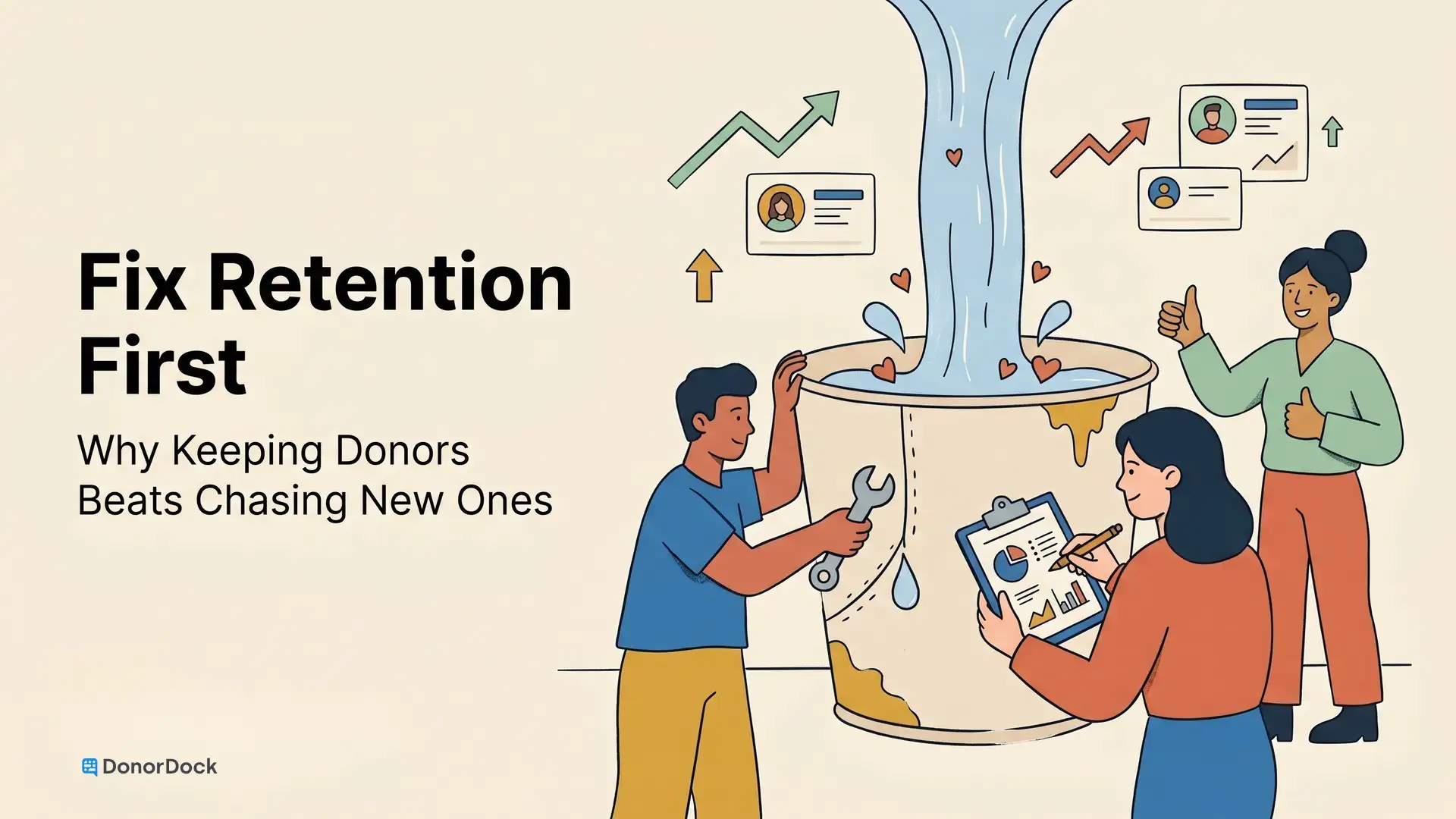
Nonprofits that fix donor retention before chasing new donors grow faster and more sustainably. With sector-wide retention hovering around 43%, keeping donors you already have is more cost-effective than constantly replacing them.
Why Do Most Nonprofits Get Growth Backward?
Your board wants more donors. Your revenue goals are climbing. So you pour resources into acquisition: events, direct mail campaigns, digital ads, peer-to-peer pushes. And it works, sort of. New donors trickle in.
But here is the problem. According to the Fundraising Effectiveness Project's data, only 24% of first-time donors give again. That means for every four new donors you acquire, three disappear within a year. You are filling a bucket with a hole in the bottom.
Andrew Kerr, Director of Development at the Georgia Conservancy shared on The Focused Fundraiser that when he arrived, the organization had about 500 supporters and a retention rate between 33% and 35%. His first move was not to chase new donors. It was to fix stewardship. Today, the Georgia Conservancy has over 3,200 donors and a 51% retention rate.
The lesson is counterintuitive but backed by data: slow down on acquisition, speed up on retention, and your donor base will grow faster.
What Does the Retention Data Actually Tell Us?
The Fundraising Effectiveness Project tracks giving patterns across thousands of nonprofits. Their data paints a clear picture of where the sector stands.
Overall donor retention edged up slightly to 43.3%, but this masks a deeper problem. New donor retention remains stuck at roughly 24%. Repeat donor retention, by contrast, sits at 66%. The gap between those two numbers is where most nonprofits lose their growth potential.
The M+R Benchmarks add another dimension. Monthly donors retain at 71% after one year, compared to 24% for one-time new donors. That three-to-one retention advantage makes recurring giving programs one of the highest-leverage retention strategies available.
What these numbers reveal is a sector that has gotten reasonably good at keeping donors it already knows, but has yet to crack the code on converting first-time givers into long-term supporters. That conversion gap is your biggest opportunity.
Why Does Retention Outperform Acquisition as a Growth Driver?
Acquiring a new donor costs 5-10x more than retaining an existing one.
When your retention rate is 35%, you need to replace two-thirds of your donor base every single year just to stay flat. That is an exhausting, expensive treadmill.
But the compounding effect of even modest retention improvements is dramatic. Moving from 35% to 50% retention, as the Georgia Conservancy did, means you keep an additional 15 donors out of every 100. Over three years, that compounds into hundreds of additional retained donors, each with higher lifetime value than a brand-new acquisition.
There is also a referral effect. Retained donors who feel genuinely appreciated become advocates. At the Georgia Conservancy, personalized thank-you videos sent during Giving Tuesday week were viewed by 350 unique IP addresses, even though only 250 videos were sent. Donors were sharing those videos with spouses and friends. That kind of organic word-of-mouth is acquisition you do not have to pay for.
How Do You Diagnose Your Retention Problem?
Before you can fix retention, you need to understand where donors are falling off. Not all attrition is the same, and the solution depends on the diagnosis.
Track your retention rate by segment. Your overall retention number hides important variation. Break it down by gift size, giving frequency, acquisition channel, and donor tenure. You may find that your major donors retain at 80% while your under-$100 donors retain at 20%. Those require completely different interventions.
Audit your stewardship timeline. Map out every touchpoint a donor receives from the moment they give until their next ask. For many nonprofits, this exercise reveals uncomfortable gaps. A tax receipt goes out, maybe a generic newsletter arrives quarterly, and then six months later, an appeal lands. That is not stewardship. That is neglect punctuated by asks.
Survey lapsed donors. The donors who left can tell you why. A short, respectful survey sent to lapsed donors often reveals fixable issues: they felt unappreciated, they did not understand their impact, or they simply forgot about you. These are stewardship errors that can be fixed.
Your nonprofit CRM should make this diagnostic work straightforward. DonorDock's donor timeline, for example, shows every interaction with a donor in one view, making it easy to spot where stewardship gaps exist.
What Does a Retention-First Strategy Actually Look Like?
A retention-first strategy is not complicated, but it does require intentionality. It means building systems that make every donor feel seen and valued before you ever ask for another gift.
Fix your thank-you speed and quality. The first 48 hours after a gift are the most important window in the donor relationship. A prompt, personal thank-you sets the tone for everything that follows. The Georgia Conservancy uses a three-layer approach: an immediate tax acknowledgment, a handwritten card (using a handwriting robot to scale the process from seven minutes per card down to under 60 seconds), and a simple personalized video message recorded on a phone.
Build stewardship tiers (journeys). Not every donor needs the same level of attention, but every donor needs some attention. Create tiers based on giving level, with specific stewardship actions mapped to each tier. At minimum, every donor gets a receipt, a personal thank-you, and at least one impact update before the next ask.
Show impact before asking again. Donors who understand the difference their gift made are dramatically more likely to give again. This does not require a glossy annual report. A short email showing one specific outcome, like "your gift helped us protect 200 acres of coastal habitat this quarter," is more powerful than a general newsletter.
Make your second ask strategic. The gap between first gift and second gift is where most donors are lost. Rather than waiting for your next campaign cycle, create a deliberate second-touch strategy within 90 days of the first gift. This might be an invitation to a small event, a survey about their interests, or a targeted appeal aligned to what motivated their first gift.
How Does the PAS Framework Help Retain Donors Through Communication?
One underutilized approach to donor communication comes from the PAS framework, which stands for Problem, Agitate, Solution.
Here is how it works in practice. First, you identify a problem your donors care about: a threatened ecosystem, an underserved community, a gap in services. Then you agitate by helping donors understand why this problem matters to them personally: this is the river you paddle, the neighborhood where your kids play, the school your family attended. Finally, you present the solution, and the solution is not your organization. The solution is the donor's participation. You are the vehicle; they are the hero.
This framework avoids the trap of fear-based fundraising while still creating urgency. Donors retain when they feel like participants in a solution, not just sources of funding. Every communication, from thank-you notes to email appeals, should reinforce this identity.
What Role Does Donor Segmentation Play in Retention?
Generic communication is a retention killer. When every donor gets the same message regardless of their age, giving history, or motivation, you are guaranteed to miss the mark with most of them.
Effective segmentation does not require complex data science. As an example, the Georgia Conservancy uses two simple donor avatars that shape their messaging. Their "Engaged Explorer" segment (roughly 25 to 50 years old) cares about personal access to nature: the rivers they paddle, the trails they hike, the green spaces in growing cities. Their "Legacy Builder" segment (50 and up) cares about preservation for future generations: saving the environment for kids and grandkids.
Same mission. Same organization. Completely different emotional triggers. When you speak to what motivates each segment, your communications feel personal even at scale.
Start with two or three segments based on the data you already have in your donor management system. Age, giving level, and acquisition source are usually enough to create meaningfully different communication tracks. DonorDock's Smart Nudges can even surface which donors need attention based on their engagement patterns, helping your team focus stewardship effort where it matters most.
How Do You Balance Retention Investment with Acquisition Needs?
This is not an either-or proposition. You still need new donors. The question is sequencing and proportion.
A practical rule of thumb: if your retention rate is below 45%, prioritize stewardship improvements before scaling acquisition. Every dollar you spend acquiring donors who will leave within a year is largely wasted. Once you have built reliable stewardship systems and your retention rate stabilizes above 45%, then scale acquisition, knowing that a meaningful percentage of new donors will actually stick.
Time blocking can help protect your retention work from getting squeezed out by urgent acquisition demands. Block at least 30 minutes of every day for stewardship activities: recording thank-you videos, writing personal notes, reviewing Smart Nudges for follow-up opportunities. When stewardship has a protected place on your calendar, it actually happens.