TL;DR: Ethical storytelling in fundraising means sharing the stories of the people you serve with their informed consent, in their own voice, with the need shown truthfully and their dignity protected. Pity can win a single gift. Dignity builds the trust that keeps donors giving.
Every development team has felt this tension. The video edit that makes the room cry is also the one that shows a client on the worst day of their life. The appeal letter that pulls the most gifts leans hardest on helplessness. And somewhere in the back of your mind sits a quiet question: would they be okay with this?
Ethical storytelling in fundraising is how you answer that question before you hit send. You can still show the need plainly, hard realities included. The difference is telling it in a way the person in the story would recognize and stand behind.
Here's what the research says about pity, dignity, and giving, and why the way you tell stories matters more as your nonprofit grows.
What is ethical storytelling in fundraising?
Ethical storytelling in fundraising is the practice of sharing the stories of the people you serve (often called beneficiary stories) with informed consent, accurate detail, and respect for the person's dignity and privacy, so the story serves both the mission and the people in it. The person in the story is a partner in telling it, not raw material for an appeal.
In practice, it rests on three commitments:
- Consent: the person understands where the story will appear, who will see it, and that they can say no or change their mind.
- Dignity: the story shows them as a whole person with strengths and choices, not only as a problem to be solved.
- Truth: the need is real, specific, and not exaggerated for effect, and the outcome is honest about what a gift can and can't do.
Industry groups have started putting this in writing. Bond, the UK network of international development organizations, publishes guidelines for the ethical production and use of images and stories that cover informed consent, responsible portrayal, and AI-generated imagery.
Why do pity-driven stories seem to work?
Because, in the moment, they often do.
A single person's story usually beats a page of statistics. In a well-known series of experiments, people given $5 donated an average of $2.38 after reading about one girl named Rokia, versus $1.14 after reading statistics about the same crisis. The effect has proven harder to replicate in more recent work, but most fundraisers have watched some version of it play out.
Sadness moves people too. In one lab study of charity appeals, 77 percent of participants donated when the appeal showed a child with a sad expression, compared with 52 percent when the same child looked happy.
So if you've seen a heartbreaking video outperform a hopeful one, you're not imagining it. The better question is what it costs you by next year.
What does pity cost a nonprofit over time?
The bill for pity-driven storytelling arrives in three places, and none of them show up in a single campaign report.
It costs the people in your stories
When researchers ask the people pictured in charity materials how they feel, the answers are more nuanced than "never show suffering." In Save the Children's study The People in the Pictures, most of the people featured were satisfied with how they'd been portrayed, but some worried about stigma in their own communities. And outside the UK, only one of the 44 people featured had ever received a copy of a photograph.
A University of Kent study of young people experiencing homelessness found something similar. They were largely supportive of whatever raised the most money for the services they relied on, but they preferred images that told a story over what the researchers called "sympathy snapshots."
It costs your relationship with donors
Pity can bring in a gift while quietly teaching donors that your organization's main product is sadness. That's a hard foundation for a long relationship. In a series of experiments on positive and negative charity appeals, positive appeals created more favorable attitudes toward the organization, while negative appeals raised the same or more in the moment. Short-term giving and long-term goodwill pulled in different directions.
Goodwill is the scarcer resource. The Give.org 2026 Donor Trust Report found 67.7 percent of people say trusting a charity is essential before they give, but only 18.3 percent report high trust in charities.
It costs your team
Program staff who see the people behind the stories every day notice when a campaign flattens someone into a tragedy. Over time, that erodes trust between your program and development teams, and the best stories stop reaching you at all.
Do dignity-first stories raise less money?
Not necessarily. The research doesn't support a blanket "sad sells" rule or a blanket "positive wins" rule. What it does support, alongside what fundraisers see in practice, is more useful:
- Agency raises giving. Across four studies, UK psychologists led by a team at Royal Holloway, University of London found people were more willing to give to disaster victims they saw as making an effort to help themselves. Showing someone's strength and choices isn't a gentler version of the ask. It's a stronger one.
- Hope gives the donor a role. A story that only shows suffering leaves the reader with sympathy and nowhere to put it. A story that shows what changes next gives them a job to do.
- Trust compounds. In Independent Sector's 2026 trust research, 74 percent of Americans said more transparency about how funds are used would increase their trust in nonprofits. Honest stories are part of that transparency.
Dignity and effectiveness aren't at odds. You can show the need clearly, even urgently, and still leave the person in the story whole.
How do you show real need without stripping dignity?
Run every story through a four-part dignity check before it goes out.
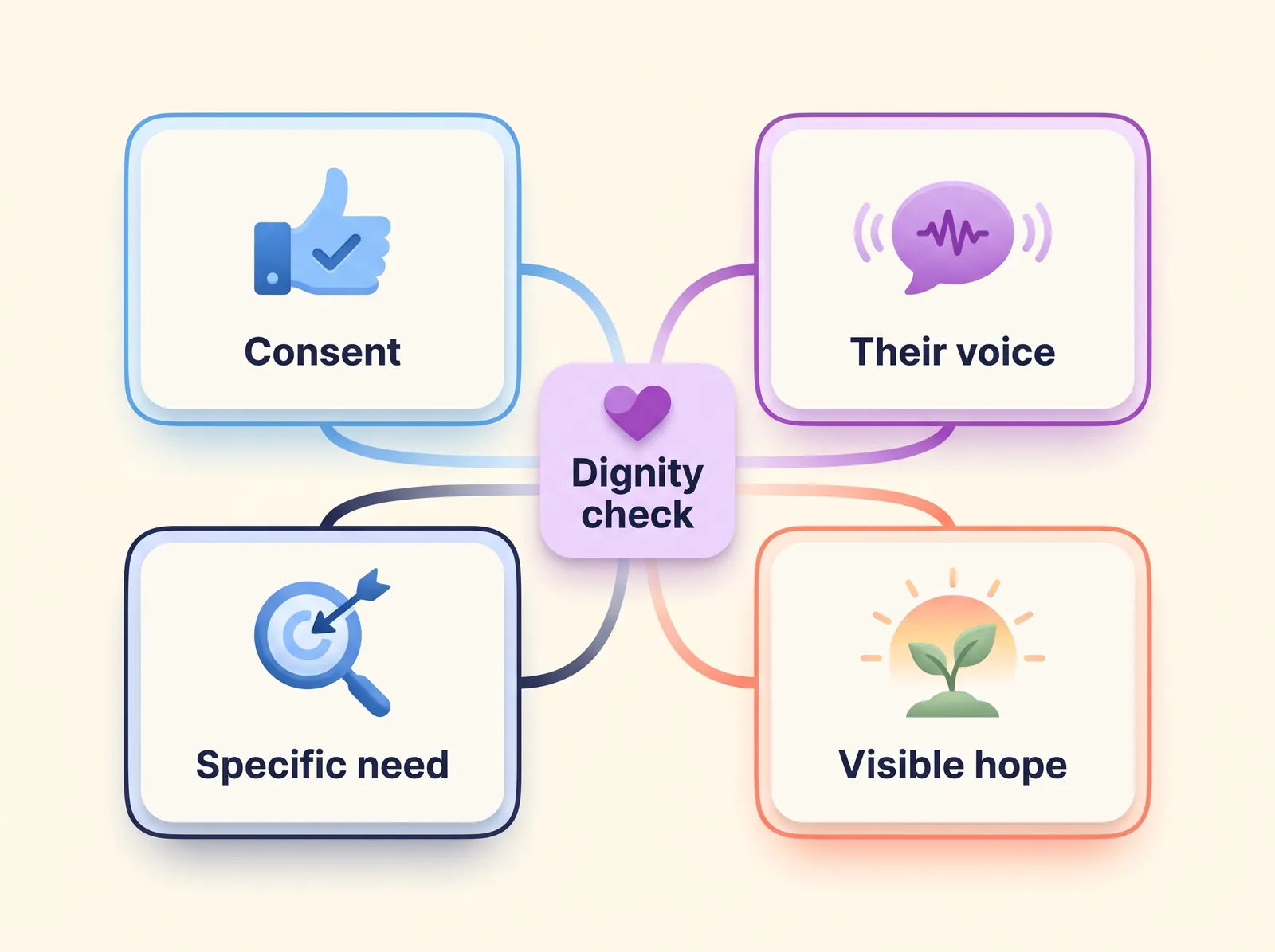
Consent: did they say yes, knowing where it will run?
A signed release isn't the finish line. Real consent means the person knows exactly where the story will appear (gala video, website, direct mail, social media), who will see it, and how long you'll use it. It also means asking at a moment when they can genuinely say no, which usually isn't the week they received help.
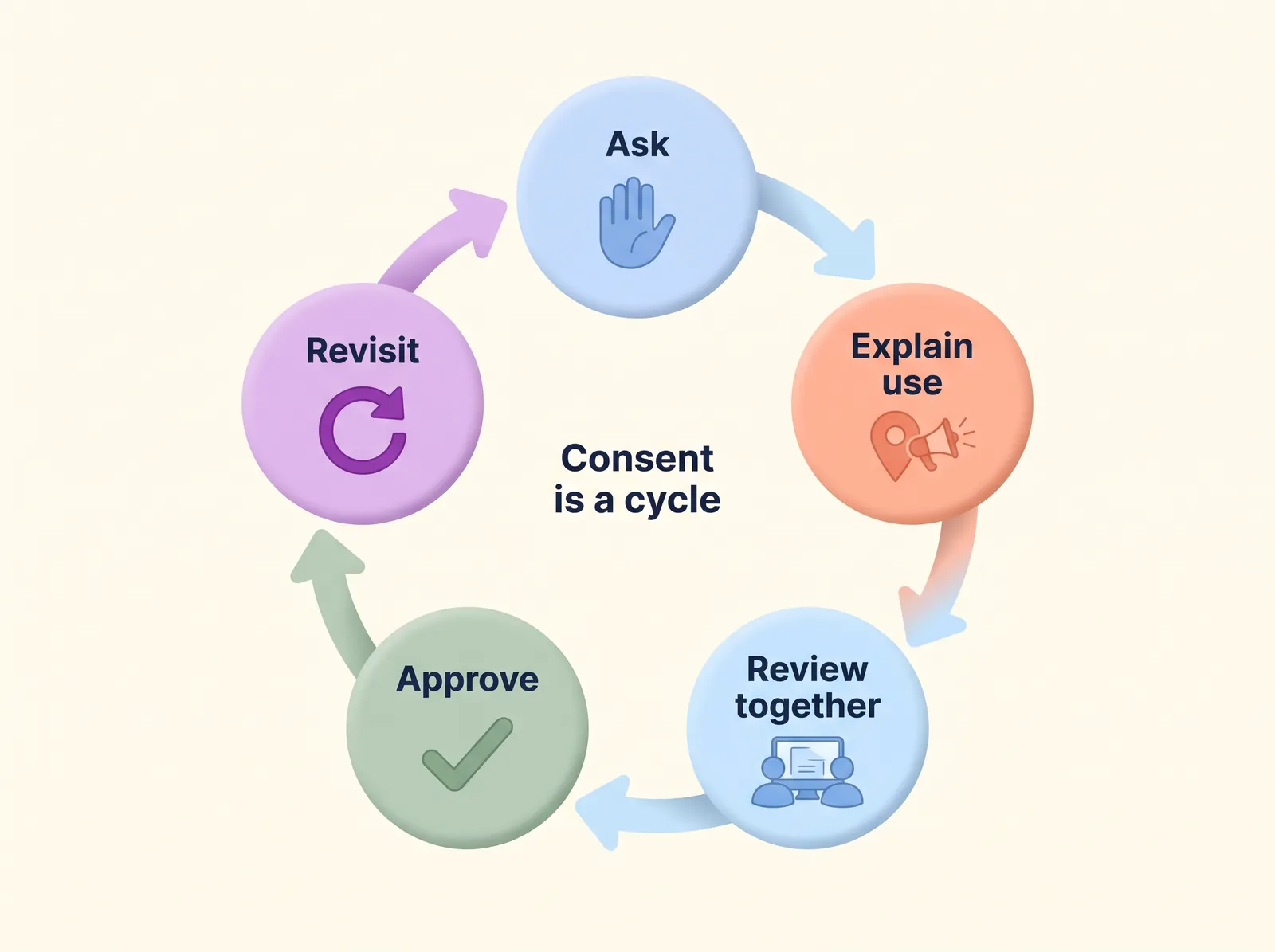
Treat consent as a cycle, not a form. Ask, explain the use, review the draft together, get approval on the final version, and revisit it later, especially if a story will run for more than a year or the person's circumstances change.
Two more rules worth writing down: get a parent or guardian's consent and the young person's own agreement for anyone under 18, and make it easy for anyone to withdraw their story without having to explain why.
Their voice: is it told in their words?
The most dignified stories are often the ones people tell themselves. Hand the camera to a family, record an interview and let them choose the clips, or quote them directly instead of paraphrasing their life in your organization's voice. You'll give up some polish. You'll gain stories that sound true, because they are.
Specific need: is it precise without exposing what should stay private?
Vague need ("families are struggling") moves no one. Specific need ("a dad working nights who can't get his daughter to her clinic appointments") does. But specific doesn't mean exposed. Describe the three bus transfers it takes to reach the clinic; you don't need footage of someone crying at the stop. If a detail would embarrass the person in front of a neighbor, it doesn't belong in your appeal.
Visible hope: does it show what a gift changes?
End with movement, not just pain: what happens next for this person, what part a donor plays, and what's already gone right. Hope isn't spin when it's true, and it's almost always true somewhere in the story.
For more on making the person in the story (not your organization) the hero, see why your story may have the wrong hero. If donors visit your programs in person, this guide to trauma-informed ways of showing impact covers that side of the work.
Why does storytelling ethics matter more as your nonprofit grows?
Early on, stories are usually told by the person closest to them: a founder, or a program director who knows every family by name. Their judgment is the policy. As your organization grows, that stops being true. Stories get told by a development associate who has never met the family, an outside video editor, a board member at a dinner party, or an agency on deadline.
That's when good intentions need a written standard. A one-page storytelling policy for a growing team covers:
- Who can request a story, and who approves it before it runs
- How consent is gathered, documented, and renewed, and where that record lives
- What you never show: minors without guardian consent, identifying details for people in crisis, private moments
- How long a story can be used, and how someone can withdraw it
- A final review where someone close to the program reads the piece with the dignity check in hand
Keep consent records with your program team's client information, under whatever privacy rules govern that data. Your donor CRM handles the other half of the picture: which donors heard which story, and what they did next.
How does ethical storytelling strengthen donor retention?
The story doesn't end when the gift arrives. Donors who responded to a story want to know what happened next, and telling them (with the person's permission) is one of the most meaningful follow-ups you can send. Our guide to using storytelling to strengthen donor engagement calls this closing the loop.
That only works if you know who gave because of which story. In DonorDock, every gift already carries its campaign and appeal, and gift tags let you label the gifts that came in response to a specific story, so six months later you can filter for those gifts and send the update to exactly those donors instead of everyone on your list. It's a small habit that turns a moving moment into a lasting relationship.
Building that follow-up into a year-round rhythm is the job of a donor stewardship plan, the everyday practice behind Smart Stewardship. For the bigger picture of how stories fit into your donor communications, explore DonorDock's approach to donor outreach.
Where should you start?
Pull the last three stories your team published: a video, an appeal letter, and a social post. Run each one through the dignity check. Would the person in it recognize themselves and feel respected? Did they know it would run where it ran? If any answer is "I'm not sure," that's your starting point, not a failure.
Then write your one-page policy before your next campaign, share it with your program team first, and keep our nonprofit storytelling checklist nearby for the craft side. Stories told this way still move people. They just keep moving them, long after the campaign ends.