
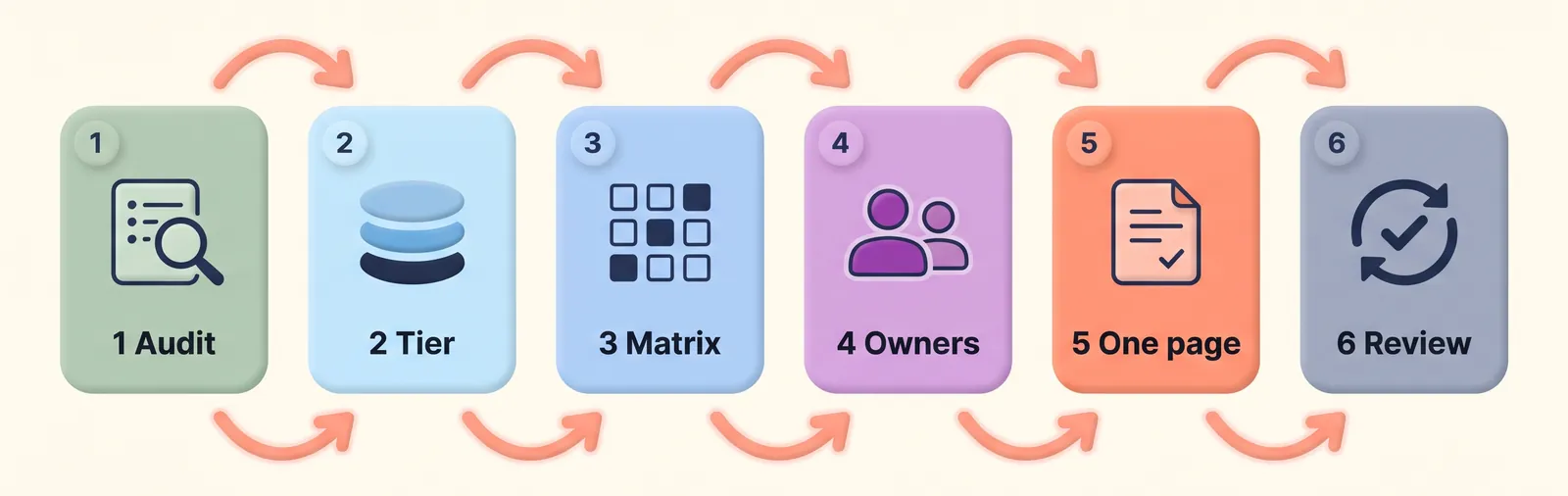
TL;DR: A donor stewardship plan is a written schedule of the no-ask thank-yous, updates, and invitations each donor tier gets, and who owns each one. Build it in six steps: audit, tier, map a matrix, assign owners, write one page, and run it from your CRM.
Here's a sentence no development director wants to hear from a loyal sponsor: "The only time I hear from you is when there's an event coming up."
It usually isn't the whole truth. Your team sends thank-you notes, a newsletter goes out every quarter, and someone meant to call. But from the donor's side of the table, the pattern is what sticks: invitation, ask, receipt, silence, invitation again.
A donor stewardship plan fixes the pattern. This guide walks you through how to build one in six steps, with a stewardship matrix, a copyable 12-month calendar, and a one-page format your whole team (board included) can actually follow.
What is a donor stewardship plan?
A donor stewardship plan is a written, tiered schedule of the touches your nonprofit makes with donors between asks: thank-yous, impact updates, invitations, and personal check-ins. It names who gets each touch, how often, through which channel, and which person on your team owns it.
Two things make it different from the calendars you probably already keep:
- It isn't your appeal calendar. Appeals ask. Stewardship touches give something back: gratitude, proof of impact, access, or personal attention.
- It isn't one-size-fits-all. A $25 monthly donor and a $30,000 sponsor should both feel valued, but they don't need the same touches at the same frequency.
Stewardship is the practice that drives donor retention. For the bigger picture of how the two fit together, start with our overview of donor retention and Smart Stewardship. This article is the hands-on part: the plan itself.
Why do donors drift when they only hear from you at events?
Because the relationship never gets a chance to grow between asks. The Fundraising Effectiveness Project found overall donor retention was 43.3 percent in 2025, and the gap opens early: only 18.9 percent of new donors gave again, compared with 59.3 percent of repeat donors.
When donors explain why they walked away, the reason often isn't the cause at all. In the 2023 Bank of America Study of Philanthropy, the top reason affluent donors gave for dropping an organization was too many requests, or requests too close together (28.2 percent). Another 9.1 percent said the organization wasn't effective or didn't sufficiently communicate its effectiveness.
Donors rarely leave because you asked once. They leave when asking is the only thing you do.
Event-acquired donors are especially exposed. They came for the evening, the tournament, or the auction item, and unless someone connects them to the mission afterward, next year's invitation is the next thing they hear. If events are a big part of your revenue, our piece on turning event guests into long-term donors goes deeper on that handoff.
How do you build a donor stewardship plan?
You can draft a working plan in about two weeks of part-time effort. Here are the six steps.
Step 1: Audit last year's touches
Before you plan forward, look back. Pull twelve months of activity for your top 50 to 100 donors (or everyone above a giving threshold you choose) and count two things for each person: how many times you asked, and how many times you reached out with no ask attached.
Then flag three patterns:
- Ask-only donors: every contact was an appeal, a ticketed invitation, or a receipt.
- Event-only donors: every contact clustered within a few weeks of your gala, tournament, or annual dinner.
- Silent donors: gave, got a receipt, and heard nothing personal for six months or more.
You'll probably find your biggest givers are in better shape than your mid-level and event donors. That's normal. It's also where the quiet losses happen.
If you can't run this audit because contact history lives in five inboxes and a spreadsheet, that's your first finding. Every call, note, and visit needs to land on the donor's record, or no plan can be measured.
Step 2: Sort donors into stewardship tiers
Tiers keep the plan realistic. Most growing nonprofits do well with five:
- Major donors: your top givers by cumulative giving, usually a small group at the top of your file. Highest touch, most personal.
- Mid-level donors: consistent givers below your major gift threshold. Often the most neglected tier, and your best pipeline for future major gifts.
- Monthly donors: recurring givers at any amount. They've already committed. Stewardship keeps that commitment from quietly ending when a card expires.
- Sponsors and event-acquired donors: businesses and guests whose first connection came through an event. They need a bridge from the event to the mission.
- First-time donors: anyone in the 90 days after a first gift. This is the highest-risk window you have.
Set dollar thresholds that fit your own file rather than borrowing someone else's. A $1,000 donor might be mid-level at one organization and major at another. When a donor fits two tiers (say, a monthly donor who also sponsors your gala), the higher-touch tier wins.
Build each tier as a saved segment so it updates itself. In DonorDock, contact lists and segments refresh as gifts come in, so a donor who crosses your major gift threshold moves tiers without anyone rebuilding a spreadsheet.
Step 3: Build your stewardship matrix
A stewardship matrix is a grid: your tiers down one side, your touches across the top, and how often each tier gets each touch in the cells. It turns "we should stay in touch" into a schedule. A good starting rule: at least two no-ask touches for every ask a donor receives. Adjust from there.
Most nonprofit email programs run the other way. M+R's 2026 benchmarks found nonprofits sent each email subscriber an average of 50 messages in 2025, and 31 of them were fundraising appeals, against just 9 newsletters.
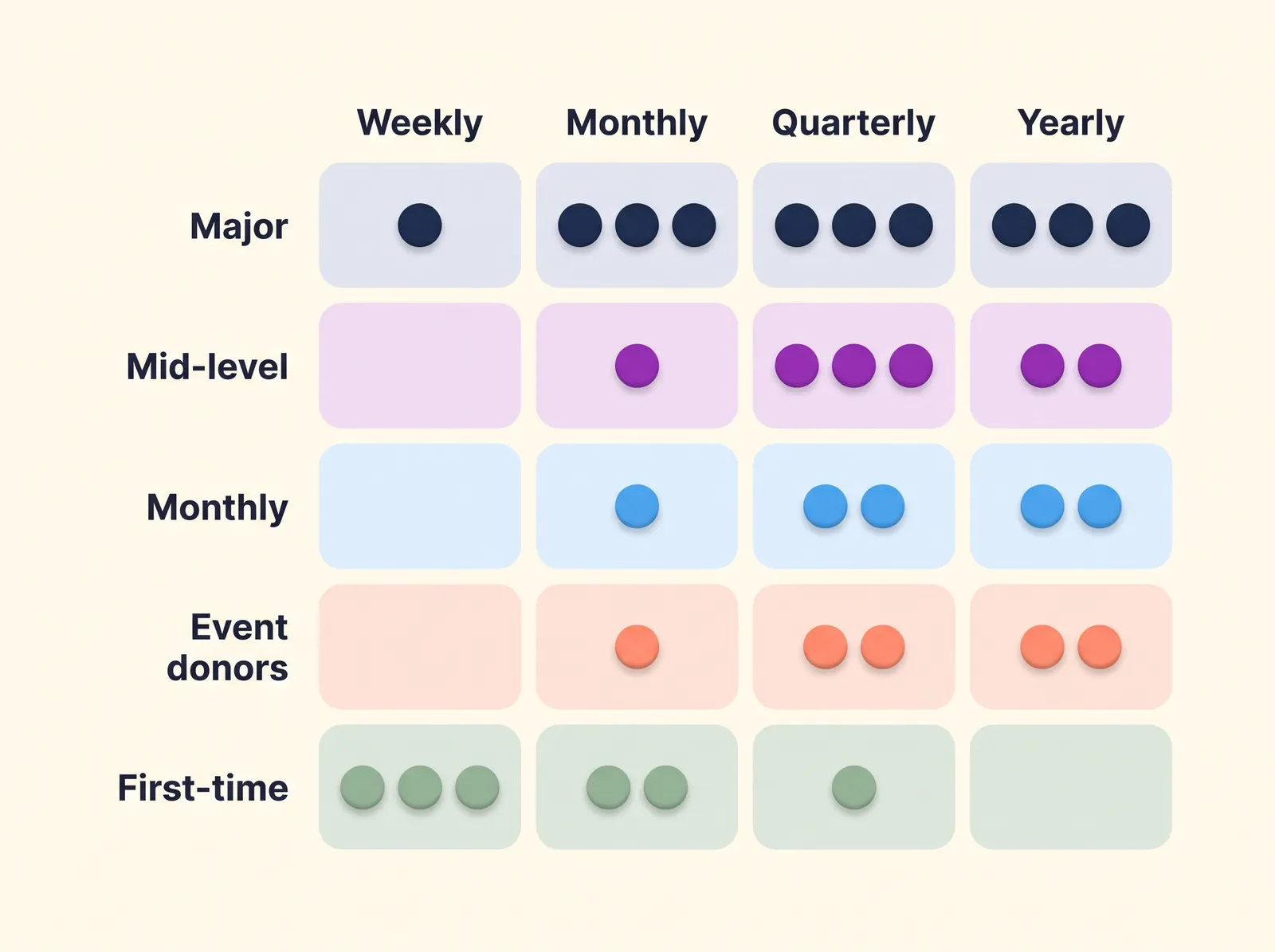
- Major donors: a personal touch every month (call, coffee, handwritten note, or short personal update), a quarterly impact conversation, an annual visit or site tour, and recognition of personal milestones you know about. For a lean way to run this tier, see major donor stewardship on 10 hours a week.
- Mid-level donors: a personal call or handwritten note each quarter, a quarterly impact update, and one invitation a year to something with no ticket price.
- Monthly donors: a thank-you on their giving anniversary, a quarterly update written for recurring givers, and a friendly heads-up before a card expires.
- Sponsors and event donors: a thank-you within 48 hours of the event, a results recap within two weeks that shows what the event funded, and at least two mission touches before next year's invitation.
- First-time donors: a thank-you within 48 hours, a short welcome series over the first 30 days, and a personal check-in between day 60 and day 90, before any second ask.
Then layer a team rhythm on top. Weekly: clear new-gift thank-yous and calls. Monthly: complete each tier's scheduled touches. Quarterly: send impact updates and hold a donor review. Annually: re-tier your file and rewrite the plan.
One caution as you fill in the matrix: no single touch carries the load. In field experiments with about 500,000 new donors, a standard thank-you phone call had no measurable effect on retention, even though fundraising professionals predicted it would raise retention by 80 percent. What moves retention is the pattern of touches across a year, and that pattern is exactly what a written plan protects.
Step 4: Give every touch an owner
A touch without an owner is a wish. Assign every recurring touch to a named person, not a department.
- Development staff own major and mid-level relationships, portfolio by portfolio.
- Your executive director owns a short list of top relationships and a handful of thank-you calls each month.
- Board members make thank-you calls. Set aside 20 minutes of a board meeting each quarter to review top donors together and hand out calls, with a two-week deadline and a place to record what they heard.
- Program staff supply the raw material for updates: a photo, a number, two sentences from the field.
Plan for turnover while you're at it. When a staff member leaves, their relationships shouldn't leave too. If every touch is logged on the donor record, whoever inherits the portfolio can see what was promised and pick up the thread.
Step 5: Write the plan on one page
If your plan needs a binder, nobody will open it. Fit it on one page, with these fields for each tier:
- Tier name and the rule that puts a donor in it
- How many donors are in the tier today
- No-ask touches per year, by month or quarter
- Channel for each touch (call, note, email, text, visit)
- Owner
- Where the touch gets logged
- The one number you'll watch for that tier
Share the page with your board and your executive director. A plan the whole leadership team has seen is a plan people defend when the calendar gets crowded.
Step 6: Run it from your CRM and review it quarterly
A plan on paper fades by March. It has to show up in your team's day.
That means every touch becomes a task with an owner and a due date, and repeatable sequences run on their own. In DonorDock, the Action Board puts each person's stewardship tasks for the day in one list, Stewardship Journeys automate repeatable sequences like a first-time donor welcome series, and Smart Nudges flag moments you'd otherwise miss, like a giving anniversary or a donor who has lapsed.
Once a quarter, review three numbers by tier:
- Retention rate: what share of last year's donors in the tier have given again.
- Touch completion: no-ask touches completed versus planned.
- Second-gift rate: for first-time donors, how many have made a second gift.
Where a tier is slipping, add a touch or change the channel. Our guide to second gift conversion rate has benchmarks for that last number.
What does a 12-month donor stewardship calendar look like?
Here's a starting calendar you can copy. It assumes a spring event and a year-end appeal, so shift the months to match your own season.
- January: Thank-you calls to everyone who gave in December above your mid-level threshold. Send giving statements with a short personal note.
- February: Year-in-review impact report to all tiers. Check-in calls with major donors.
- March: Handwritten notes to mid-level donors from program staff. Quarterly board donor review, with spring calls assigned.
- April: Event invitations go out. Major donors get a personal invitation or a pre-event tour.
- May: Event month. Thank sponsors and guests within 48 hours.
- June: Event results recap showing what the night funded. Quarterly board donor review.
- July: Midyear impact update. Ask major and mid-level donors for their advice or feedback, not their money.
- August: Behind-the-scenes invitation (site visit, program observation, or virtual tour).
- September: Personal check-ins with event-acquired donors. Re-tier your file based on giving to date. Quarterly board donor review.
- October: Impact story email to all tiers. Major donor visits ahead of year-end conversations.
- November: Gratitude calls with no ask, timed before the year-end appeal lands.
- December: Year-end appeal. Thank every gift within 48 hours. Hold your annual plan review and the fourth board donor review.
Running all year: the first-time donor welcome series, monthly donor anniversary thank-yous, and personal milestones you've recorded.
What counts as a stewardship touch?
Anything that gives a donor gratitude, proof, access, or attention without asking for money. A few that consistently land:
- A thank-you call with no agenda. Short, warm, and specific about what their gift did. It works best as one touch in a pattern, not a one-off.
- A handwritten note. Three sentences, signed by someone the donor knows or someone close to the work.
- An impact update. One outcome, one number, one photo or short story, shared with the permission of the people in it. (Our guide to ethical storytelling in fundraising covers how.)
- An invitation in. A tour, a program visit, a small-group conversation with your executive director.
- A request for advice. Asking a donor what they think is one of the most underused stewardship moves there is.
- A personal milestone. A birthday, the anniversary of their first gift, a congratulations on news you saw.
Not sure which touches your donors prefer? Ask them how they want to be thanked, then record the answer where your whole team can see it.
Where should you start this week?
Start with Step 1. Pick your top 50 donors, pull last year's touches, and count asks versus no-ask contacts. That one exercise usually makes the case for the rest of the plan better than any article can.
When you're ready to turn the plan into a habit, the Smart Steward Method™ lays out the Evaluate, Establish, Execute rhythm DonorDock teams use to keep stewardship running every week.