You know that moment when someone says something like,
“Could we come see the kids?”
Your stomach drops a little.
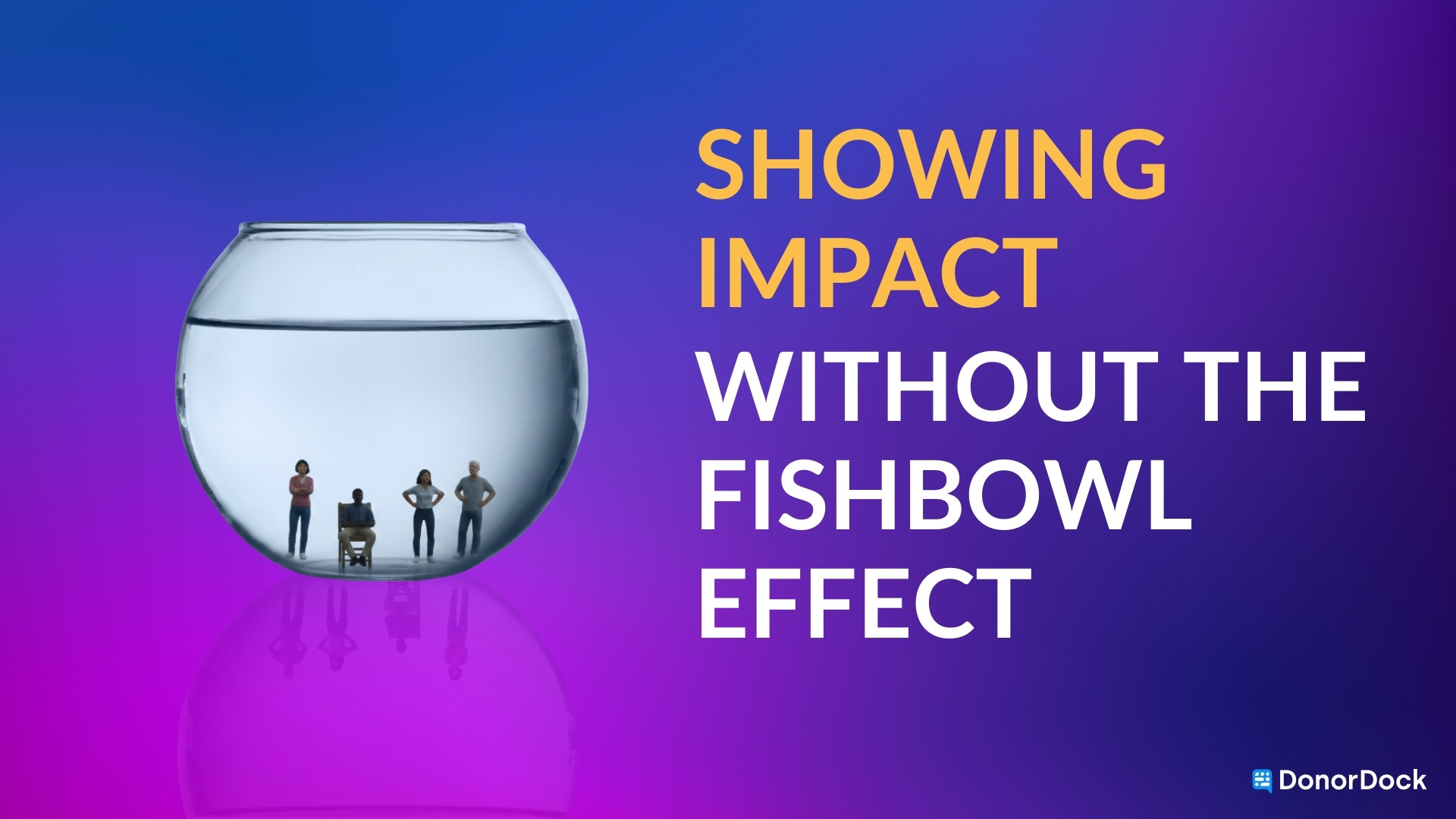
You want donors to see the impact. You also know that lining them up to watch program participants can feel like putting your community in a glass tank. That tension is exactly what people mean by the “fishbowl effect.”
Community-Centric Fundraising has been calling this out for years. It urges fundraisers to prioritize the whole community, share power, and move away from treating people as props for philanthropy. At the same time, trauma informed care reminds us that any environment built around people with lived experience of trauma has to lead with safety, trust, choice, and empowerment.
So how do you actually do both?
How do you invite donors closer without turning your work into a show?
In this article, we walk through a trauma informed, community centric way to:
- Explain the fishbowl problem.
- Reframe what donors really want to “see.”
- Design concrete alternatives to fishbowl visits, even with a lean team.
- Set clear, kind boundaries with donors and boards.
And, because this is DonorDock, we will keep it practical and CRM friendly so you can actually sustain it.
What is the fishbowl effect in donor engagement, really?
The “fishbowl effect” shows up when:
- Donors are invited to stand in the corner and watch a class, support group, or intake process.
- Participants are expected to share intimate stories on command.
- The unspoken message is, “Look at them” instead of “Stand with us.”
Fundraisers and program staff often describe this as feeling like poverty tourism or savior theater. Community centric fundraising voices have pushed back on these patterns for years, arguing that fundraising should be grounded in equity and social justice and that we should treat our work holistically, not as one off emotional transactions.
From a trauma informed lens, fishbowl moments can violate several core principles at once:
- Safety - participants may feel emotionally or physically unsafe being watched.
- Trust and transparency - they may not fully understand who is in the room or why.
- Choice - they often are not given a real option to say no.
- Collaboration and empowerment - power is tilted heavily toward donors and staff.
Put simply:
No participant owes their story, face, or presence to your fundraising goals.
Do donors need to see impact? Absolutely.
Do they need a front row seat to someone’s hardest moment? They do not.
The good news is that donors usually want something much more reasonable:
- To understand what you do.
- To know their gifts matter.
- To feel connected to the story.
You can give them all of that without putting anyone in a fishbowl.
How does a trauma informed approach change the way you host donors?
Trauma informed care is often explained through a set of guiding principles: safety, trustworthiness, choice, collaboration, empowerment, and cultural awareness. Those principles were developed in health and human services, but they translate surprisingly well into donor engagement.
If we apply them to tours, meetings, and “come see the work” moments, we get a very different playbook.
1. Start with participant safety, not donor expectations
Ask these questions first, before you say yes to a visit:
- Will this make participants feel watched, evaluated, or exposed?
- Could this re trigger trauma or shame for anyone in the room?
- Are there ways to show this work without having donors present during live services?
If the answer is “I am not sure,” that is a signal to slow down.
2. Make transparency and consent non negotiable
Trauma informed organizations emphasize clear expectations and shared decision making, so people are not surprised by who shows up or what is being asked of them.
In practice, that can look like:
- Informing participants if visitors will be on site, and why.
- Giving them real options: opt out, be present but not engaged, or actively participate.
- Making sure “no” does not come with consequences for services or relationships.
3. Share power in how stories are told
Community Centric Fundraising pushes us to center community voices and recognize historical trauma and power imbalances.
So instead of, “We need a heart wrenching story for this event,” try:
- Inviting alumni or leaders with lived experience to speak, with paid honoraria and clear guardrails.
- Using pre recorded audio or video where storytellers had time to prepare and consent.
- Allowing people to review how their story will be framed before it is shared.
4. Design donor touchpoints as part of a Relationship Loop
At DonorDock, we talk about the Relationship Loop as a simple cycle: notice, thank, update, invite.
A trauma informed version of that loop asks:
- Does this thank you respect the dignity of everyone involved?
- Does this update show impact without overexposing anyone?
- Does this invitation share power and choice?
When you build donor engagement into a loop like that, you rely less on flashy, one off, fishbowl visits and more on consistent, high trust communication.
What are practical ways to show impact without putting people on display?
Here is the fun part. Once you release the idea that “impact” equals “watching live programs,” you suddenly have a lot of creative options that work on a growing fundraising team.
Let me walk through a few categories you can mix and match.
1. Staff led impact stories
Instead of taking donors into a classroom, bring the classroom to them through your team.
Ideas:
- A “day in the life” panel with program staff, case managers, or teaching artists.
- Short videos recorded on phones, stitched into a 3 minute highlight reel.
- A newsletter series where each issue features one staff voice and one small win.
Our article Lead With Why: How Story Beats Stats in Today’s Donor Decisions breaks down how to shape these stories so donors feel the impact without needing a front row seat to a crisis.
2. Alumni and peer led storytelling on their terms
If you work in education, workforce, housing, or recovery, you may have alumni who want to share their experience. Honor that desire, but do it in a way that respects trauma and power.
A trauma informed, community centric approach might include:
- Paying alumni stipends for speaking or content creation.
- Co creating talking points so they control what they share.
- Offering options: live storytelling, pre recorded video, written Q&A, or anonymous quotes.
You can also give alumni veto power over where and how their story is used. That directly aligns with empowerment and choice principles in trauma informed care.
3. Environment and systems stories
Sometimes the most powerful impact stories are not about people at all, at least not directly.
Show donors:
- Before and after photos of spaces you have renovated or made safer.
- Maps of how services expanded across a neighborhood.
- Process diagrams: “Here is what used to happen when someone called us, here is what happens now.”
This type of storytelling helps donors see how their gift changed conditions, not just moments. It also sidesteps the pressure on individual participants to perform their pain.
4. Micro reporting instead of mega reports
If you have read Show Donors the Impact (Without a 20 Page Report), you know we are big fans of short, regular updates: one screen, one outcome, one next step.
You can use micro reports to show impact between visits:
- A 3 bullet email and one photo.
- A one page PDF with one stat, one story, and one quote.
- A simple dashboard screenshot that highlights a key change.
What matters is the rhythm. Donors are more likely to keep giving when they are thanked quickly, see impact, and feel known, not just blasted with appeals.
5. Simulations and role plays that do not involve real clients
If you want donors to feel a challenge in their bodies, not just their heads, you can design low risk simulations.
Examples:
- Walking donors step by step through the paperwork, bus routes, or phone trees a client has to navigate.
- Giving donors a fictional case file and asking them to make choices with limited resources.
- Running a mini “budget game” that shows trade offs your community faces.
These experiences help donors empathize with your work while keeping real people out of the spotlight.
How do you set boundaries with donors and boards without losing support?
This is where it gets real. You might be thinking, “I get all of this, but my board chair still wants to sit in the classroom.”
You are not alone. Many organizations are in the middle of shifting from donor centric to more community centric practices. Research on the Community Centric Fundraising movement shows that adoption is growing, but it often requires internal culture change and clear communication with stakeholders.
Here are some practical moves.
1. Put your values in writing
Create a short “dignity and storytelling” or “visitor engagement” policy that covers:
- When visitors are welcome in program spaces, and when they are not.
- How you handle consent, anonymity, and compensation for storytellers.
- What types of images and stories you will never use.
Then, use your CRM to make this real. In DonorDock, you can:
- Tag stories with consent type and expiration dates.
- Log which donors have seen which stories or reports.
- Track visits, so every engagement is part of a plan, not a one off scramble.
2. Script your “yes, and” and “no”
When someone asks for a fishbowl style visit, you do not have to improvise.
A “yes, and” might sound like:
“We love that you want to see the impact. To protect participants, we do not host visitors during live sessions. Instead, we can offer a staff led walkthrough, a story panel, and a short video that shows the program in action.”
A firm but kind “no” might be:
“Our participants have asked us not to have outside observers in the room, and we take that seriously. To honor their dignity, we have shifted to other ways of showing impact. Here is what that looks like.”
The more you practice these phrases, the more confident you will feel using them with donors, board members, and partners.
3. Use focus to protect your team’s capacity
You do not have time to say yes to every creative idea. That is why we talk about the “ruthless elimination of more” in articles like “We Don’t Have Capacity for Stewardship.” Or Do You?.
Give yourself permission to:
- Choose 2 or 3 impact formats you can sustain.
- Say, “This is how we show impact here,” and stick to it.
- Use your CRM to keep that rhythm visible so it does not live in your brain alone.
That is how you get out of reactive mode and into a community centric stewardship rhythm that actually fits your team.
Bringing it together: impact and dignity
You do not have to pick between donors and participants. You really do not.
When you:
- Lead with trauma informed principles like safety, choice, and collaboration.
- Let community centric values challenge fishbowl habits.
- Offer creative, staff led and alumni led ways for donors to see impact.
- Put your boundaries in writing and back them up with simple systems.
You build relationships that are deeper, more honest, and more sustainable.
DonorDock was built for small and growing fundraisers who want to cut through the noise and focus on what matters most. If you are ready to rethink how you show impact, schedule a demo to see how DonorDock can track consent, visits, and impact touchpoints so you can host donors in ways that honor the people you serve.