
Donor cultivation is the two-way work of building trust before you ask. Donors and funders say yes to relationships they understand, on timelines they control. Run cultivation as months of low-stakes, values-led contact your whole team can see, and the ask stops feeling like a leap.
You've probably lived some version of this. A promising new program, a polished proposal, a funder who looked like a natural fit. You hit send, and then nothing. Meanwhile, the organization across town lands a multi-year partnership with a funder they've been having coffee with since spring.
The difference usually isn't the proposal. It's donor cultivation: the months of conversation, curiosity, and quiet moments of trust that come before any ask. This article makes the case for treating cultivation as a long game, looks at what the research says about why people give, and shows how a growing development team can run cultivation as a shared system instead of one person's memory.
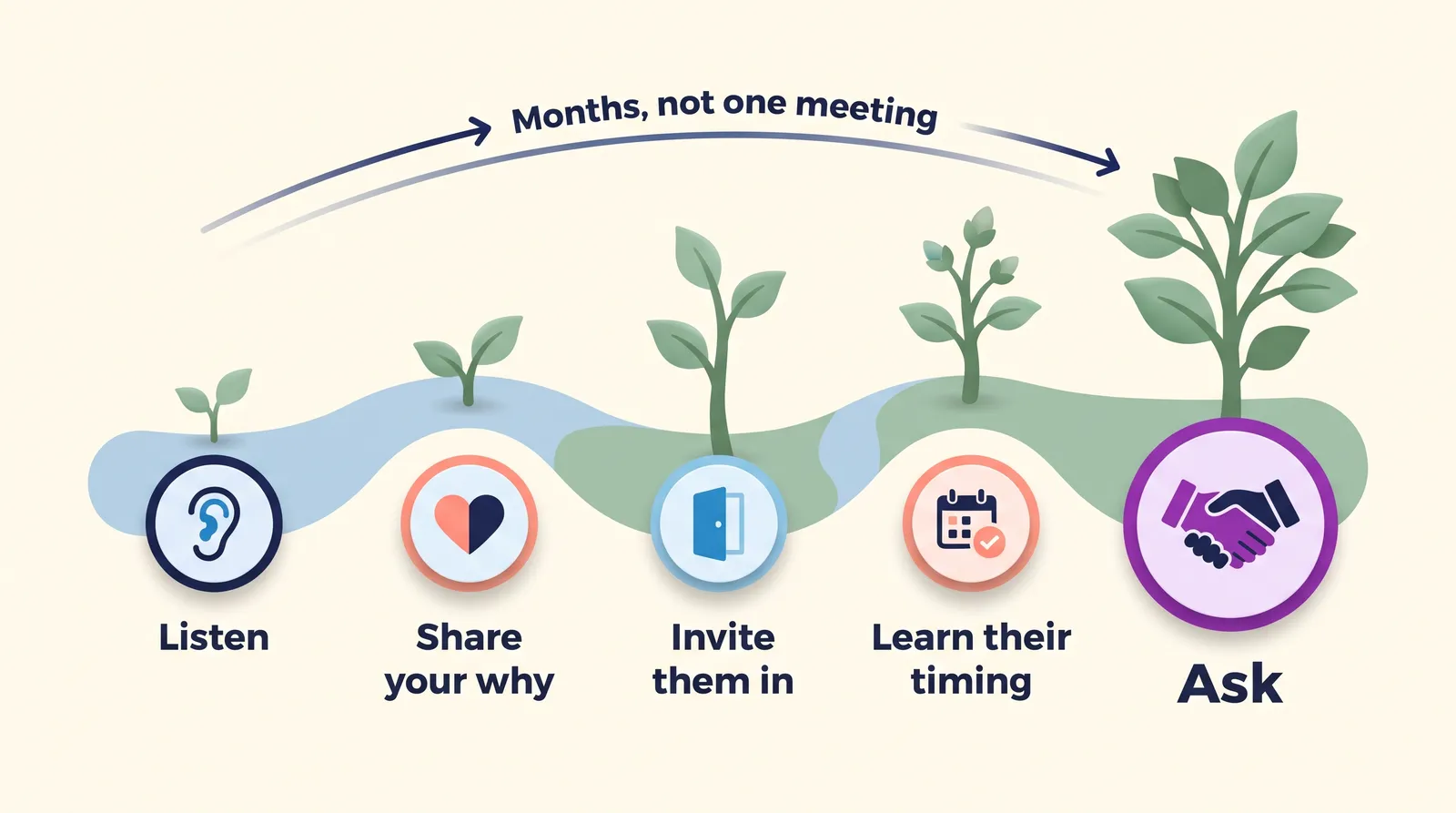
The short version: cultivation works when it's patient, two-way, and organized. You share your why, invite people into the work, listen for their timing, and ask when the relationship and their calendar line up. Most failed asks aren't bad asks. They're early ones.
What is donor cultivation, really?
Donor cultivation is everything that happens between a first real connection and a meaningful ask. For a prospective donor, that might be a tour, a lunch, a few personal updates, and a conversation about what they care about. For an institutional partner, like a foundation, a school district, or a hospital's community-benefit office, it's the slow process of learning how they make decisions and helping them understand what you do.
The common mistake is treating cultivation as a warm-up act, a series of touches designed to soften someone up before the pitch. People can feel that. Real cultivation runs in both directions. They're deciding whether your mission deserves their trust. You're learning whether they're a genuine fit, what they care about, and when they're actually able to say yes.
Trust is the whole game. In the Give.org 2026 Donor Trust Report, 67.7% of respondents said it is essential to trust a charity before donating, yet only 18.3% reported high trust in charities. Cultivation is how you close that gap with the specific people you hope will fund you.
Cultivation vs. stewardship
Stewardship is what you do after a gift: thanking, reporting impact, and keeping the relationship healthy. Cultivation is what you do before the ask. In practice they form a loop, because good stewardship is the cultivation for the next gift. For the after-the-gift side, our Relationship Loop stewardship framework covers the details.
Why do people give after cultivation instead of after a pitch?
Look at how affluent donors say they choose where to give. In the 2025 Bank of America Study of Philanthropy, produced with the Indiana University Lilly Family School of Philanthropy, the top reason wealthy households give is that they believe in the organization's mission (58%).
How they pick organizations is even more telling. Half (50%) said firsthand experience, meaning they or someone they know benefited from the organization, leads them to choose it over others. Only 11% pointed to a compelling pitch, whether in person, virtually, or through printed materials.
Read that again if you've ever spent a week polishing a pitch deck. Personal connection to the work beats a pitch more than four to one. Belief in a mission doesn't come from a single meeting. It builds when someone sees the work up close, meets the people doing it, and watches you follow through on what you said you'd do.
And individuals still give most of the money. Giving USA 2026 reports that individuals gave $394.2 billion of the $617.2 billion Americans gave to charity in 2025. Most of the dollars your team is pursuing sit with people who decide based on trust and experience, not polish.
Why does donor cultivation take months?
Because the timing isn't yours. Every donor and funder runs on a calendar you don't control.
- Institutional budgets. Public agencies, school districts, and corporate giving programs can only commit money that already exists in a budget line, often once a year.
- Foundation cycles. Board meetings, grant rounds, and strategy refreshes decide when a program officer can actually say yes.
- Household timing. Year-end tax planning, a business sale, a retirement, or a family change can open or close the window for a larger gift.
That's why the best cultivators sound patient. They aren't stalling. They're staying close, being useful, and making sure that when the money is ready to move, your organization is the obvious place for it to go.
With foundations, the relationship is often the only door in. Candid's review of FY2023 tax filings found that only 29% of the 112,733 private foundations it studied don't restrict their giving to preselected charities. Candid notes that more foundations are open to new grantees in practice, but the takeaway holds: with most foundations, a relationship comes before an application.
Relationships also shape how funders experience you once you're in. The Center for Effective Philanthropy's Relationships Matter research (2017), drawing on survey responses from almost 20,000 grantees of 86 foundations, found that a funder's understanding of the grantee and the funder's transparency are the two strongest drivers of a strong funder-grantee relationship. Funders don't come to understand your work from a PDF. They understand it because you've spent time helping them see it.
What does good donor cultivation look like week to week?
Good cultivation is rarely dramatic. It's a handful of intentional moves repeated over months. These four matter most.
1. Lead with your why
Share the thinking behind your work, not just the results. Why do you run the program the way you do? What did you learn from the participants who struggled? A prospect who understands your philosophy can defend you to their board or their spouse. A prospect who has only seen a budget can't.
2. Invite them into the work
Since personal connection drives so many giving decisions, bring prospects as close to the work as you can. You can't make every prospect a beneficiary, but you can build real ways in: a site visit, a seat at a graduation, a short call with a program lead. Keep these low-pressure. The goal is for them to see the work, not to hear another ask.
3. Listen for their timing
Every conversation should teach you something about when and how they decide. When does their fiscal year start? Who else weighs in? Is there a board meeting, a budget cycle, or a life event that changes what's possible?
Write it down. Timing is the most valuable thing you'll learn during cultivation, and the easiest to forget.
4. Let the relationship carry the hard-to-count outcomes
Some of the most important things nonprofits produce, like confidence, belonging, or a renewed sense of hope, don't fit neatly in a grant report. Cultivation is where those outcomes become believable. Months of stories, visits, and honest updates do what a single metric can't. Our piece on fundraising around intangible outcomes goes deeper on this.
If you want a week-by-week rhythm for these moves, our 30-day cadence for development teams breaks it down. And if an institutional partner has already told you "not now," keeping funding partners warm in uncertain times is a useful companion.
How do you know a relationship is ready for the ask?
Asking too early is one of the most expensive mistakes in fundraising, because it can end a relationship that was going well. The same Bank of America study found that 77% of affluent households kept giving to every organization they supported. Among those who did stop giving to an organization, the most common reason (25%) was too many requests, or requests that came too close together.
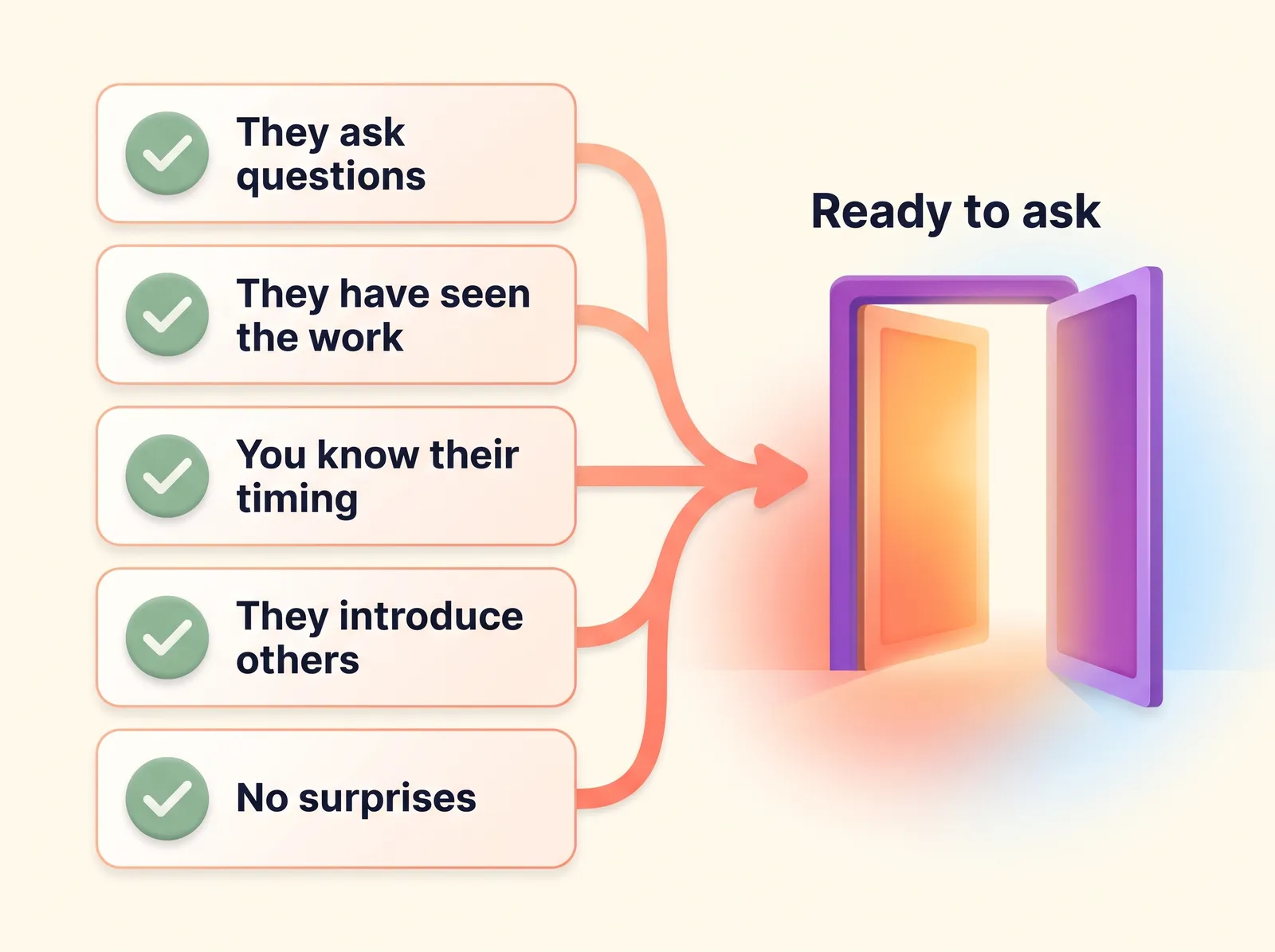
So instead of asking on a schedule, watch for signals. A relationship is usually ready when:
- They ask you questions. Curiosity about how the program works, what it costs, or what's next means they're picturing themselves in it.
- They've seen the work firsthand. A visit, an event, or a conversation with someone you serve has given them their own story to tell.
- You know their timing. You understand when they decide, who's involved, and when funds are realistically available.
- They bring other people in. An introduction to a colleague, a spouse, or a board member is a strong sign of trust.
- The ask feels like the next sentence. When your request surprises no one, you've cultivated well.
None of these require a script. They require attention, and a reliable place to record what you notice. And if a conversation turns tense along the way, our guide to handling difficult conversations with donors walks through exactly what to say.
Why does donor cultivation need to be a team system?
Here's the uncomfortable truth: cultivation usually lives in one person's head, inbox, and calendar. That works until that person gets busy, takes a new job, or forgets to circle back after a funder's budget meeting. Then months of trust quietly evaporate.
The stakes compound over time. The Fundraising Effectiveness Project reports that 18.9% of new donors gave again in 2025, compared with 59.3% of repeat donors. Relationships that make it past the first gift become far more durable. Cultivation is how you get people there, and it can't depend on any one person's memory.
Running cultivation as a team system comes down to three habits:
- Log every meaningful touch. Record who you talked to, what you learned (especially about timing), and what happens next.
- Let everyone with relationships cultivate. Executive directors, program staff, and board members all hold connections. A relationship mapping workflow for your board shows how to put those connections to work.
- Review the pipeline on a steady rhythm. A short weekly review keeps any relationship from going quiet by accident. Building a donor pipeline that lasts covers that habit.
This is where your CRM earns its keep. In DonorDock, Ask Boards track each major-gift opportunity through stages in a shared pipeline, so your whole team can see which opportunities are ready, which have stalled, and where a visit is due. You can watch a quick Ask Board walkthrough to see how it works. Smart Nudges then surface time-sensitive moments, like a lapsing giving pattern or an upcoming anniversary, so an important relationship doesn't drift while everyone is buried in year-end.
For the step-by-step version of moving prospects from first meeting to commitment, our guide to the moves management process lays it out. As those relationships grow into larger gifts, building an effective major donors program is the natural next step, and you can see how DonorDock supports major gift management for growing nonprofits.
Where to start this week
You don't need a new program to cultivate better. Pick three relationships that matter for the coming year. For each one, write down what you know about their why, their timing, and the last time they saw your work in person. Then plan one low-pressure invitation for each before the month is out.
Cultivation will always feel slower than sending a proposal. But the slow work is what makes the fast yes possible. If your team is ready to run cultivation as a shared system instead of a memory test, see how DonorDock helps growing development teams do it.