A donor giving anniversary is the yearly date of a donor's first gift, or of a monthly donor's first payment. To use it well, choose the date that counts, pull a list each month, match the touch to the donor, share what their giving made possible, and skip the ask.
Think about a donor who made her first gift on a Tuesday in April three years ago. Since then she's heard from you at year-end, at spring appeal time, and whenever there's a campaign. Every one of those messages wanted something.
Now picture a short note arriving this April instead. It mentions the date she first gave, tells her one specific thing her giving helped make happen, and doesn't ask for a thing.
That's a giving anniversary touch, sometimes called a "giftiversary." It's one of the easiest stewardship habits a development team can build, and one of the most commonly skipped, because nobody owns the date. This guide gives you a six-step plan to run giving anniversaries every month, plus copy-ready templates for email, text, cards, and calls.
What is a donor giving anniversary?
A giving anniversary is the yearly return of a meaningful date in a donor's relationship with you. Most teams use one of three dates:
- First gift date. The day the donor first gave to your organization. This is the default, and the most meaningful for most donors.
- Monthly start date. The day a recurring donor's first monthly payment went through. For sustainers, this matters more than their first one-time gift.
- Milestone gift date. The day a donor made their first major gift or joined a giving society. Useful for your top tier.
Whichever you choose, the anniversary is a stewardship moment, not a solicitation. It sits inside your broader donor stewardship plan as one of the touches that gives gratitude and proof instead of making a request.
Why do giving anniversaries help with retention?
Because the first anniversary lands right when a donor is deciding whether to stay.
M+R's 2026 Benchmarks found that online new donor retention was just 24%, which means about three in four new online donors didn't give again the following year. Monthly donors are steadier but not immune: 10% stop within two months of signing up, and after a full year only 71% are still giving. The 12-month mark is a real checkpoint for both groups, and your second-gift conversion rate lives or dies in that window.
The anniversary also gives you a reason to reach out that isn't an ask. In the 2025 Bank of America Study of Philanthropy, the most common reason affluent households gave for dropping a charity was too many requests, or requests too close together. A quarter of affluent households that stopped supporting an organization said so.
One caution before you start: a gesture on its own isn't magic. In a large field experiment with 500,000 new donors, researchers Anya Samek and Chuck Longfield found that thank-you calls had no measurable effect on retention, even though fundraising professionals predicted an 80% lift. What you say matters more than the fact that you reached out.
Donors back that up. In the same Bank of America study, more affluent donors said it was at least somewhat important to hear the specific impact of their gift (64%) than to receive a thank-you note (57%). So the six steps below are built around one idea: an anniversary touch should show the donor what their giving did.
How do you run a giving anniversary program?
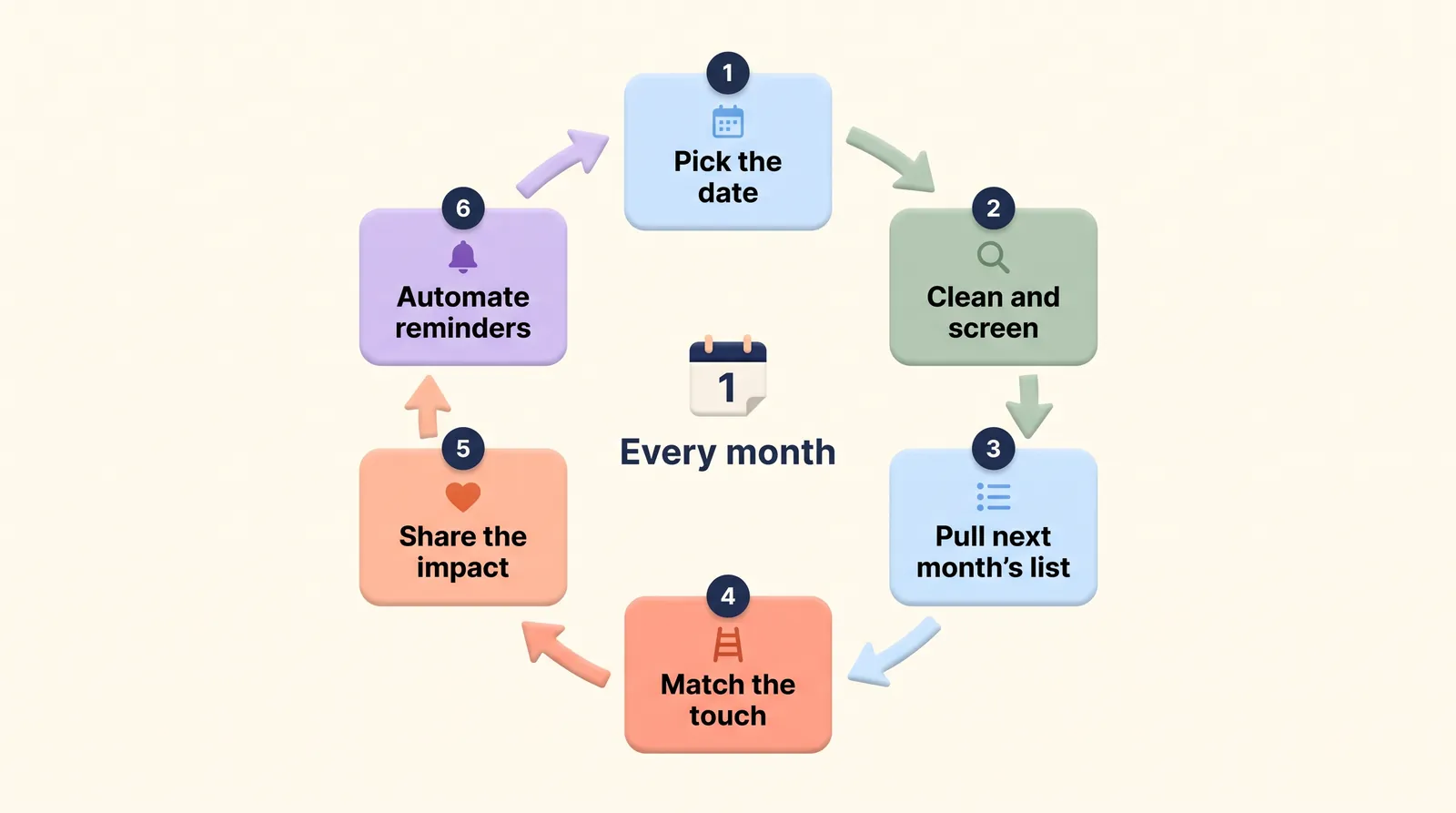
Here's the whole system. Set it up once, then run it in about an hour a month.
Step 1: Decide which date counts
Pick one rule per donor type and write it down so everyone on your team uses the same one. Here's a version that works for most teams:
- Monthly donors: use the date their first recurring payment cleared.
- Major donors and giving society members: use their first major gift date, and mention their first-ever gift in the message.
- Everyone else: use their first gift date.
Step 2: Clean the dates and screen sensitive gifts
Before anything goes out, check two things.
First, confirm that first gift dates are real. If your organization switched databases, some records may show the import date instead of the original gift date. Spot-check a handful of long-time donors you know well.
Second, screen out gifts where an anniversary could hurt. A memorial or tribute gift may mark the date someone died. Flag those donors for a softer message, or skip the anniversary entirely, and exclude any deceased contacts. This one step prevents the most painful mistake a giving anniversary program can make.
Step 3: Pull next month's list on the same day every month
On the first Monday of each month, run a report of every donor whose anniversary date falls in the following month. Pulling a month ahead gives you time to write cards and schedule calls instead of scrambling.
Add one more filter: anyone who made a gift or got a personal touch in the last two weeks. If you just thanked them for a year-end gift, an anniversary note five days later feels automated, even when it isn't.
Step 4: Match the touch to the donor
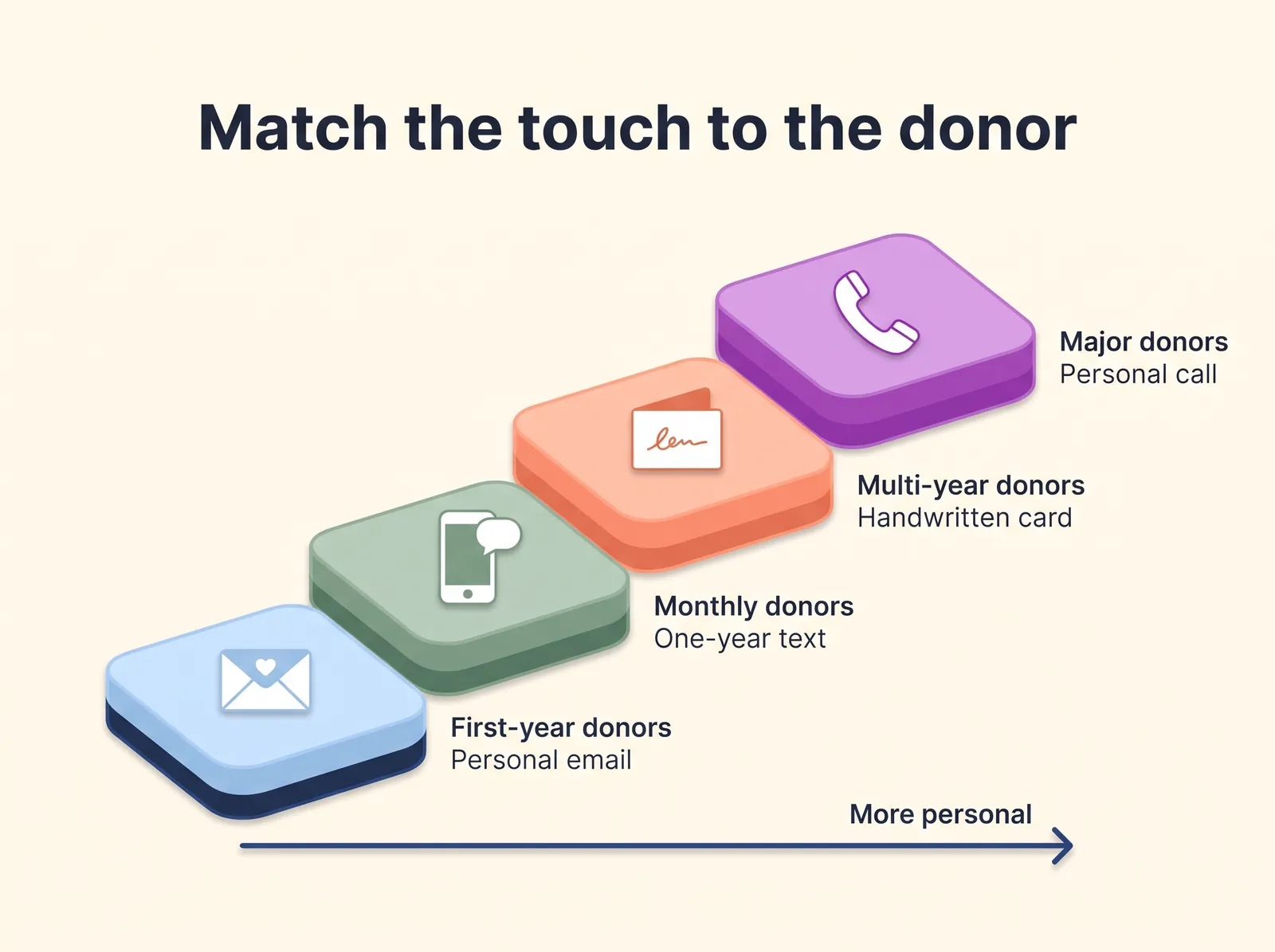
Not every donor needs a handwritten card, and your team can't write 400 of them. Match effort to the relationship, using the same tiers from your stewardship plan:
- First-year donors: a short, personal email on their first anniversary, signed by a real person. This is the group most likely to lapse, so it's where the touch earns the most.
- Monthly donors: a quick text or email on their one-year sustainer anniversary that names what twelve months of giving added up to.
- Loyal multi-year donors: a handwritten card on milestone years, like the 3rd, 5th, or 10th.
- Major donors: a personal call or short voicemail from someone who knows them, followed by a card.
Step 5: Write a message that shows impact, not an ask
Every strong anniversary message has four parts:
- The date. "One year ago this week, you made your first gift."
- One specific result. Not "you made a difference," but what actually happened, in plain numbers or a short story.
- A personal detail. Something from their record: the program they chose, an event they attended, a note they wrote with their gift.
- A soft close. A thank-you, an invitation to reply, or an offer to see the work. No donation link.
Keep it short. The templates below run 40 to 90 words, and that's plenty.
Step 6: Automate the reminder, keep the message personal
The part that should be automated is remembering. The part that shouldn't be automated is the message itself.
In DonorDock, Smart Nudges surface giving anniversaries and birthdays as suggested actions in your Action Board, so the right person sees the right donor on the right day without anyone keeping a spreadsheet. Your team then writes the note, makes the call, or adds a personal line to a template before it goes out.
For first-year donors, pair the anniversary with a welcome series built in Stewardship Journeys, so the anniversary isn't the first thing they've heard from you since their receipt.
Giving anniversary templates you can copy
Use these as starting points. Swap in your real results and your own voice. Brackets mark the parts to personalize.
First-year donor email
Subject: One year ago this week
"Hi [First name], one year ago this week you made your first gift to [Organization]. I wanted to tell you what happened next. This year, [specific result, e.g., 140 students finished our after-school reading program, and 9 in 10 moved up a reading level]. You were part of that. Thank you for taking a chance on us a year ago. If you ever want to see the program in person, just reply and I'll set it up. [Your name]"
Monthly donor text
"Hi [First name], it's [Your name] at [Organization]. Today marks one year since you started giving monthly. Your 12 gifts helped [specific result]. Thank you for showing up every single month. No reply needed, just wanted you to know."
Multi-year donor card
"[First name], five years ago this month you made your first gift to [Organization]. Since then, [one specific change over those years]. Donors like you, who stay with us year after year, are the reason we can plan ahead instead of scrambling. Thank you for five years. [Handwritten signature]"
Major donor call or voicemail
"Hi [First name], it's [Your name] from [Organization]. No ask today, I promise. I noticed it's been [number] years since your first gift, and I wanted to say thank you and share one quick thing: [one specific result tied to their giving]. I'd love to hear what's on your mind about the work whenever you have a few minutes. Have a great week."
Need more inspiration for the thank-you itself? Our donor thank-you cheat sheet walks through what makes a thank-you land.
Where do birthdays fit?
Birthdays can be a warm touch, but only when the donor shared the date with you. A birthday message from an organization that wasn't told the date feels like surveillance, not gratitude.
If you'd like to celebrate birthdays, ask. Add an optional birthday field to your donation form or welcome survey, or simply ask donors how they want to be thanked. Then keep birthday messages light: a short email or card, with no mention of giving at all.
Can you celebrate board and volunteer anniversaries too?
Yes, and you should. Board members and volunteers give you their time and expertise, and they hear "thank you" even less often than donors do.
Track the date each board member joined and each volunteer's first shift. On those anniversaries, a handwritten note from the executive director or board chair goes a long way. Small, personal gestures work better than expensive ones: a note that names a specific contribution, a coffee, or a public shout-out at the next board meeting.
What should you measure?
Keep it to three numbers, reviewed once a quarter:
- Second-gift rate for first-year donors who received an anniversary touch, compared with the same group last year.
- Sustainer retention past month 12 for monthly donors who got a one-year message.
- Reply rate. How many donors wrote back, called, or asked to visit? Replies are a sign the relationship is growing.
Give it a full year before you judge results. Each donor has only one anniversary a year, so the data builds slowly. For more ways to keep monthly donors engaged between anniversaries, see our donor appreciation guide, and read why recurring donors deserve their own plan.
Start with next month's list
You don't need a perfect system to begin. This week, pull every donor whose first gift anniversary falls next month. Screen out memorial gifts. Pick the ten who matter most and write them a short note that tells them one thing their giving did.
That's Smart Stewardship in its most basic form: the right touch, at the right moment, with something real to say. It's also one of the most direct ways to improve donor retention without adding another appeal to the calendar.
Want the reminders to show up on their own? See how DonorDock works for growing development teams.