
Fundraising event ROI is what an event raises after every cost is counted, including staff and volunteer hours. An event is worth it when that number beats what the same hours would raise elsewhere, and when the people it brings in give again.
It's January, and the planning meeting for the spring event is already on the calendar. Someone pulls up last year's numbers: $40,000 raised, $14,000 in costs. Everyone nods. Another success.
Then a question comes up. How many hours did it take?
Nobody knows, because nobody tracked them. But your development team remembers. They remember the March evenings spent chasing sponsors, the week the venue changed, and the follow-up list that never quite got finished.
Measuring fundraising event true ROI means counting those hours. This article walks through how to calculate an event's real return, why night-of revenue tells only half the story, three ways to run an event that change the math, and a five-step annual review that tells you whether to keep, fix, or retire it.
What does a fundraising event really cost?
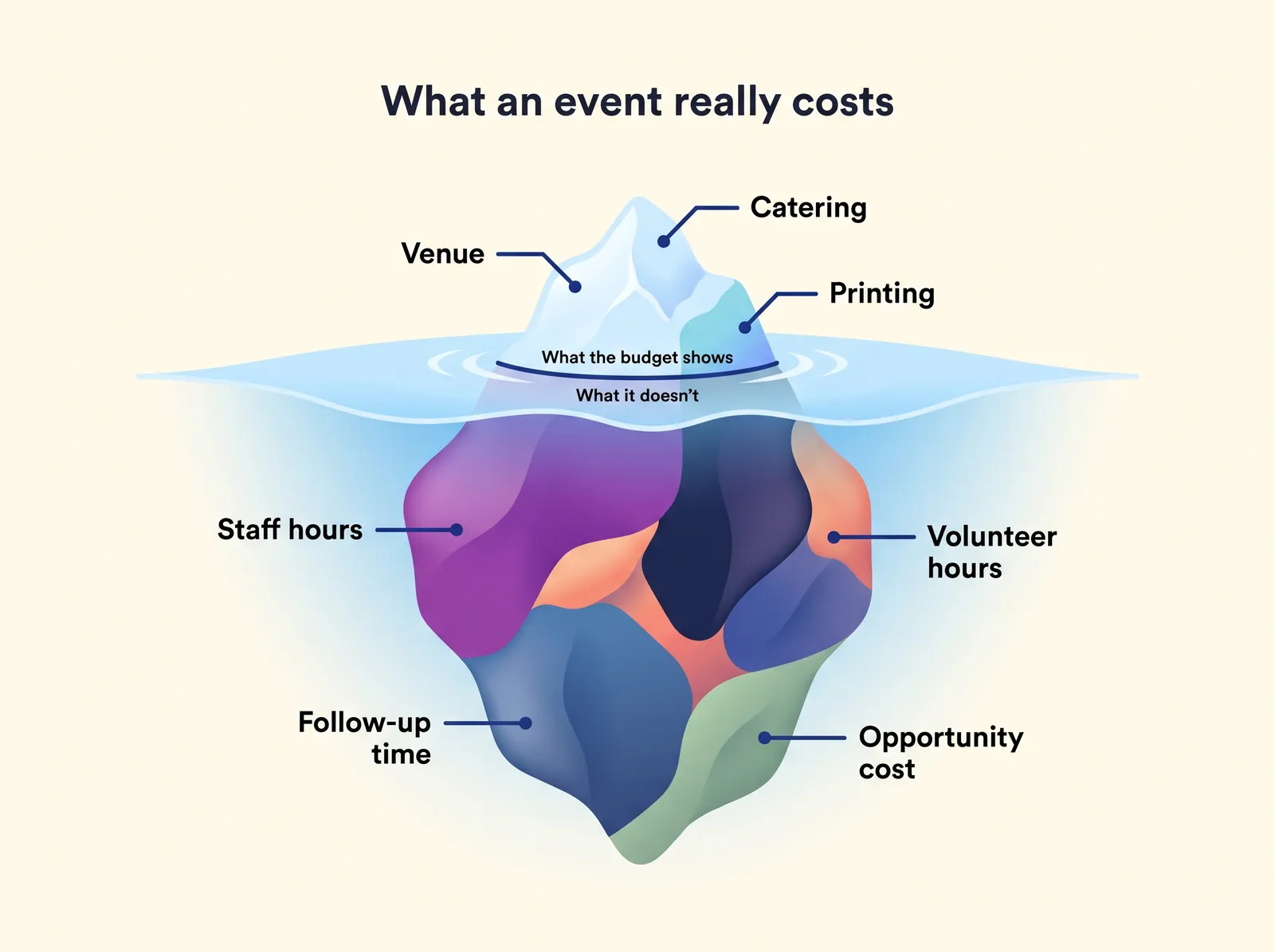
Most event budgets count what shows up on an invoice: venue, catering, rentals, printing, permits, insurance. Those are real costs, but they're the easy ones.
The costs that decide whether an event is worth it usually sit below the waterline:
- Staff hours. Planning, sponsor outreach, logistics, day-of work, and cleanup. For example, three staff members might each put in 100 hours on a mid-sized event.
- Volunteer hours. You don't pay volunteers, but their time is finite. Independent Sector estimates the national value of a volunteer hour at $36.14.
- Follow-up time. Thank-yous, data entry, and post-event outreach. This is the work that turns guests into donors, and it's the first thing cut when everyone is exhausted.
- Opportunity cost. Every hour spent on table linens is an hour not spent on a donor visit, a grant report, or a stewardship call.
The Urban Institute's 2025 National Survey of Nonprofit Trends and Impacts found that 46% of nonprofits with paid staff had job vacancies, and 72% of staffed nonprofits said vacancies hurt their ability to pursue their mission. If your team is already stretched, hours are your scarcest resource, not dollars.
How do you calculate the ROI of a fundraising event?
Start with a fully loaded cost. Add your hard costs, your staff hours at a loaded hourly rate, and your volunteer hours at the Independent Sector rate. Then compare that total to what the event raised.
Here's how the spring event from our opening scenario looks when you count everything:
- Gross revenue: $40,000
- Hard costs: $14,000
- Staff time: 300 hours at a loaded rate of $40 an hour, or $12,000
- Volunteer time: 50 volunteers working 5 hours each, or 250 hours at $36.14, about $9,035
- Fully loaded cost: about $35,035
On the invoice-only view, the event netted $26,000 and cost 35 cents to raise each dollar. On the fully loaded view, it netted about $4,965 and cost roughly 88 cents per dollar.
Same event. Very different decision.
A few numbers are worth calculating every time:
- Net revenue after time. Gross revenue minus the fully loaded cost.
- Cost per dollar raised. Fully loaded cost divided by gross revenue.
- Net revenue per staff hour. Net revenue after hard costs, divided by staff hours. This is the number to compare against your other channels.
One note on the books: most volunteer time isn't a cash expense, and you shouldn't record it as one (specialized professional services are the exception). This is a decision view, not an accounting view. For the accounting side, see how to track an event's net revenue in your books.
What is a good cost to raise a dollar for an event?
There's no single official benchmark for events. The most common guardrail comes from the BBB Wise Giving Alliance, whose accountability standards ask charities to spend no more than 35 percent of related contributions on fundraising overall.
Events almost always run more expensive than other channels, and that's okay if they do something other channels can't. The more useful comparison is internal. If your events cost 88 cents per dollar and your major gift program costs a fraction of that, the event has to earn its place some other way.
Why does night-of revenue tell only half the story?
Because an event's biggest asset isn't the money raised that night. It's the people who were in the room.
Many of those guests are giving to you for the first time, and first-time donors are fragile. The Fundraising Effectiveness Project found that only 18.9% of new donors gave again in 2025, compared with 59.3% of repeat donors.
Run those numbers on a guest list. If 200 people make their first gift at your event and your follow-up is average, about 38 of them give again next year. If your follow-up is excellent, that number climbs, and so does the event's real return.
That's why every event scorecard should include a 12-month number:
- Second-gift rate. What share of first-time event donors gave again within 12 months?
- Repeat attendee giving. Did returning guests give more, less, or the same as last year?
- Pipeline movement. Did any guests become major gift prospects, sponsors, or volunteers?
An event with modest night-of revenue but a strong second-gift rate can be a better investment than a blockbuster that brings in strangers who never come back. If you don't have a plan for those 12 months yet, start with a post-event follow-up plan.
Judge an event by the relationships it starts, not just the revenue it books.
This is Smart Stewardship applied to events. The event is the first touch, and the return depends on everything that happens after the guests go home. DonorDock's attendee tracking logs event attendance on each donor's profile next to their giving history, so you can actually see which guests came back.
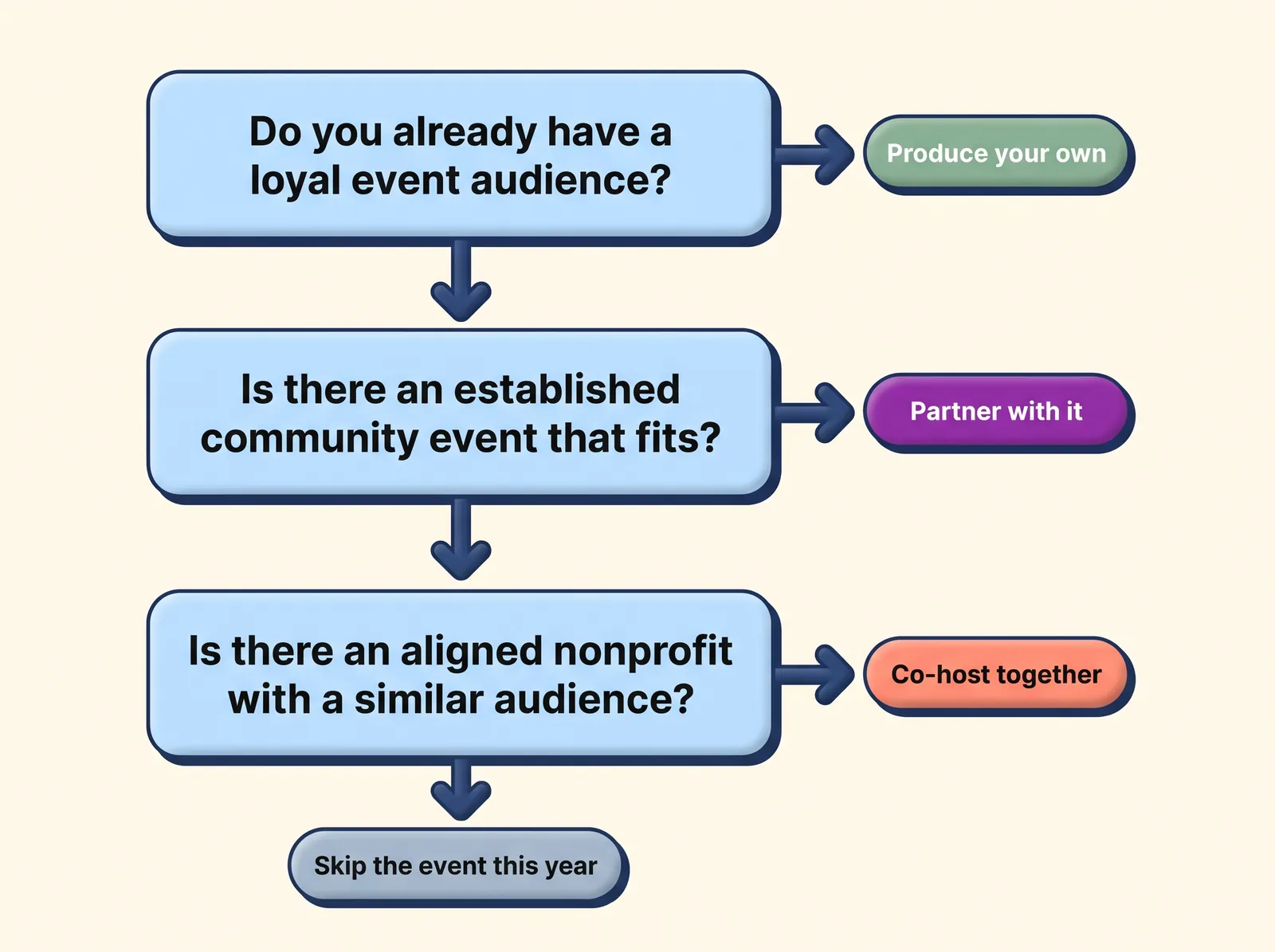
Should you produce your own event, partner, or co-host?
The fastest way to improve an event's ROI isn't to squeeze the catering budget. It's to change who carries the load. There are three basic models.
1. Produce your own event
You own the date, the guest list, the brand, and the revenue. You also own every cost, every permit, and every hour. This model makes sense when you already have a loyal audience and a team with real capacity to spare.
2. Partner with an established community event
Instead of building an audience from scratch, add something valuable to an event that already draws a crowd. Picture a kids' dash at the start of a long-running street fair, or a family activity zone at a local festival. The host brings the audience, the insurance, the permits, and the setup crew. You bring a reason for families to show up early and stay longer.
You give up some control and some revenue. In exchange, your hours drop dramatically and you meet people you'd never reach on your own.
3. Co-host with an aligned nonprofit
Two organizations with overlapping audiences can split costs, staff time, and volunteer shifts, and introduce their supporters to each other. Donors tend to see this as a strength, not a compromise. In the 2025 Bank of America Study of Philanthropy, 62 percent of affluent households said it was at least somewhat important that organizations they give to work collaboratively with other nonprofits.
The key is agreeing up front on how revenue, donor data, and credit get shared. Put it in writing before the first planning meeting.
Why does team energy belong in the ROI math?
Every event runs on people, and people have limits. An event that only one person on your team is excited about will drain everyone else, no matter how good the spreadsheet looks.
Your volunteers deserve special care here. The same Bank of America study found that affluent individuals who volunteered gave nearly three times as much as those who didn't, $13,522 versus $4,950 on average. The people setting up chairs at your event are often among your most generous supporters. Burning them out has a cost that never shows up in the event budget.
So add an energy check to your evaluation:
- Who is asking to lead it? An event a board member champions, with their own network and enthusiasm behind it, is a very different bet than an event staff are dragging forward out of habit.
- Does it match your team's interests? A board member who rides with a weekend cycling club might bring the energy, and the riders, for a community ride. That same board member might quietly dread another dinner.
- Is the timing right? A good idea in a year when your team is short-staffed can become a bad investment. "Not this year" is a legitimate answer.
Energy isn't soft. It shows up in how fast sponsors get confirmed, how many volunteers come back, and whether follow-up actually happens.
How do you decide whether to keep, fix, or retire an event?
Once a year, ideally a few weeks after the event while memories are fresh, run every event through the same five-step review.
- Calculate the fully loaded cost. Hard costs plus staff hours plus volunteer hours. Ask each staff member to estimate their time honestly, and track it in real time next year.
- Calculate cost per dollar and net per staff hour. Compare both to your other channels, not to an industry average.
- Check the 12-month relationship value. Pull the second-gift rate for first-time event donors and note any new prospects or volunteers.
- Score team and board energy. Who wants to lead it next year? Who is quietly hoping it goes away?
- Decide. Keep it if the numbers and the energy both hold up. Fix it if one is weak, often by moving to a partner or co-host model. Retire it if both are weak.
Retiring an event can feel like failure. It isn't. It's a decision to give your team's hours to work that will raise more. If you're weighing what should replace it, look at which events belong in your portfolio before you add anything new.
And keep the scorecard short. A handful of honest numbers beats a dashboard full of vanity metrics. If you want to go further, here are the fundraising KPIs that actually matter.
Start with last year's biggest event
Pick last year's biggest event and run the numbers this week. Ask the people who worked on it how many hours they spent. Add the volunteer hours. Pull the list of first-time donors and see how many gave again.
You may find your event is a quiet star. You may find it's quietly eating the time that should be going to your major gift strategy. Either way, you'll make next year's decision with real numbers instead of a feeling.
If your event data lives in one tool and your donor data in another, that review takes days instead of an hour. DonorDock's event management tools keep ticket sales, attendance, and follow-up in one place, so the numbers are ready when you are. Planning the next one? Start with our event planning checklist, or see how DonorDock works for growing development teams.