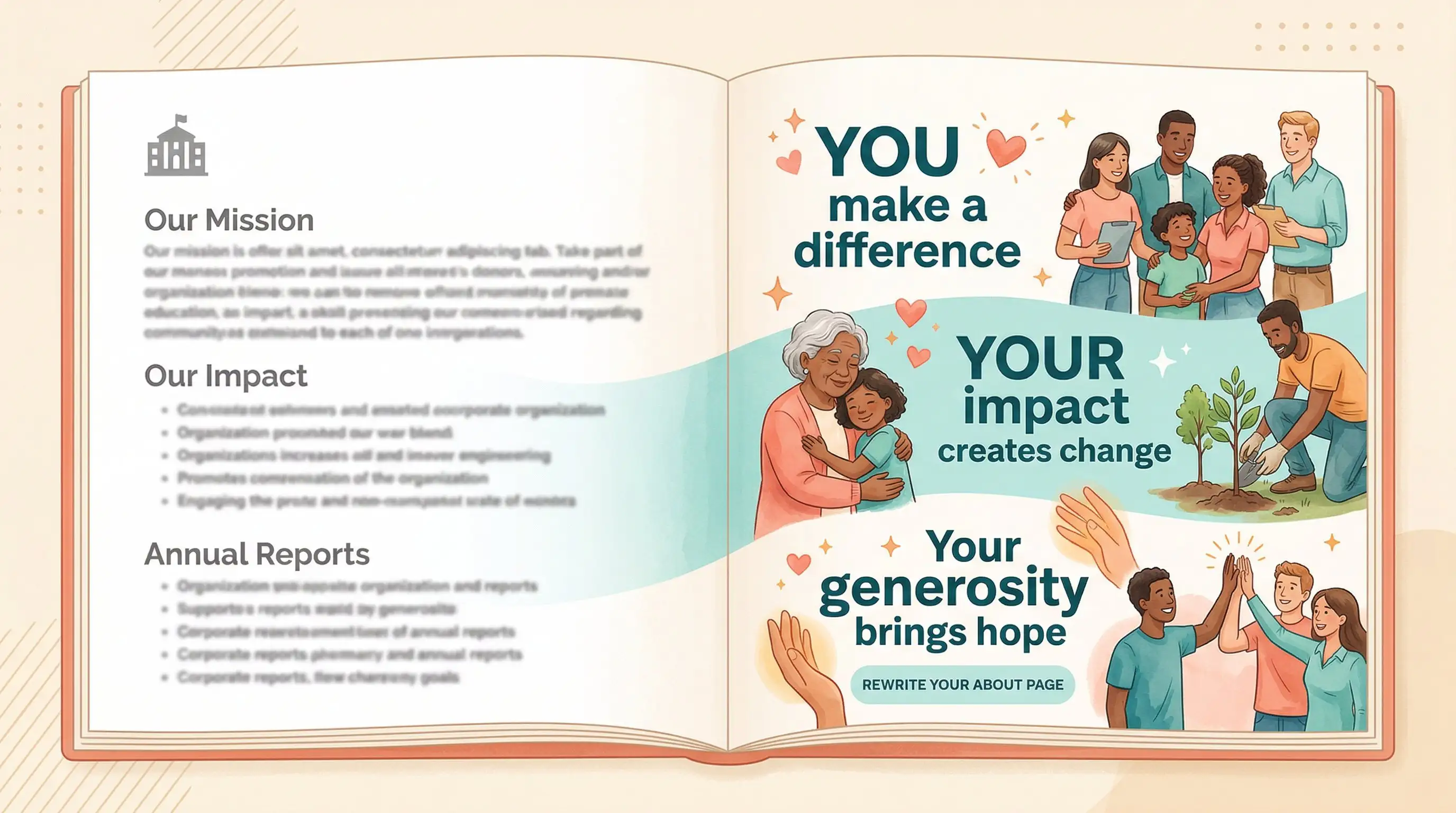
If you want to know how to write a nonprofit about page that actually moves people to action, start by reading the one you have right now. Count how many times the word "we" appears versus the word "you." Most nonprofit about pages read like resumes: we were founded in 2003, we serve 5,000 families, we believe in community transformation. It's all accurate. And it's all pointed in the wrong direction.
The fix is a language shift that takes an afternoon and can fundamentally change how visitors experience your organization. This guide walks you through the exact process of rewriting your about page to position your donors, volunteers, and supporters as the heroes of your story, not the audience watching from the sidelines.
Why "We" Language Pushes Donors Away
There's a reason your "who we are" messaging isn't converting visitors into supporters, and it's probably not your design or your SEO. It's your positioning. When your about page leads with "we," you're unintentionally telling potential supporters that this story is about your organization. And that creates a subtle but real psychological distance.
Donors don't give because they're impressed by your history. They give because they see themselves in your work. They want to feel like their involvement matters, like they're a meaningful part of the change happening in their community. When your about page centers your organization as the hero, it leaves donors in the role of spectators.
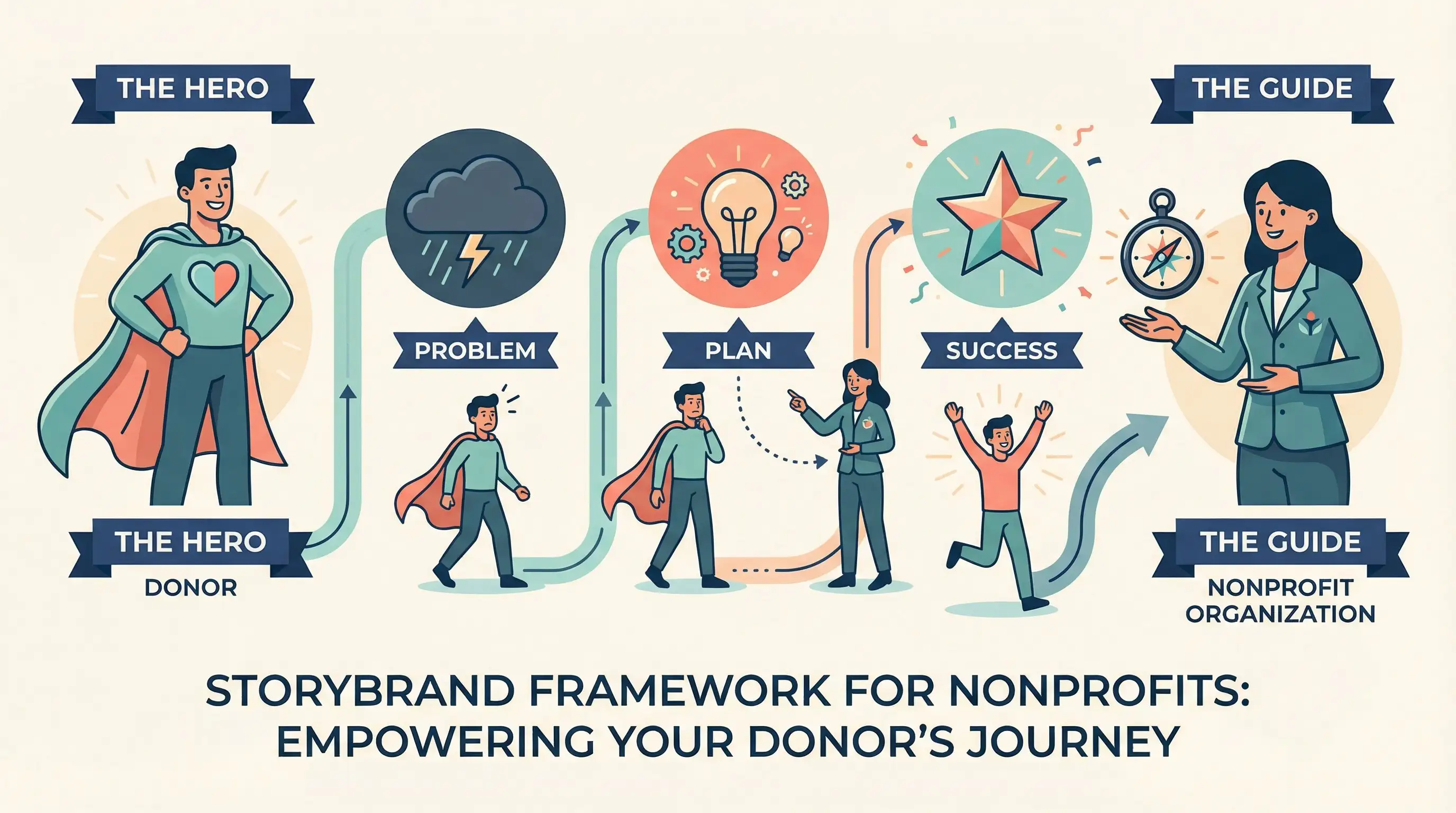
The StoryBrand framework for nonprofits calls this the hero/guide distinction. Your donors are the heroes. Your organization is the guide. The guide has expertise and empathy. The hero has a desire to make a difference. When you flip those roles on your about page, something powerful happens: visitors start to see themselves in the story.
The "You" Language Audit: Step 1
Before you rewrite anything, do a quick audit of your current about page. This takes about 15 minutes and gives you a clear picture of where you stand.
Open your about page in a browser and copy the text into a document. Then do three things:
- Count the pronouns. Highlight every instance of "we," "our," and "us" in one color. Highlight every "you," "your," and "yours" in another. Most nonprofit about pages run at a ratio of 10:1 or higher in favor of "we" language.
- Identify the hero. Read each paragraph and ask: who is the main character in this sentence? If it's your organization in every paragraph, you've found the problem.
- Flag the resume lines. Mark any sentence that reads like an organizational fact sheet: founding date, number served, awards won. These aren't bad, but they need to be reframed through the lens of what they mean for the reader.
This audit alone will show you exactly how much work your about page needs. For most organizations, the answer is: more than you thought, but less than you feared.
Step 2: Identify Who You're Talking To
Here's a question that will shape every word you write: who is the primary audience for your about page? The answer might seem obvious, but it's worth being specific.
Your about page likely gets traffic from three main groups: potential donors researching your organization before giving, community members looking for services, and possible volunteers or partners exploring involvement. You can't write for all three equally. Pick the one that matters most to your goals and write for them first.
For most growing nonprofits, that primary audience is prospective donors. Someone who has heard about your organization, maybe clicked a link from social media or a Google search, and is now trying to answer one question: "Is this organization worth my investment?"
Write your about page to answer that question. Not with facts about yourself, but with a clear picture of what their involvement makes possible.
If your about page currently reads like it was written for a board report or a grant application, that's a sign you're speaking to the wrong audience. Board members and funders have their own channels. Your website's about page is public-facing real estate, and the people landing there are trying to decide whether your mission is worth their time, money, or energy. Speak to them directly.
Step 3: Rewrite With the Hero/Guide Framework
Now comes the actual rewriting. Take each section of your about page and run it through this simple filter: make the donor the subject of the sentence, and make your organization the support system.
Before and After: Mission Statement
Before: "We provide meals and nutrition education to underserved families in the metro area, serving over 3,000 households annually."
After: "Your support puts a nutritious meal on the table for families in our community who need it most. Together with supporters like you, 3,000 households receive meals and nutrition education every year."
Notice what changed. The donor became the subject. The impact became personal. The statistic stayed, but now it's framed as shared accomplishment rather than organizational output.
Before and After: History Section
Before: "Founded in 2008 by a group of concerned parents, our organization has grown from a small food pantry to a comprehensive nutrition services provider."
After: "When you give to [Organization], you're joining a community that started with a handful of parents who refused to let their neighbors go hungry. Since 2008, supporters like you have helped grow that kitchen-table mission into a comprehensive nutrition program that reaches every corner of the metro."
The history is still there. But now the reader is part of it. They're joining something, not reading about something that happened without them.
This reframing works especially well for organizations with deep histories. The longer you've been around, the more your founding story can feel like ancient news to visitors. But when you frame that history as a legacy the reader is being invited to continue, it becomes relevant and personal. Your age becomes a trust signal, not just a timeline bullet point.
Before and After: Impact Section
Before: "Our programs have reduced food insecurity by 40% in our target communities. We also offer cooking classes and garden workshops."
After: "Your generosity is driving real change: food insecurity in the communities you support has dropped 40%. And through cooking classes and garden workshops you help fund, families are eating better and building skills that last."
Step 4: Add a Clear Path Forward
Most nonprofit about pages end with a generic "Learn More" button or, worse, nothing at all. After you've rewritten your content to position the visitor as the hero, give them a clear next step that feels like an invitation, not a demand.
The call to action on your about page should feel natural given everything the visitor just read. If they've just spent two minutes reading about how their involvement makes transformation possible, don't drop them into a generic donation form. Invite them into the next chapter of the story.
Strong about page CTAs sound like:
- "See how your support is making a difference" (links to impact page or stories)
- "Join the community of supporters making this possible" (links to giving page)
- "Get to know the people your generosity helps" (links to stories or program details)
Each of these keeps the donor as the hero. Each one invites rather than demands. And each one creates a natural next step in the relationship.
Step 5: Check Your Work With the "You" Test
Once you've completed your rewrite, run the same pronoun audit from Step 1. Your goal isn't to eliminate "we" entirely. Your organization still needs to show up as a credible, competent guide. But you should see a dramatic shift in the ratio.
Aim for at least a 2:1 ratio of "you" language to "we" language. If you can get closer to 3:1, even better. Read the page out loud and ask yourself: does this sound like we're talking about ourselves, or talking to someone we care about?
A few other things to check in your final pass:
- Does the page answer "why should I care?" in the first two sentences? Visitors decide within seconds whether to keep reading. Lead with what their involvement means, not with your founding date.
- Are your statistics framed as shared wins? "We served 3,000 families" becomes "Together, we reached 3,000 families." Even better: "Your support reached 3,000 families."
- Does every section have a clear emotional through-line? The page should flow from "here's what matters to you" to "here's how you're making it happen" to "here's how to keep going."
Why This Works (And What Happens Next)
Repositioning your about page around "you" language taps into a well-documented psychological principle: people engage more deeply when they see themselves as active participants rather than passive observers.
When your about page makes donors the hero, it does three things. First, it increases time on page because visitors are reading about themselves, not about an organization. Second, it lowers the barrier to giving because the ask feels like a natural extension of the story they're already in. Third, it sets the tone for every other communication you send, because the relationship started with "you matter" instead of "look at us."
If you're using a donor management platform like DonorDock, this about page rewrite pairs well with your broader stewardship approach. When your website language, your email follow-ups, and your donor timeline all reflect the same donor-as-hero positioning, supporters experience a consistent story from first click to long-term partnership.
Once your about page is rewritten, don't stop there. Apply the same "you" language lens to your donation page, your email welcome series, and your event invitations. The organizations that build the strongest donor relationships are the ones that position supporters as heroes consistently, not just on one page.
Your about page is the starting point, but the principle extends everywhere your organization speaks.
This about page exercise is one small change. But it signals something much bigger: that your organization sees donors as partners in a shared mission. And that shift in perspective tends to ripple through everything else you do.