You're staring at your fundraising dashboard, and the numbers look... fine. You wrote 100 grant applications last year. You sent newsletters to 5,000 people. Your donor list grew by 200 names. But here's the uncomfortable truth: none of that tells you if you're actually building a sustainable fundraising program.
Too many small fundraising teams are drowning in metrics that make them feel productive without actually moving the needle. You're tracking everything but understanding nothing. And when you're already wearing 12 different hats, that's not just frustrating. It's exhausting.
The difference between vanity metrics and KPIs that matter isn't just semantic. It's the difference between spinning your wheels and actually retaining donors, growing revenue, and sleeping better at night.
What are vanity metrics and why do they waste your time?
Vanity metrics are numbers that look impressive in reports but don't connect to actual fundraising outcomes. They create the illusion of progress without telling you what's working or what needs to change.
Think about it. You sent 10,000 emails last quarter. Great! But how many of those emails resulted in a second gift from a first-time donor? How many re-engaged a lapsed supporter? If you can't answer those questions, you're tracking activity, not impact.
Here's what vanity metrics often look like in action:
Total number of grants submitted sounds productive until you realize grant approval rates average around 10% nationally. Submitting 100 grants with a shotgun approach might yield 10 approvals. Meanwhile, a focused strategy targeting 30 well-researched, mission-aligned grants could yield 15 approvals.
Total donor count is another culprit. Your database grew by 300 donors last year. Fantastic! Except when you dig deeper and realize nearly 70% of first-time donors never give again. You spent resources acquiring 300 people, but only retained 90. That's a leaky bucket.
Email open rates used to feel like solid data until Apple's Mail Privacy Protection started inflating numbers by preloading tracking pixels. Now that 45% open rate might not mean what you think it does. Are people actually reading? Are they taking action? Open rates alone won't tell you.
The pattern? Vanity metrics measure effort, not effectiveness. They let you say "we did something" without proving that something mattered.
What fundraising KPIs should growing fundraising teams actually track?
Chris Stibbs and his team talk about this firsthand in The Focused Fundraiser. When they sat down for their development retreat, they didn't just set goals. They identified metrics that would actually change their decisions.
Here's what they landed on, and why these KPIs work for lean fundraising teams:
Donor retention rate for donors giving $100 or more
Overall donor retention hovers around 26%, but that number includes one-time Facebook fundraiser donations from people who'll never engage again. Those donors matter, but they skew your data.
Instead, Chris's team filters for donors giving $100 or more. Why? Because these supporters have made a meaningful investment. They're not giving because it's their friend's birthday. They've chosen your mission intentionally.
Retention rates for $100+ donors typically sit closer to 42-47%, depending on donor size. When you track this segment separately, you can spot warning signs earlier. If your $100+ retention drops from 45% to 38%, that's a red flag worth investigating. Maybe your stewardship fell off. Maybe your impact stories got too generic. But you won't know unless you're watching the right number.
Segmenting your donor retention data like this lets you focus your stewardship efforts where they'll have the biggest impact. And with tight budgets, that focus matters.
Grant approval rates, not just grant submissions
Remember that national 10% approval rate? Here's the thing. If you're tracking how many grants you submit without tracking how many get approved, you're measuring busywork.
Chris emphasized this shift:
"We are really trying to track how many grants are approved and also how many new grants are approved."
This dual focus tells you two critical things:
First, it reveals whether your prospecting and research process is working. If you're only getting 5% of new grant applications approved, you're either aiming too high, missing key funder priorities, or not cultivating relationships before applying. Foundation approval rates vary wildly, with smaller foundations (35-45% approval) being far more accessible than major foundations (15-25% approval).
Second, tracking recurring grant approvals shows whether you're maintaining strong funder relationships. High renewal rates mean you're delivering on promises and staying aligned with evolving priorities.
Bonus: this metric helps you kill bad strategies faster. If you've submitted 20 grants to large national foundations with zero approvals, maybe it's time to pivot toward community foundations or local corporate givers where your approval odds improve.
Monthly giving growth
Recurring donors are the backbone of sustainable fundraising. They give consistently, retain at much higher rates (often 60-70% compared to 20-30% for one-time donors), and provide predictable revenue you can actually plan around.
Yet many growing fundraising teams treat monthly giving as an afterthought. They might celebrate hitting 50 recurring donors without asking the next question: are we adding more monthly donors than we're losing each month?
Track two numbers here: new monthly donors acquired and monthly donors retained or upgraded. If you're gaining five new monthly donors each month but losing six, you're moving backward. If you're gaining five and keeping 90%, you're building momentum.
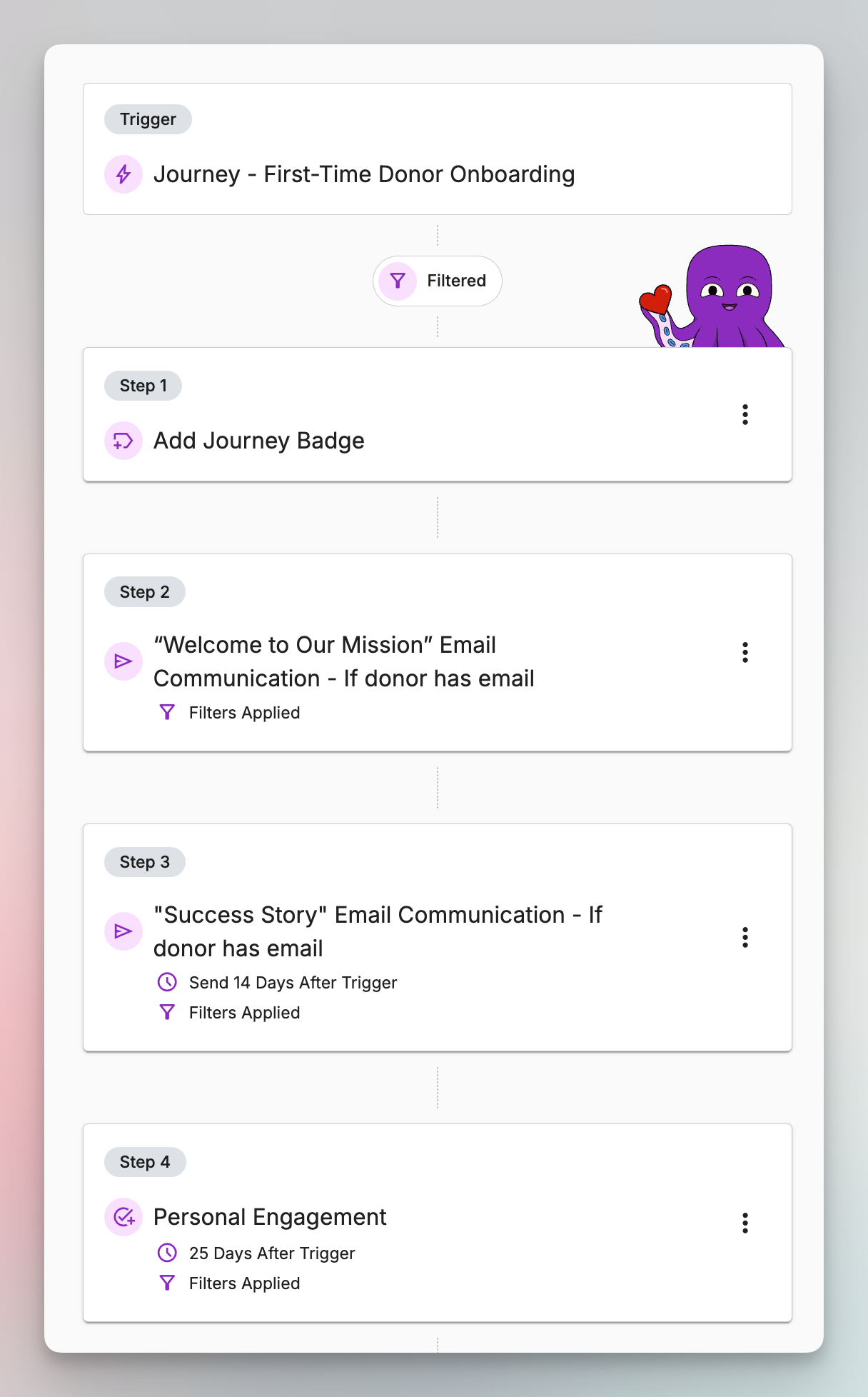
Automated donor journeys make this easier to manage at scale. You don't need to personally call every monthly donor every month. But you do need systems that flag when someone's credit card expires or when they've been giving for 12 months (prime time for an upgrade conversation).
Campaign performance that connects to behavior, not just revenue
You raised $50,000 during your year-end campaign. Awesome! But what percentage of that came from new donors versus repeat donors? What was the average gift size? How many donors upgraded? How many first-time donors did you retain in the first 90 days afterward?
These behavioral metrics tell you whether your campaign built relationships or just extracted one-time gifts. First-time donor retention is typically 20-30%, but with strong stewardship, that can jump to over 60%. The difference? Intentional follow-up, impact reporting, and making donors feel valued beyond the ask.
When Chris talks about building donor journeys, he's describing a system where every campaign feeds into long-term retention. Your year-end appeal isn't just about December dollars. It's about creating engaged donors who'll give again in March, volunteer in June, and upgrade next December.
How do you shift from vanity metrics to meaningful KPIs without overwhelming your team?
Here's the truth: you can't track everything. And trying to will burn you out faster than any donor loss ever could.
Pick 3-5 core KPIs that directly tie to your fundraising goals. Then, commit to reviewing them monthly. Not quarterly. Not "when we have time." Monthly.
Why monthly? Because it creates accountability without overload. You spot trends early. You celebrate wins when they're still fresh. And you can course-correct before small problems become big crises.
Create a simple review rhythm. Block 30 minutes at the start of each month. Pull your retention rate, grant approval rate, monthly giving growth, and campaign performance data. Ask three questions:
- What's working? (Do more of that.)
- What's not working? (Fix it or stop doing it.)
- What do we need to test next month? (Stay curious, not reactive.)
Document what you learn after each campaign or major initiative. DonorDock's guide to measuring impact makes this point brilliantly: if you're not writing down what you discover, next year you'll be starting from scratch again.
Assign ownership, even if it rotates. Someone needs to be the "numbers driver," even if they're not a data nerd. On growing fundraising teams, this might rotate quarterly. The point isn't perfection. It's consistency. Someone needs to own pulling the reports and starting the conversation.
Ruthless elimination applies to metrics, too. If a metric doesn't answer "Should we do more of this or less of this?" then question whether you need it. Your time is too valuable to track numbers that don't change decisions.
Why mid-level donors are your secret weapon (and a KPI worth watching)
Chris brought up something that often gets overlooked: "Mid-level donors often get forgotten. It's like, here are our first-time donors, and then here are our major donors."
These supporters give more than your average donor but less than major gift thresholds (often $1,000-$5,000 depending on your organization). They've demonstrated both capacity and commitment. Yet they often receive the same generic newsletter as everyone else because they're stuck in the middle.
Here's why they matter as a KPI: mid-level donors have the highest upgrade potential without requiring intensive major donor cultivation. They're already saying yes to meaningful giving. They're just one personalized touch away from saying yes to more.
Track this: What percentage of your $100-$999 donors upgraded to $1,000+ this year? If that number is below 5%, you have opportunity sitting right there in your database. Small increases in mid-level retention and upgrades can significantly impact your bottom line without requiring you to find entirely new donors.
One practical move? Segment your mid-level donors and create a specific donor journey for them. Maybe that's a quarterly impact call, exclusive behind-the-scenes updates, or early access to events. It doesn't have to be elaborate. It just has to be intentional.
The bottom line: metrics should ease your mental load, not add to it
You became a fundraiser to make a difference, not to drown in spreadsheets. The right KPIs should give you clarity, not confusion. They should help you focus, not overwhelm you.
Chris's team figured this. They built their KPIs, then scheduled a six-month check-in to evaluate and adjust. Because here's what most people miss: even good KPIs need tuning. What made sense in July might not fit in January after you've learned more about your donors or launched new programs.
The Fundraising Effectiveness Project's latest data shows donor retention rates have stabilized around 26% after years of decline. But dollars raised increased 2.9%. Translation: fewer donors are giving more. That's the reality growing fundraising teams face in 2026. You can't afford to chase vanity metrics. You need numbers that tell you who's sticking around, who's ready to upgrade, and where you're wasting time.
Focused fundraising isn't about tracking everything. It's about tracking what matters and having the discipline to ignore the rest. Start with donor retention for your $100+ supporters, grant approval rates, monthly giving growth, and campaign behavior. Review them monthly. Adjust quarterly. And give yourself permission to stop tracking everything else.
Because the best KPI isn't the one that looks impressive in board reports. It's the one that helps you make better decisions tomorrow than you did today. That's the metric worth chasing.
Ready to stop guessing and start knowing? See how DonorDock's reporting tools can help you track the metrics that matter, build intentional donor journeys, and focus on what actually moves your mission forward. Schedule a demo and discover how the right CRM can ease your mental load while strengthening donor relationships.