You keep hearing that AI is going to change everything. But when you sit down at your desk with 47 unread emails, a board report due Friday, and a stack of thank-you notes that should've gone out last week, "everything" feels pretty far away.
The gap between AI hype and AI usefulness is real, especially for growing nonprofit teams. Most AI training out there is built for tech companies, marketers, or enterprise teams with dedicated IT staff. Not for the development director who's also the event planner, grant writer, and database manager.
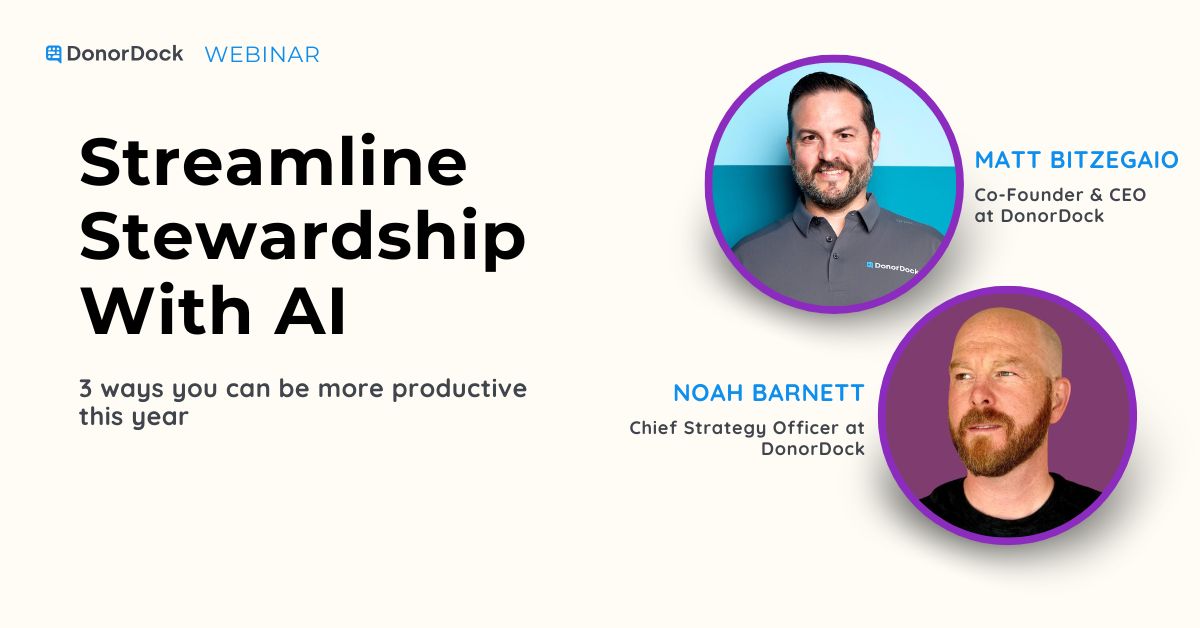
That's exactly why we built this training. It's a free, on-demand recording that walks through how to use AI for the fundraising and donor management tasks you're already doing every day. No jargon. No fluff. Just practical skills you can put to work this week.
Watch the full AI training for nonprofits
This free recording covers practical, nonprofit-specific ways to start using AI today. No technical background required.
Why we call it "AI-supported" stewardship
The name is intentional. Not AI-powered. Not AI-driven. Not AI-done-for-you.
Stewardship is a human task. The bond between your organization and your supporters is built on genuine connection, trust, and a shared commitment to your mission. No tool can replicate that, and we'd be doing you a disservice if we pretended otherwise.
What AI can do is support you in getting there. It can handle the administrative drag that keeps you from picking up the phone. It can surface the donor you've been meaning to call for three weeks. It can draft the thank-you note so you can spend your energy on the personal detail that makes it real.
That framing matters because it changes the question you're asking. The question isn't "what can AI do for me?" It's "what could I do for my donors if I had a little more support?"
The stewardship squeeze is real
One thing that came up early in the session and resonated with nearly everyone in the room: most nonprofit leaders are only stewarding their top five to ten donors consistently.
Not because they don't care about the rest. Because they don't have time.
The leaders we talk to every day are managing everything: fundraising, board relationships, programs, communications, data, events, and a dozen other things. When we asked two nonprofit leaders the day before this training how often they do regular donor stewardship, both gave the same honest answer: not very often.
What's hard about that answer is what comes after it. Both of them said they want to do more. They want to call the donor who gave last December and hasn't given again yet. They want to reconnect with supporters who've gone quiet. They just can't find the space in their workflow to do it.
That's the stewardship squeeze. Budgets are tightening. Teams are lean. Donor expectations are rising. And the tools that were supposed to make things easier have mostly just added more complexity.
This is the environment AI has to actually help in. Not by adding more tasks, but by removing enough friction that the human work becomes possible again.
The AAA framework: three ways to think about AI
One of the most useful takeaways from the session was a framework for thinking about AI differently. Instead of asking "what is AI," we asked: what role could AI play for your team?
We identified three roles, each one useful on its own and more powerful in combination.
AI as your assistant
The simplest place to start. Think about the tasks you'd hand off to a great assistant and you've already identified strong AI use cases.
Drafting emails and thank-you notes is the obvious one. AI can take a donor's name, gift amount, and a few context notes and produce a solid first draft in seconds. You still review it. You still add the personal touches. But you're starting from something instead of starting from a blank page, and that's a meaningful difference when you're doing it for fifty donors at once.
Summarizing donor profiles is another high-value use. Before a major gift meeting or a phone call with a longtime supporter, you could ask AI to pull together a two or three paragraph narrative of how that person has engaged with your organization. Their giving history, their involvement, key interactions. Instead of scanning through years of notes and records yourself, you walk into the conversation prepared.
The third one from the session that many people related to: cleaning up notes and organizing follow-ups. If you take voice memos on a walk, jot things in a notebook, or think out loud after a donor call, AI can take that raw input and turn it into organized action items. Nothing falls through the cracks. Your to-do list actually reflects what you need to do.
AI as your analyst
This is where it gets more strategic. An analyst doesn't just complete tasks; they look at your data and tell you what needs attention.
Think about the donors you haven't thought about in a while. The one who gave $100 three years running and didn't give last year. The one who just increased their gift for the first time. The one whose engagement has dropped off but who was once one of your most involved supporters.
Manually scanning for these patterns across hundreds or thousands of records isn't realistic. AI can do it in seconds. It can flag lapsed donors ready for re-engagement (what fundraisers sometimes call "lybunts" and "sybunts"), surface spike-up gifts where someone has started giving significantly more than before, identify stewardship gaps where important donors haven't heard from you recently, and highlight giving trends that should inform how you communicate with different segments.
During the session, Matt walked through how Otto Intelligence does exactly this inside DonorDock. Otto isn't a separate AI tab you have to open. It's woven into your donor data, so the analysis is already happening in the background. When you open a donor record or log in to start your day, the insights are there.
That's the difference between a general AI tool and one built into your donor management system. A general tool doesn't know your donors. Otto does.
AI as your automator
The third role is the one that compounds the value of the first two. Once you've identified what needs to happen, automation makes it happen without you having to remember to do it.
This is where DonorDock's Stewardship Journeys come in. When a first-time donor gives, a journey automatically sends a welcome sequence. When a recurring donor's payment fails, a follow-up gets triggered. When a lapsed donor hits a certain threshold, a re-engagement email goes out. These aren't cold, generic messages -- they're personalized based on the data already in your system.
The goal with automation isn't to remove the human from stewardship. It's to make sure the human shows up at the moments that actually require human judgment, and that every other touchpoint still happens on time.
What this looks like inside DonorDock
Matt gave the group a live walk-through of several Otto features in the session, so we'd encourage you to watch the recording for the full product tour. But here are the specific capabilities that came up most in the conversation:
Smart Nudges surface timely reminders before you'd think to check. A donor's birthday. A lapsed supporter who last gave in December and hasn't given again. A major gift follow-up that's a week overdue. Smart Nudges make sure those moments don't pass without action.
Spike-up gift detection flags donors who've increased their giving significantly. A donor who went from $100 to $200, or from $500 to $1,500. That signal matters and it's easy to miss without something surfacing it for you.
Donor profile summaries give you a prepared, narrative view of a donor's relationship with your organization before a meeting or call -- without having to dig through records yourself.
ActionBoard pulls all of your prioritized follow-ups into one focused view so you always know what to do next. No more starting the day uncertain about where to put your energy.
The point isn't efficiency, it's margin
One thing Matt said during the session worth repeating: a lot of the feeling that we need to do more comes from a lack of clarity about what we actually need to do.
AI can help with that. Not by generating more tasks, but by cutting through the noise and surfacing the things that actually matter. The donor who needs a call. The segment that's ready for an ask. The thank-you that's a week late.
When the right things surface at the right time, you stop spinning. You know what to do. And you have enough space in your day to actually do it well.
That's what we mean by AI-supported stewardship: not replacing the human work, but protecting the conditions that make it possible.
Keep learning and take a next step
If this session resonated, here are a few good places to go from here:
- How nonprofits can use AI for donor stewardship: a simple 3 E's framework -- a companion read to this session with a structured approach to getting started
- Why your CRM notes are your secret weapon (and how AI makes them even better) -- practical guidance on the data that makes AI actually useful
- "We don't have capacity for stewardship." Or do you? -- an honest look at where the time actually goes and what can change
- Free AI assistant for nonprofits (Otto Chat) -- try Otto in your browser before committing to anything
When you're ready to see how Otto works inside your actual donor data, schedule a free demo. Every DonorDock account includes Otto from day one.