You know that donor who's been giving $500 every year for the past three years? The one who attended your event last fall and volunteers occasionally? Yeah, that person. When was the last time you called them?
If you're like most growing nonprofits, the answer is probably "not recently enough." Or maybe never.
Your mid-level supporters. Stuck in the middle. Getting the same generic newsletter as everyone else while you pour attention into acquiring new donors and cultivating major gift prospects.
Here's what you're missing: these donors are already saying yes. They've demonstrated both capacity and commitment. They're not experimenting with a $25 gift. They're investing meaningfully in your mission. And they're one intentional touch away from becoming your most loyal partners.
What makes someone a mid-level donor?
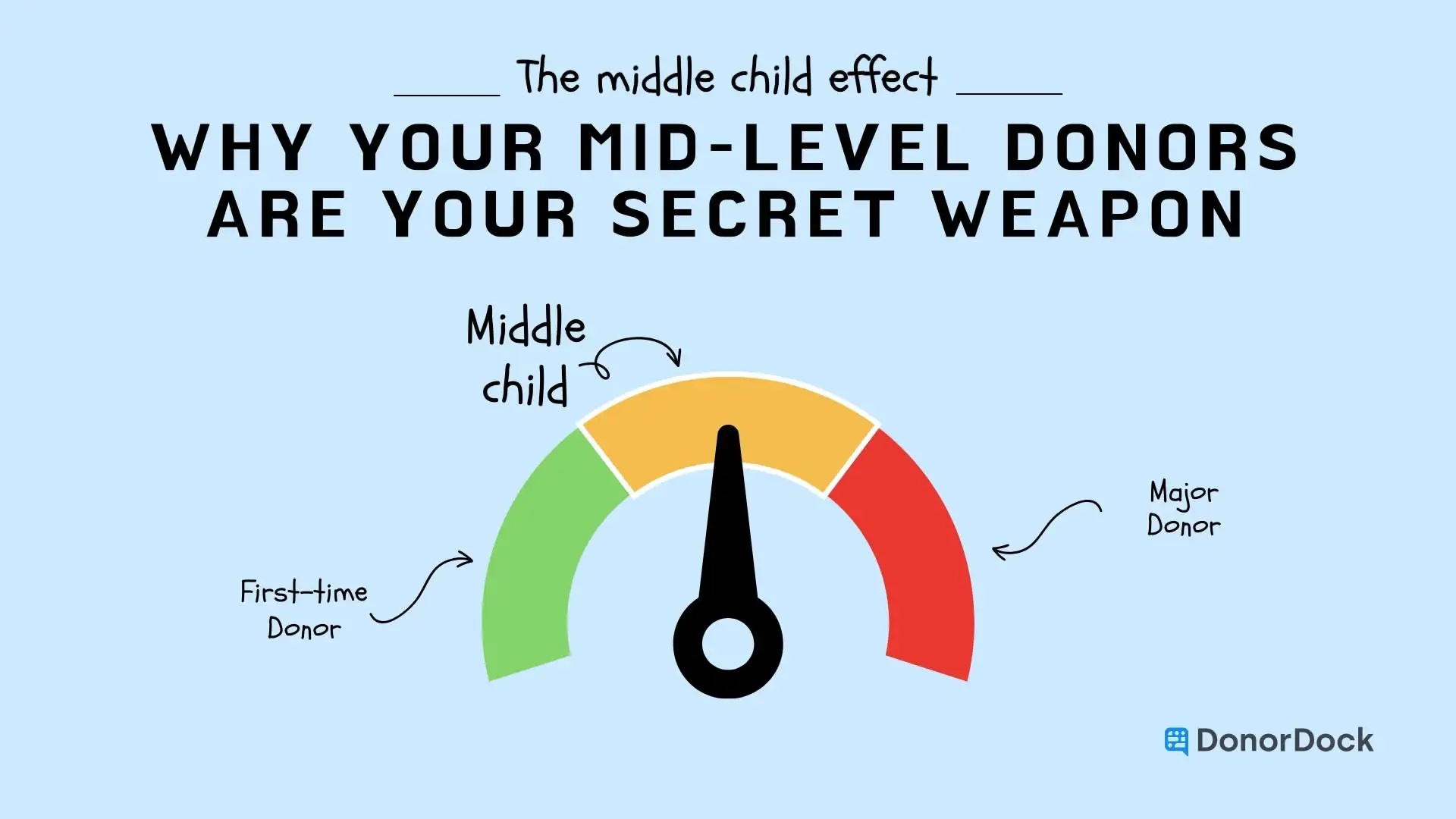
Mid-level donors typically give between $250 and $5,000 annually, though this range shifts based on your organization's size and donor base. Some nonprofits define mid-level as $1,000 to $10,000. The specific dollar amount matters less than what these donors represent: they're contributing more than your average supporter but haven't crossed into major gift territory yet.
What sets them apart isn't just the check amount. It's what that gift signals. A donor who writes a $1,200 check has done more than decide to support your cause. They've prioritized you in their budget. They've looked at their finances and said "this matters enough to give meaningfully."
These supporters often share characteristics beyond giving level. Many are:
Already engaged beyond donations. They attend events, volunteer occasionally, or follow you on social media. They've built a relationship with your organization that goes deeper than an annual appeal response.
Financially stable with room to grow. Unlike donors maxing out at $25 because that's genuinely their capacity, mid-level donors often have additional giving potential. They're not stretching to make their current gift. They're testing the waters to see how your organization values them.
Mission-aligned but not yet deeply involved. They care about your cause but haven't been invited into deeper partnership. They're waiting to see if you'll notice them, value them, and offer meaningful ways to connect beyond writing checks.
Think of them as the bridge between transactional donors and transformational partners. They've crossed the first bridge. They're standing in the middle, looking around, wondering if you see them there.
Why are mid-level donors overlooked in the first place?
The oversight isn't malicious. It's practical. Growing Fundraising Teams operate in survival mode, triaging everything by urgency and perceived impact.
First-time donors demand immediate attention because only 19% give a second gift. That feels urgent. Major donors require cultivation because they fund significant portions of your budget. That feels essential. Mid-level supporters? They're already giving consistently. They don't feel like a crisis or an emergency.
So they wait. And while they wait, your engagement defaults to whatever everyone else gets: the quarterly newsletter, the year-end appeal, maybe an event invitation if you remember to segment your list.
You're caught in a capacity trap. You're juggling donor outreach, grant writing, event planning, board relations, and actually delivering your mission. When you sit down to plan donor touches, you gravitate toward the extremes. New donors need welcoming. Major prospects need cultivation. Mid-level supporters? They seem fine. They're giving already, right?
Your systems aren't set up to surface them. Most donor databases make it easy to pull lists of "gave $10,000+" or "gave for the first time last month." But mid-level donors require more nuanced queries. Who gave $500+ for three consecutive years? Who started at $100 and is now at $750? Your database probably can tell you, but it takes intentional effort to ask the right questions.
Industry attention skews toward major gifts. Fundraising conferences, webinars, and thought leadership focus heavily on major donor cultivation and annual fund acquisition. Mid-level programs get mentioned in passing, if at all. You've absorbed this messaging: chase the big checks, convert the new donors, and everyone else can wait.
The result? A segment that stabilizes the "leaky bucket" of small donor churn gets treated like an afterthought. And that's costing you more than you realize.
What's the actual cost of ignoring mid-level donors?
Lost revenue is the obvious answer, but it's not the full picture. The real cost shows up in missed retention, stalled upgrades, and compounding opportunity loss over time.
Retained donors give approximately 42% more year over year compared to their initial gift. When you ignore mid-level donors, you miss those incremental increases. That $500 annual donor could be giving $700 this year and $1,000 next year. But not if they don't hear from you beyond mass appeals.
You're losing upgrade momentum. Mid-level donors represent your highest upgrade potential without the intensive cultivation major gifts require. They've already demonstrated capacity. They're not starting from zero. A simple upgrade conversation, a personalized impact report, or an invitation to a behind-the-scenes tour can move the needle. But you're not having those conversations because they're buried in the middle of your donor list.
"Oftentimes they have some capacity to go up, even if that's, hey, I'm going from $500 to $1,500. I mean, that's $1,000 additionally a year that you're getting." - Chris Stibbs, The Focused Fundraiser
He's right. Those aren't small numbers when you multiply them across your entire mid-level segment. If you have 50 mid-level donors and convert just 10% to upgrade by $500 each, that's $2,500 in additional annual revenue with donors you already have.
You're creating churn by invisibility. Mid-level donors have retention rates that stabilize donor bases, but only when they're stewarded appropriately. A donor giving $1,000 annually who never receives personal contact, never gets thanked beyond an automated receipt, and never hears how their gift created impact? They won't stay forever. Eventually, someone else will recognize their value and invite them into meaningful partnership.
Think about it from their perspective. They're investing significantly in your mission. They're prioritizing you in their budget year after year. And you're treating them exactly like the person who gave $50 once because their friend posted about you on Facebook.
That doesn't feel good. And donors who don't feel valued or see impact of their funds find other places to invest.
How do mid-level donors fit into your donor journey strategy?
The solution isn't adding more work to your plate. It's creating intentional systems that treat mid-level donors like the valuable partners they are.
Start by segmenting your donor base in ways that surface mid-level supporters. Don't just sort by "last gift amount." Look at giving patterns over time. Who's given $250+ for multiple years? Who's increased their giving consistently? Who's engaged in multiple ways (donating, volunteering, attending events)?
These patterns reveal commitment that a single transaction snapshot misses. A donor who started at $100 three years ago and is now at $600 shows trajectory. That person is different from someone who gave $600 once. Both matter, but they need different stewardship approaches.
Design a mid-level donor journey that balances automation and personal touch. This is where tools like DonorDock's automated donor journeys become essential. You can't personally call 50 mid-level donors every month. But you can create systems that prompt you when it matters and automate the routine touches.

A strong mid-level journey might include:
Immediate personalized acknowledgment after a gift that references their giving history. Not "thanks for your donation," but "thanks for your fourth consecutive year of support at this level."
Quarterly impact updates that show exactly what their giving range makes possible. Generic newsletters work for some donors, but mid-level supporters deserve tailored content that connects their specific investment to tangible outcomes.
Annual personal outreach via phone call or handwritten note from a board member, executive director, or development team member. This doesn't scale to thousands, but it absolutely scales to 50-100 mid-level donors. Block time quarterly for these touchpoints.
Exclusive opportunities that signal they're valued. Early event access, behind-the-scenes tours, small group Q&As with leadership. These don't require massive budget but create differentiated experiences.
Upgrade conversations at natural inflection points. Anniversary of their first gift. After they've attended an event. When they've been giving consistently for three years. These moments matter, and DonorDock's Otto intelligence can surface them automatically so you never miss the opportunity.
What specific actions move mid-level donors toward deeper engagement?
The best mid-level stewardship blends consistent communication with strategic personal touches. You're not trying to do major donor cultivation at scale. You're creating a distinct experience that honors their commitment level.
Make the thank you personal and prompt. Donors who receive a personal phone call within 24 hours are 39% more likely to give again. You probably can't call every $25 donor within a day. But can you call every $500+ donor? Probably. Start there.
Even a 60-second voicemail message transforms the donor experience. "Hi Sarah, this is Chris from Growing Futures. I saw your gift of $1,200 came through this morning and wanted to personally thank you. This is your third year supporting us at this level, and that consistency means everything to our families. No need to call back, just wanted you to know we see you and we're grateful."
That's it. One minute. Huge impact.
Show them the specific impact of their giving range. Don't just tell mid-level donors "your gift matters." Show them what $500, $1,000, or $2,500 specifically enables. If $1,000 funds one family's participation in your program for a quarter, tell them that. If $500 covers materials for five students, make that connection explicit.
This is where segmented communication becomes powerful. Your $50 donors get generalized impact stories. Your mid-level supporters get targeted messages that connect their exact contribution to measurable outcomes.
Invite them into experiences, not just events. Mid-level donors often don't respond to more fundraising asks. They respond to meaningful connection. Offer facility tours, program observations, or casual coffee conversations with your executive director. These low-cost, high-impact touchpoints deepen relationship without requiring major event planning.
One nonprofit we know hosts quarterly "donor coffee hours" where 8-10 mid-level supporters join the executive director for 90 minutes. No formal presentation. Just coffee, conversation, and direct access to leadership. Attendance is high, feedback is consistently positive, and the nonprofit tracks clear increases in retention and upgrades from participants.
Ask for their input, not just their money. Mid-level donors are deeply invested in your success. They want to know their contribution matters, and they often have valuable perspectives on your work. Send them a brief survey about program priorities. Invite them to a focus group about a new initiative. Ask their opinion on something that actually matters.
This isn't fake engagement. It's genuine partnership. And donors who feel consulted become donors who feel invested.
What role does technology play in mid-level donor stewardship?
You can't manually track every mid-level donor's giving anniversary, engagement history, and optimal contact timing. That's where smart systems become essential. Not to replace human connection, but to make it possible at scale.
The right CRM helps you identify mid-level donors automatically. It surfaces patterns you'd miss manually. It flags opportunities for upgrade conversations before they pass. And it prompts you to reach out at moments that actually matter, not just when you remember to check your list.
DonorDock's approach to mid-level donors combines automated journeys with smart prompts. The system handles routine touchpoints (welcome emails, impact updates, anniversary acknowledgments) while surfacing the moments that need your personal attention (upgrade opportunities, engagement milestones, lapsed giving patterns).
Chris's experience switching to DonorDock reflects this balance:
"We are kind of in the very early stages as we've just moved to DonorDock, and really starting to segment out, like here is what the experience is like for someone who's giving $100 or more."
Technology doesn't eliminate the need for personal connection. It creates capacity for it. When you're not scrambling to remember who needs a thank-you call or manually tracking giving anniversaries, you can focus on the relationship-building work that actually moves donors.
How do you measure mid-level donor program success?
Don't just track total mid-level giving. That number can look healthy while masking serious problems. Instead, watch metrics that reveal relationship health and program effectiveness.
Mid-level donor retention rate. What percentage of last year's mid-level donors gave again this year? This is your primary health indicator. If retention sits above 60%, you're doing well. Below 50% signals problems that need immediate attention.
Upgrade rate within the segment. How many donors increased their giving this year compared to last? Track both the number of donors who upgraded and the average increase amount. A healthy mid-level program sees 15-20% of donors increasing their giving annually.
Engagement beyond giving. Track event attendance, volunteer participation, and response rates to mid-level-specific communications. Donors who engage in multiple ways retain at significantly higher rates. If your mid-level donors only write checks, you're missing opportunities to deepen connection.
Time to upgrade from lower tiers. How long does it take donors to move from $100-$250 giving to mid-level? If that timeline stretches beyond three years, your stewardship journey needs adjustment. Faster progression indicates you're creating compelling reasons for donors to increase investment.
Lifetime value by entry point. Compare the lifetime value of donors who entered at mid-level versus those who upgraded into it. Both matter, but understanding the difference helps you allocate resources appropriately between acquisition and cultivation.
What's the first step for nonprofits who've been ignoring mid-level donors?
Start with acknowledgment. Literally. Pull your list of donors who've given $250+ for two or more consecutive years. That's your core mid-level segment. Now look at when you last contacted them with something other than an ask.
If the answer is "I'm not sure" or "probably our last newsletter," you have work to do. But that's okay. You're not behind. You're identifying opportunity.
Pick one action and commit to it for 90 days. Don't try to build a comprehensive mid-level program overnight. Chris talked about taking small bites at the beginning of the year: "We know about the resolution trend that we as humans have, where we're going to just magically do a million different things. So I think the same thing kind of applies in the nonprofit sector. What are little things we can start out doing in the new year to build that momentum?"
Choose one thing:
- Call five mid-level donors each week to thank them personally
- Send quarterly impact updates specifically tailored to their giving level
- Invite mid-level donors to one exclusive event or experience
- Create a simple welcome journey for donors who cross into mid-level giving
Just one. Do it consistently for three months. Track what happens. Then add another element.
Get your systems in place. You can't sustain mid-level stewardship through manual effort alone. Evaluate whether your current database makes it easy to segment, track, and engage this donor group. If you're fighting your systems, consider whether tools like DonorDock could ease your mental load and create capacity for relationship building.
Train your team and board to recognize mid-level donors. Not everyone needs to know every donor personally, but your board and key volunteers should understand that a $1,000 donor deserves different treatment than a $25 donor. Brief them on who these supporters are and why they matter. When board members can recognize and thank mid-level donors at events or in the community, it amplifies your stewardship efforts without adding to staff workload.
Why mid-level donors deserve your attention right now
The 2025 fundraising landscape shows clear trends: more dollars from fewer donors. Small-dollar giving continues to decline. First-time donor retention hovers around 19-26%. The donor base is consolidating.
In this environment, mid-level donors represent stability. They're not experimenting with a small gift to see if they like you. They're not writing one-time checks because Facebook reminded them. They're making deliberate, meaningful investments in your mission year after year.
That consistency matters more now than ever. Building a strong mid-level program isn't about chasing a trendy fundraising strategy. It's about recognizing and nurturing the donors who are already voting with their wallets that your mission matters.
Mid-level donors have figured out their timing. They're showing up consistently with meaningful gifts. The question is whether you're putting in the effort to notice, value, and deepen those relationships before someone else does.
Ready to stop overlooking your most loyal supporters? See how DonorDock helps growing fundraising teams segment donors, automate thoughtful stewardship, and surface the moments that matter most. Schedule a demo and discover how focused fundraising builds stronger mid-level donor relationships without burning out your team.