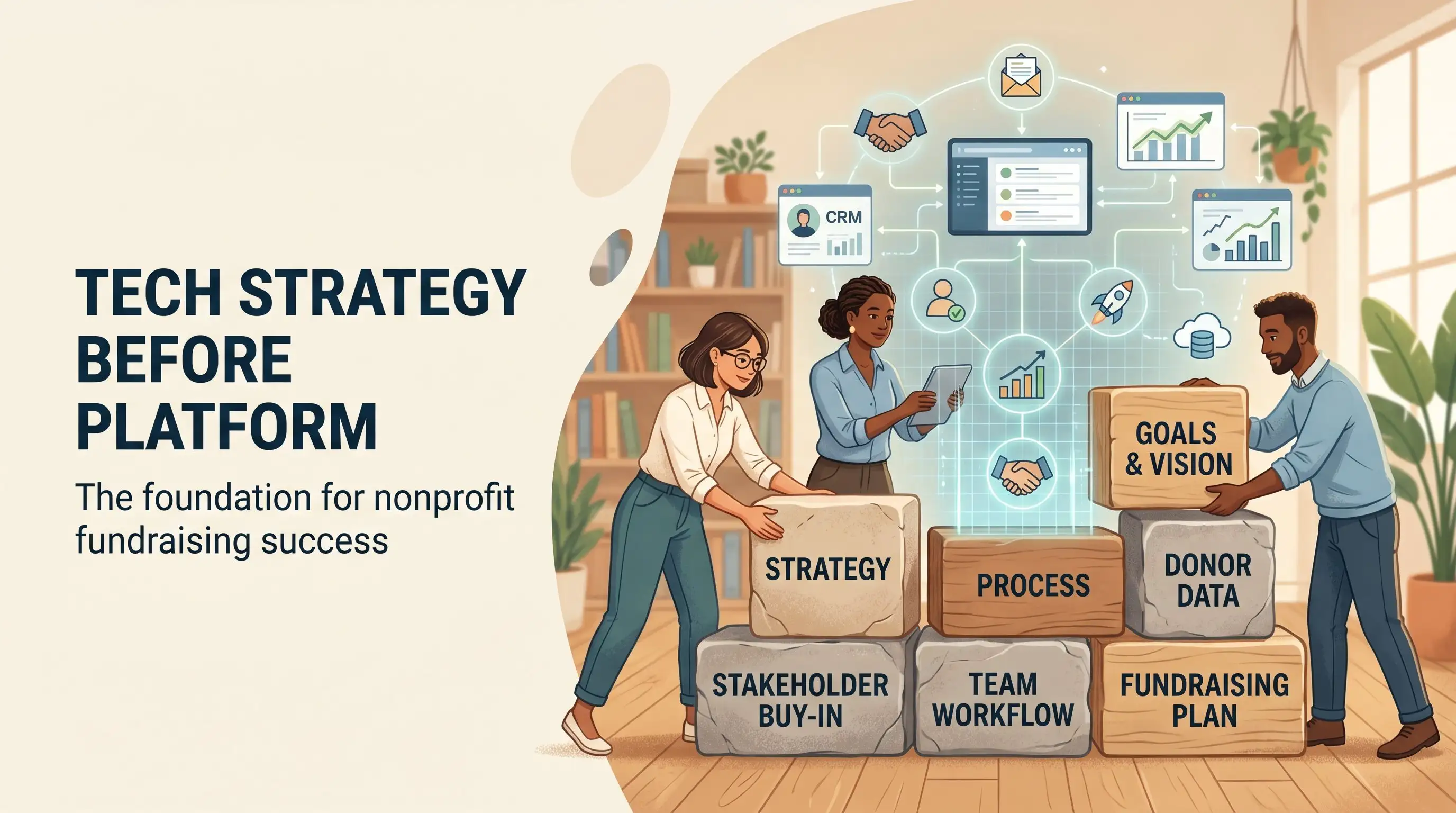
Most nonprofits that fail at technology adoption have a process problem that they're hoping software will solve. This distinction matters because it changes everything about how you approach your next tech investment.
Why Your Next Tool Won't Fix What's Actually Broken
Here's what typically happens: your team is overwhelmed. Communication feels disjointed. Donor information lives in multiple places. Someone suggests a new platform as the solution, and it seems logical. Surely better software will make the chaos manageable.
The reality is harder. When you implement a tool without fixing the underlying workflow, you're just automating a broken process. You spend months onboarding, train your team, and six months in you realize the platform didn't solve anything because the problem was never the platform.
The technology should support a process that already makes sense.
If your donor communication strategy is unclear, no CRM will clarify it. If your data entry standards don't exist, a more powerful database won't create them. If your team doesn't know who owns which task, project management tools become another source of confusion.
This is why the first step isn't evaluating tools. It's evaluating yourself.
What Actually Happens When You Adopt Without Strategy
The data tells a bleak story. According to the Fundraising Effectiveness Project, only 14% of donors acquired in 2024 gave again in 2025. Only 2% of lapsed donors were recaptured. Meanwhile, 70% of nonprofit leaders identify donor retention as a top challenge. These aren't technology problems in the abstract. They're workflow problems that impact real retention rates.
When you add a new tool without a clear process to support it, three things happen in sequence: initial excitement, mounting confusion, and eventual abandonment. Your team gets an email about the new platform. There's training. Then reality hits.
Example: a nonprofit implements a donor management system expecting it to surface major gift prospects automatically. The system has excellent prospect features. But the organization never established consistent wealth capacity research practices beforehand. The system flags prospects. No one has time to evaluate them. The feature goes unused. The team feels like they wasted budget on a tool that doesn't work.
The tool worked fine. The process didn't exist.
Tool Fatigue Is Real (And Your Team Feels It)
For years, the nonprofit answer to every problem was the same: get another app. Need better email? New tool. Need to track volunteers? New tool. Need to manage grant deadlines? You guessed it.
The result is that most nonprofit teams are juggling 5, 10, sometimes 15 different platforms. Context switching between systems drains mental energy. Training on another platform feels impossible. And research shows that using more than 10 apps increases communication issues by 59% compared to using fewer than 5.
The mindset has shifted. Teams aren't asking "what can we add?" anymore. They're asking "what can we consolidate?" This is a meaningful change because it prioritizes sustainability over novelty.
If you're considering a new tool, that's actually a conversation worth having internally first: Do we need something new, or do we need to use what we have more effectively?
Sometimes the answer is genuinely "we need better tools." Often it's "we need to stop adding and start optimizing."
The Lean Team Reality (And Why It Matters Now)
Nonprofit staffing hasn't increased, but expectations have. Organizations expect lean teams to accomplish what larger teams used to do. A development director now owns annual fund strategy, major gifts, planned giving, and donor communications. A data coordinator manages constituent records, reporting, and compliance across multiple systems.
This isn't going away. It's the operating environment. Technology can help by being truly built for lean teams, not by being an enterprise system that's "simplified." There's a difference.
An opinionated platform that says "here's a workflow that works for lean teams" is more valuable than an infinitely customizable one that requires you to build everything from scratch. You don't need every possible feature. You need the features that matter, working together seamlessly. That's why platforms like DonorDock's all-in-one CRM are built around consolidation, giving lean teams one place for donor management, outreach, tasks, and reporting instead of a patchwork of disconnected tools.
This is where strategy intersects with tool selection. Before you evaluate platforms, be honest about your team size, available time, and actual priorities. A tool that requires 10 hours of setup per week doesn't work for you, no matter how powerful it is. You need something that gets out of the way and lets your team work.
What the Data Quality Problem Means for AI
You've probably heard that AI will revolutionize donor relationships. It can. But not everywhere, and not yet for most organizations.
AI is genuinely useful for first drafts (thank you, email generation), summarizing donor history across scattered touchpoints, cleaning mailing lists, and making sense of unstructured data like notes from years of interactions. These are real, valuable applications that lean teams can actually use today. (We wrote about how nonprofits can practically use AI for donor stewardship using the same framework we'll cover below.)
The hype falls apart when you start hearing phrases like "AI that knows your donor better than you" or "predictive donor scoring." These sound incredible. And they work beautifully in organizations with years of clean, consistent data. For most nonprofits, this lands squarely in garbage-in-garbage-out territory.
If your data quality isn't there, if donor records are incomplete or inconsistent, AI can't compensate for that. It will give you faster answers to bad data. If you're considering an AI-powered tool, ask bluntly: does this solve a problem we actually have, or is it solving a problem we'd like to have if our data quality were different?
The Three-Part Framework That Actually Works
Before you sign any contract or move any data, use this approach. It's the same Evaluate, Establish, Execute loop behind the Smart Steward Method, a free fundraising framework that's helped over 6,000 fundraisers raise more than $4.1B combined:
- Evaluate where you really are. Not where you want to be or where you think you should be. Where you actually are. Document your current workflows, identify the real bottlenecks, and be specific. "Donor management is hard" is not a starting point. "We can't segment our audience for appeals because donor data lives in three places" is. (DonorDock's free Smart Steward Assessment can help you get an honest baseline.)
- Establish a plan. Based on where you are, what specific outcome are you trying to reach? And what workflow changes need to happen before or alongside your technology investment? Write this down. Share it with your team. Make it specific enough that you can measure it.
- Execute the plan, then repeat. Pick your tool. Implement it thoughtfully. Give it time. Then evaluate whether the outcome happened. This is not a "set it and forget it" exercise. Technology needs oversight.
How to Choose a Tool (Without Losing Your Mind)
Once you've done the process work, tool evaluation is actually easier. You're looking for a few specific things.
First, a philosophy of ease of use. Not stripped-down features, but design-level commitment to keeping things intuitive. Does the tool get out of your way, or does it require you to learn its logic? Can your team learn the basics in a day or does it demand weeks of training?
Second, integration with tools you're already using. If you use DonorDock's built-in task management, you want it connecting to your email and giving you a donor timeline without switching windows. That seamless integration saves enormous amounts of mental energy.
Third, actual support for lean teams. Not enterprise teams with dedicated admins. Can a single person manage this system and keep the rest of your team productive? Does the platform assume you have the bandwidth for complexity?
Ask yourself honestly: would this tool make your team's life better next month, or just different?
The Real Problem Most Nonprofits Miss
Technology adoption fails when the expectation is that a platform will fix organizational problems. It won't. Technology amplifies and supports good processes. It accelerates bad ones.
If your communication is unclear, a new platform won't make it clear. If your data practices are messy, better tools will show you how messy they are (loudly). If your team is stretched too thin, another system won't solve that. It might make it worse.
Start with process. Then add technology to support it. Evaluate your current state honestly. Figure out what needs to change in how you work. Then find the tool that makes that change sustainable.
The nonprofit technology landscape is crowded. But the problem was never about finding the right platform. It's about having the clarity to know what you actually need before you start looking.