If you are a growing fundraising team fundraiser, you are probably juggling more than any one person reasonably should.
You are keeping campaigns moving, answering board questions, closing out grants, trying to remember who needs a thank you call, and wondering how many first-time donors you lost last year because you simply ran out of time.
That tension is real. And the data backs it up.
Average donor retention across nonprofits still hovers around 45% to 50%, which means about half of your donors do not give again the next year. Recent Fundraising Effectiveness Project data shows that only about one in five new donors came back the following year, a sharp drop from the year before. At the same time, research suggests that up to 60% of donors give once and never return, often because they do not feel seen or thanked in a meaningful way.
Enter AI. Everyone is talking about it. Your board may be asking what your AI plan is. Your staff may already be quietly using ChatGPT in a browser tab. But you do not want to lose the human warmth your donors love.
That is where the idea of AI as a smart steward comes in. Not a replacement for you, but a layer that helps you evaluate, establish, and execute better donor stewardship using the Smart Steward Method’s 3 E’s.
Why does donor stewardship need an AI upgrade right now?
Let’s start with the “why” before we talk about the “how.”
The retention problem is getting more expensive
Beyond that stubbornly low overall retention rate, a few trends are especially painful for growing fundraising teams:
- New donor retention has dropped to about 19% in recent data, meaning four out of five first-time donors do not give again the next year.
- The cost to reacquire a lost donor can be 5 to 7 times higher than retaining one you already have.
On top of that, donors are living in a digital world where personalized, relevant communication has become the norm. Twilio’s 2024 State of Nonprofit Digital Engagement report highlights that nonprofits are increasingly turning to AI and digital tools to create more timely, personalized communication at scale.
In other words, doing donor stewardship on sticky notes and heroic memory alone is becoming a liability.
Donors still want a human relationship
Here's the challenge. Studies on donor engagement consistently show that donors are more likely to keep giving when they:
- Are thanked quickly and personally
- See the impact of their gift
- Feel known, not just “blasted” with appeals
That lines up with our Relationship Loop framework, which frames stewardship as an ongoing cycle of noticing, thanking, updating, and inviting, rather than a one-time thank you letter.
The goal is not more messages. It is more meaningful messages.
That is why we talk about AI as a smart steward. Tools like DonorDock’s Otto are designed to help you automate the heavy lifting, while you keep the relationship, tone, and values anchored in the human side.
What does “AI as smart steward” actually look like?
Think of AI as a very sharp, always available assistant who:
- Knows your donors, gifts, and interactions
- Can summarize long histories in plain language
- Can draft messages that sound like your organization
- Suggests who needs attention next
And does all of that inside your CRM, not in a random browser tab that can't see your data.
Embedded AI vs “adjacent” AI
If your AI lives in a separate window, you are constantly copying and pasting:
- Donor data out of your CRM
- Notes from your last call
- Drafts back into your email or mail merge
That adds more mental load to the day.
When AI lives inside tools like your CRM, you get a “smart steward” that can:
- Generate donor summaries before a call
- Suggest next steps based on giving patterns
- Draft thank you emails using real donation details
- Help segment donors by behavior or interests
AI is powerful, but you set the boundaries
AI should not:
- Decide your case for support
- Promise things you cannot deliver
- Replace personal calls, texts, or visits for key donors
Your job is to set the guardrails and keep the human connection strong. That is where the Smart Steward Method’s 3 E’s really shine.
How do you use the 3 E’s to guide AI in donor stewardship?

The Smart Steward Method is a simple framework designed to help fundraisers improve donor retention without burning out: Evaluate, Establish, Execute.
Let’s apply those 3 E’s directly to AI.
1. Evaluate: Where can AI realistically help your stewardship?
Before adding more tools, step back and ask:
- Where are we losing donors?
- Where are we dropping the ball on follow up?
- Which stewardship tasks feel repetitive or manual?
- What data do we already have that we rarely use?
A quick way to start is by taking our free Smart Steward Assessment. It gives you a snapshot of your current stewardship strengths and gaps, and it is tailored to small and growing nonprofits.
When you look at the results, highlight the places where AI could realistically help. For most growing fundraising teams, that often includes:
- Drafting first and second thank you messages
- Summarizing donor histories before meetings
- Tagging or segmenting donors based on behavior
- Generating ideas for impact stories or updates
- Creating follow up sequences for new or lapsed donors
This is not about chasing shiny objects. It is about taking the pressure off your brain so you can focus on high value human touch points.
2. Establish: Build simple AI-supported workflows and guardrails
Once you know where AI can help, you move into Establish mode. Here is where you design your smart steward system.
Start by picking 1 or 2 workflows, for example:
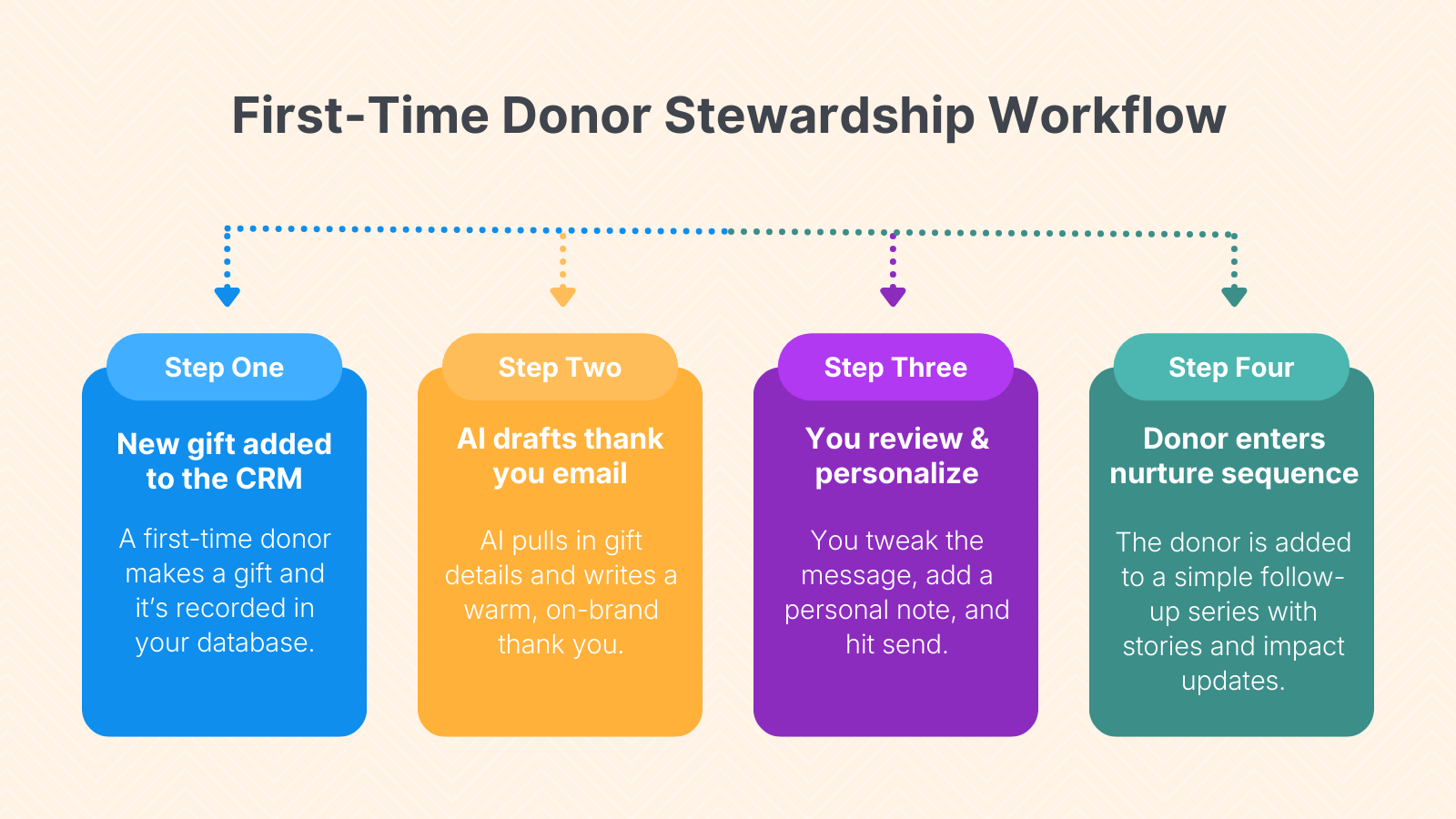
Workflow 1: First-time donor welcome
- Trigger: A new donor makes their first gift
- AI’s job:
- Draft a warm thank you email that includes gift amount, campaign, and impact
- Suggest 2 follow up touch points, like a story email and a short survey
- Your job:
- Review and tweak the email for tone
- Decide if this donor should be added to a specific segment
- Make one personal phone call per week to a first-time donor on the list
Workflow 2: Lapsed donor re-engagement
- Trigger: Donors who have not given in 12-18 months
- AI’s job:
- Create short donor summaries for each person
- Draft a re-engagement email that references their past support
- Suggest talking points if you want to call them
- Your job:
- Approve segments and filters
- Choose which donors get a personal call vs just email
- Add a human story about current impact that AI might not know yet
To keep AI aligned with your values, document a few basic guardrails:
- Language we never use
- Promises we only make when approved
- Topics that always require human review
This is the type of balance we talk about in our piece on fundraising automation and the “human equation” of blending automation with empathy.
3. Execute: Start small, measure, and iterate
The last E is where most teams get stuck. Execute does not mean “launch a huge AI initiative.” It just means start, measure, and adjust.
Pick one pilot, like the first-time donor workflow, and track:
- How quickly donors are thanked
- Reply rates or engagement with your emails
- How many first-time donors give again within 12 months
Industry data shows that nonprofits with a structured donor stewardship plan can see retention increase by up to 40%.
Combine that with AI-powered personalization and follow up, and you give yourself a real chance to move your numbers without adding more stress to your week.
A few practical tips for execution:
- Schedule a weekly “AI power hour” where you review AI drafts, approve segments, and clean up data
- Save prompts and templates that work well so others on your team can reuse them
- Keep a running list of “AI wins” to share with your board or ED, like hours saved or donors re-engaged
What are some practical AI stewardship use cases for growing fundraising teams?
If you are wondering where to start, here are realistic, high impact examples that fit small and growing nonprofits.
Instant donor briefings before meetings
With AI inside your CRM, you can generate a quick summary like:
“This donor has given 3 times since 2020, usually in November, at an average of $250. They responded well to your last email about scholarships and opened your volunteer recruitment message.”
That kind of briefing helps you walk into a meeting prepared, even if you only had five minutes between calls.
Smarter thank you workflows
Instead of rewriting every thank you from scratch, AI can:
- Pull in gift amount, designation, and campaign name
- Suggest impact language based on your typical programs
- Adjust tone for recurring vs major vs first-time donors
You review, tweak, and add a personal note where it matters most. DonorDock’s built in AI features are already designed to help with subject lines, email copy, and calls to action, so you are not starting from a blank screen every time.
Board and leadership updates
Need to report on donor engagement to your board?
AI can:
- Summarize key trends in your donor data
- Draft narrative explanations for dashboards
- Help you turn raw numbers into a short story your board actually understands
You stay in control of the message and strategy. AI just helps you move from spreadsheet to story.
How do you keep stewardship human while using more AI?
If all of this still makes you a little nervous, that is completely normal. Many nonprofit leaders say they feel both excited and anxious about AI, especially around ethics and capacity.
Here are a few simple practices that protect the human side:
- Always add at least one human element to AI drafts, like a personal anecdote or specific program story
- Use AI to free up time specifically so you can make more calls, visits, and personalized touches
- Make a short list of “human only” tasks, like major donor asks, sensitive impact updates, or crisis communication
Good stewardship is about progress, not perfection. Your tools should help you scale the human touch, not replace it.
Ready to try AI as your smart steward?
You do not need a massive budget or a data team to start using AI in donor stewardship. You just need:
- A clear framework like the 3 E’s
- A willingness to experiment
- Tools that are built for small and growing fundraisers, not just giant institutions
If you want a simple first step, you can:
- Take the free Smart Steward Assessment to see where your stewardship stands
- Explore the Smart Steward Method to understand the full framework
- Test drive DonorDock’s AI assistant for nonprofits and explore how built in AI inside your CRM can ease your mental load
- Read more about nonprofit AI and how to use it without losing your human touch
You deserve more focus and less frenzy. Let AI serve as your smart steward so you can focus on what matters most: building real, lasting relationships with the people who believe in your mission.