You'll remember the conversation. You're sure of it. The donor mentioned something about their grandkids... or was it their new job? They were excited about your literacy program... or was that a different supporter?
You meant to write it down, but then three more emails came in, a board member called, and by the time you circled back, the details had already started to blur.
Sound familiar?
Donors don't expect you to be perfect, but they do expect you to remember them. When donors feel forgotten or treated like transaction numbers instead of partners, they quietly move on.
The good news? You don't need a superhuman memory to build lasting donor relationships. You need a system that captures what matters and surfaces it when it counts.
What makes donor notes actually useful?
Not all notes are created equal. Jotting down "had a nice chat" doesn't help you six months later when you're trying to reconnect. The notes that actually move relationships forward capture three things:
Context. What brought this donor into your orbit? Did they volunteer first? Attend an event? Get referred by a board member? Understanding their entry point helps you frame future conversations in ways that resonate.
Connection points. These are the personal details that make someone feel seen. Their kid's soccer tournament. Their job transition. The story about their grandmother that connects to your mission. These aren't just nice-to-know tidbits, they're the threads that weave authentic relationships.
Next steps. Every conversation should point somewhere. "Follow up in three weeks about sponsorship opportunity" or "Send impact report before year-end" turns your notes from historical record into actionable roadmap.
When you consistently track these elements, patterns emerge. You start noticing that mid-level donors who volunteer twice are prime candidates for monthly giving. You see that lapsed donors who engaged on social media might respond better to a phone call than an email. Your CRM transforms from a digital filing cabinet into strategic intelligence.
How do you actually capture donor insights without drowning in admin work?
The discipline of taking notes after every donor interaction sounds great in theory. In practice, it often falls apart under the weight of everything else on your plate. Here's how to make it sustainable:
Write immediately, not eventually. Right after the call or meeting, open your donor management CRM and spend three minutes capturing the highlights. Not a novel, just the key points.
Waiting until Friday afternoon to batch-process the week's conversations guarantees you'll lose the nuance.
Use a template in your head. Hit these basics every time:
- What did we talk about?
- What did I learn about them personally?
- What's the next action, and when?
- Any red flags or concerns?
This mental checklist keeps your notes consistent and complete without requiring a formal structure.
Tag strategically. Most nonprofit CRMs let you tag donors with custom labels. Use them. "Interested in capital campaign," "Prefers phone over email," "Animal lover," "Corporate match eligible"—these tags become gold when you're segmenting for outreach. As research on donor data management shows, strategic tagging can dramatically improve your targeting.
Set follow-up reminders while you're in there. The note isn't done until you've scheduled the next touchpoint. If you promised to send something, create a task. If you agreed to reconnect in a month, set the reminder now.
Your CRM should be your accountability partner, not just your record-keeper. If you're using a CRM like DonorDock, you can set reminders and tasks tied to the contact's record, giving you more context and priority over what needs to get done next.
Why unstructured data is more valuable than you think
For years, the fundraising world has obsessed over structured data, the neat columns and rows that populate reports. Donation amounts. Frequency. Recency. These metrics matter, but they only tell part of the story.
The real relationship gold lives in unstructured data: the notes, the conversation summaries, the follow-up comments. This is where you capture why someone gives, not just that they give. It's where you document the personal connection that turns a one-time donor into a lifetime supporter.
Notes is where you capture why someone gives, not just that they give.
According to research from NetSuite, every interaction between your nonprofit and a donor, from website visits to gala attendance, generates data that should inform your stewardship. The challenge has always been making sense of it all without hiring a data analyst.
Enter AI.
How AI turns your notes into donor intelligence
Artificial intelligence isn't here to replace the human touch in fundraising. On the contrary, it's here to amplify it. When applied to your CRM notes, AI becomes your research assistant, your pattern-spotter, and your reminder system rolled into one.
Instant conversation summaries. Before picking up the phone with a major donor, you used to scroll through months or years of notes, trying to piece together the history. Now AI can synthesize that entire relationship into a concise summary in seconds: giving history, personal details, past conversations, expressed interests. You walk into every interaction fully prepared, without spending 20 minutes on prep work.
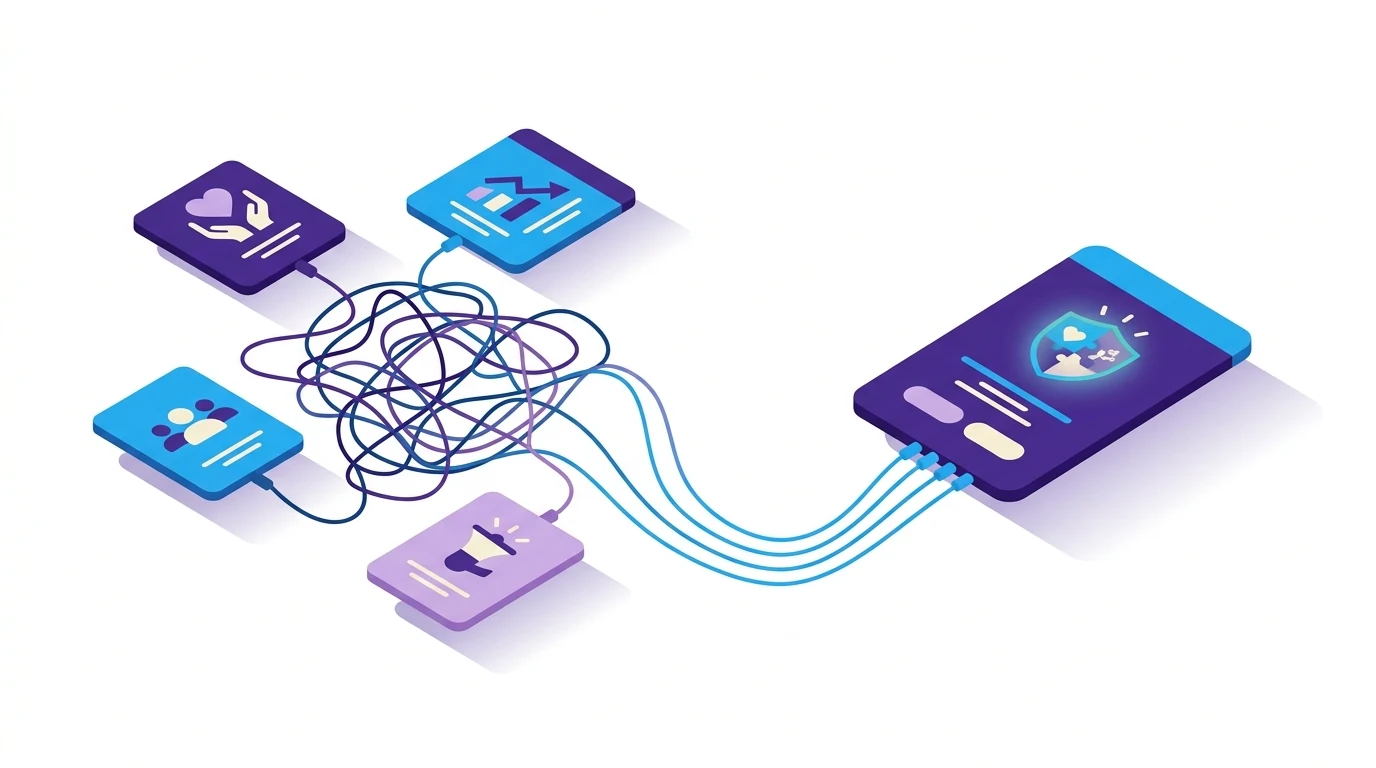
This is exactly what Otto, DonorDock's built-in AI assistant, does. Otto analyzes both your structured data (donation amounts, frequency, last gift date) and your unstructured data (every note you've ever taken, every conversation you've logged) to give you a complete picture of each donor relationship. Click on a contact, and Otto provides an intelligent summary. What would've taken you 30 minutes to compile manually you get in 30 seconds.
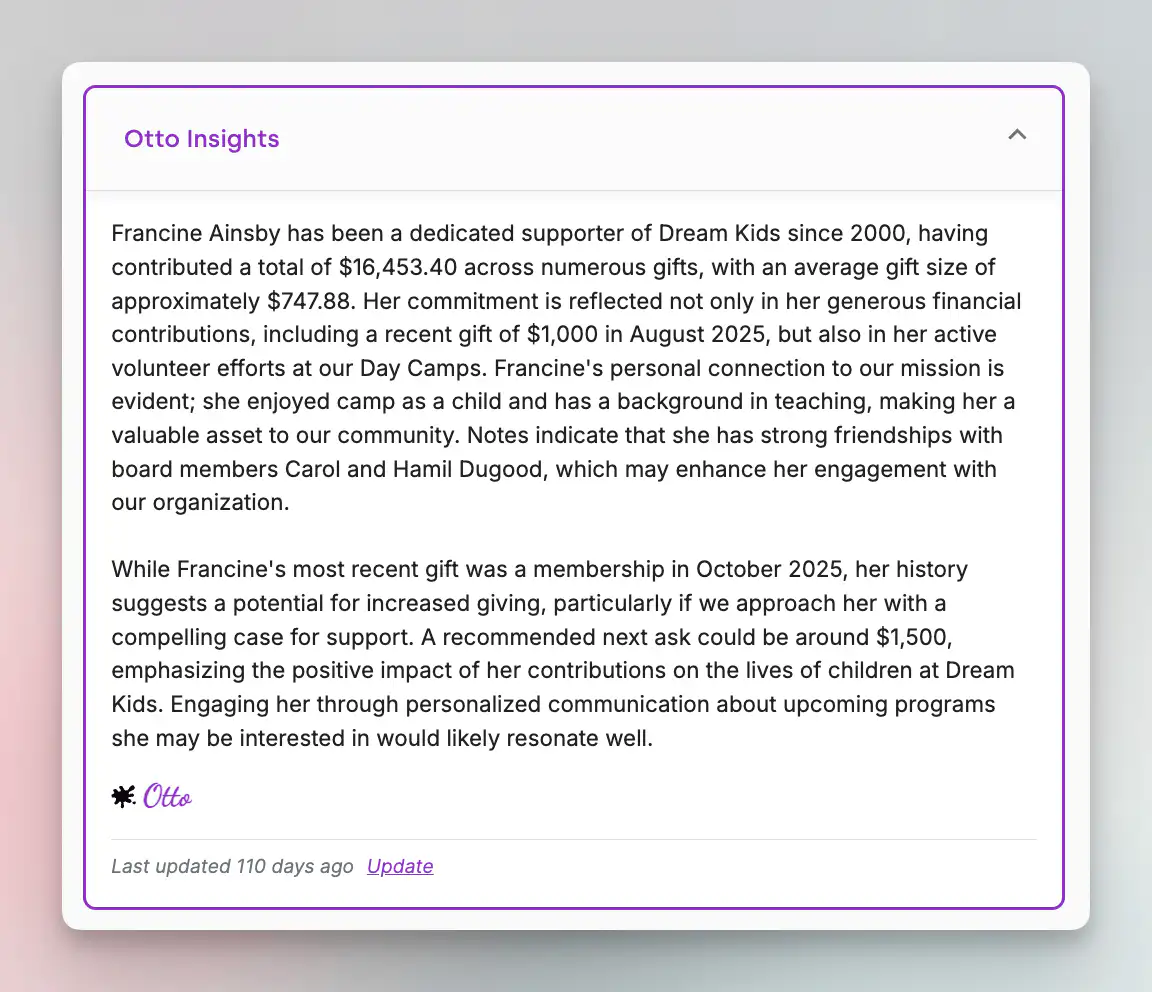
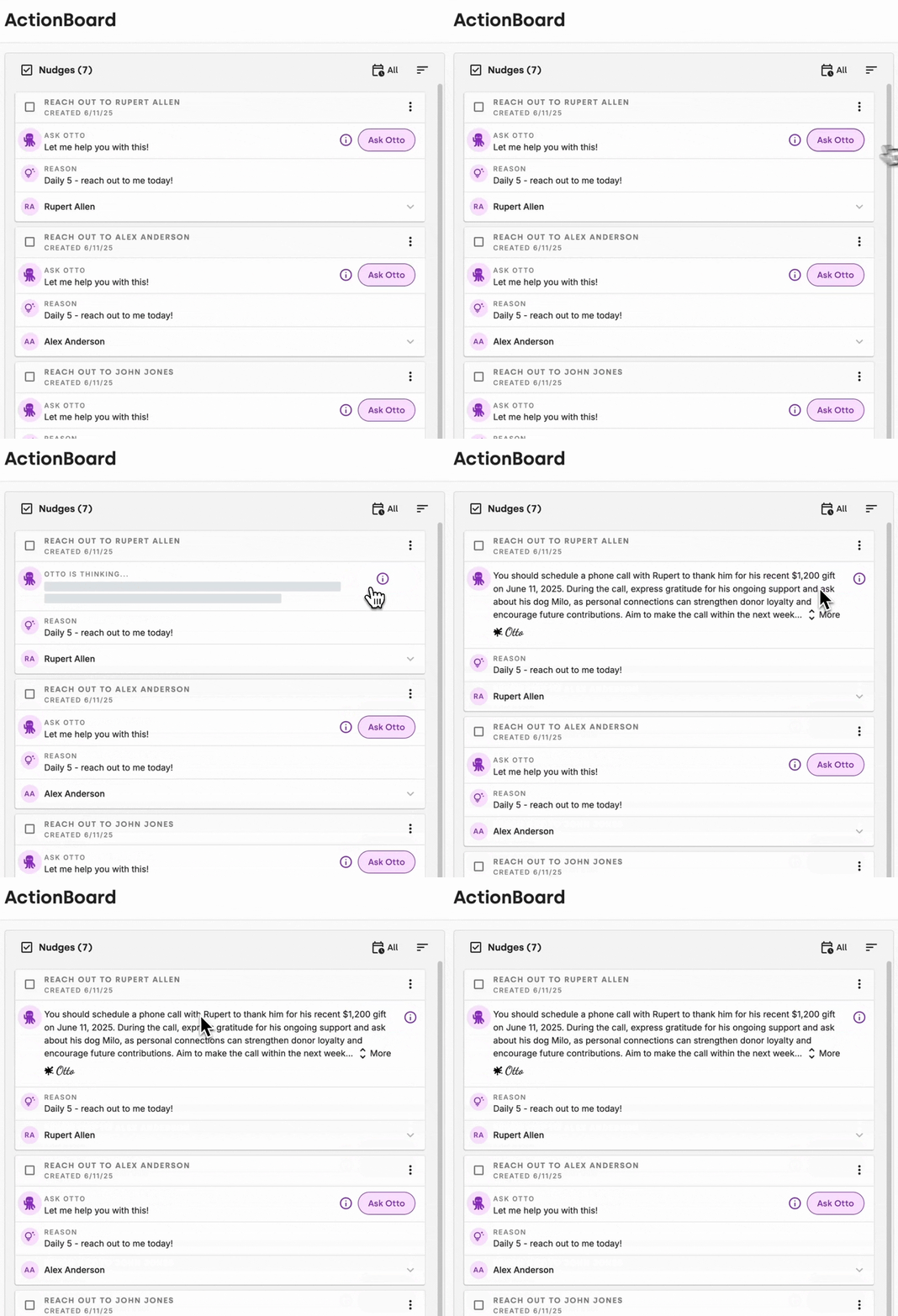
But here's where it gets really practical: Otto doesn't just analyze patterns, it recommends specific next steps for each donor based on their unique history. A donor who's been giving $100 annually for three years and just opened your last two impact emails? Otto might suggest it's time for an upgrade conversation. A major donor who hasn't engaged in 60 days but previously responded well to personal calls? Otto will recommend reaching out by phone rather than email. These aren't generic rules, they're insights drawn from your actual donor data and notes.
Automated next-step suggestions. Instead of wondering "who should I reach out to this week?" your CRM can analyze notes and giving patterns to surface donors who are warming up, cooling down, or ready for deeper engagement. This is enhancing your ability to focus on the right relationships at the right time.
The key is that AI works best when it enhances human connection, not replaces it. As noted in research from BWF, over half of nonprofits now use AI in some capacity, but the most successful applications focus on eliminating guesswork so fundraisers can concentrate energy on their top prospects.
What does this look like in practice?
Let's look at a few examples of this in action.
You're a development director at a small environmental nonprofit. You have 800 donors in your database and exactly zero spare minutes in your week.
Scenario 1: The lapsed donor. Sarah gave $500 annually for three years, then stopped. You pull up her record and click Otto's summary button. In seconds, you see: "Recurring donor 2020-2023. Passionate about watershed restoration. Mentioned her daughter's college graduation in March 2023. Last engagement: opened email about volunteer day but didn't register. Recommended action: Personal outreach mentioning past involvement and family milestone."
AI has already done the research you would have spent 10 minutes on. It surfaced the detail about her daughter from a note you took 18 months ago (something you'd completely forgotten). It also analyzed her engagement pattern and suggested a personal touch rather than another email blast.
Armed with this context, you craft a personal email: "Hi Sarah, hope your daughter is loving her first year post-graduation. We're planning another watershed restoration day this spring and thought you might enjoy bringing her along. Would love to reconnect."
That's relationship fundraising powered by intelligent technology.
Scenario 2: The major gift prospect. You're meeting with a potential major donor tomorrow. Instead of spending an hour reading through every note, you open her record and review Otto's summary: "Major donor prospect. Lifetime giving: $15,000 over 8 years. Family connection: daughter attended program 2019-2021. Board member referral (Janet Smith). Expressed interest in naming opportunities at 2024 gala. Prefers quarterly impact reports to frequent emails. Strong relationship with program director. Recommended action: Discuss legacy giving and potential capital campaign involvement."
You walk in confident, prepared, and able to have a genuine conversation rather than frantically trying to remember details.
The trust factor: keeping donors at the center
Here's where some fundraisers get nervous. "Won't donors feel weird about us using AI to analyze our conversations with them?"
The answer depends entirely on how you use it. According to the AI Equity Project 2025, nearly 80% of nonprofits use AI in some way, yet only 9% feel ready to use it responsibly. The difference between helpful and creepy comes down to intent and transparency.
Do use AI to: Remember important details so donors feel valued. Surface opportunities for deeper engagement. Ensure timely follow-up so nothing falls through the cracks. Personalize outreach based on expressed interests and past conversations.
Don't use AI to: Manipulate donors with psychographic profiling. Generate completely automated communication with no human review. Make predictions about donation capacity without proper wealth screening ethics. Share donor data with third parties for training AI models.
The goal is to use technology to strengthen human relationships, not replace them. As research from Nonprofit Tech for Good reveals, 67% of donors agree that nonprofits should use AI for marketing and fundraising tasks, but the more generous the donor, the more they expect it to be used thoughtfully.
Your donors don't want to feel like data points. But they do want to feel remembered, valued, and connected to your mission. AI helps you deliver that experience at scale.
Making the shift: from chaos to clarity
If you're still tracking donor relationships in spreadsheets or sticky notes (no judgment, we've all been there), the thought of implementing AI might feel overwhelming. Start here:
Clean house first. AI can't make sense of garbage data. Spend time cleaning up your donor records: merge duplicates, fill in missing contact info, standardize naming conventions. This investment pays off immediately.
Build the note-taking habit. Before you worry about AI, just start consistently taking notes after every donor interaction. Even basic summaries are infinitely better than nothing. Make it part of your workflow: have the conversation, write the note, set the follow-up. Every single time.
Choose a CRM built for smart stewardship. You don't need enterprise software with 47 features you'll never use. You need a system that's intuitive, affordable, and actually built for how growing nonprofits work. Look for platforms that integrate AI features without requiring a data science degree to use them. Modern donor management systems are designed specifically for this purpose.
DonorDock, for example, was built with lean teams in mind, which is why Otto is included in the platform, not sold as an expensive add-on. You don't need to configure complex AI models or worry about data privacy issues. Otto works right out of the box, analyzing your donor data and notes to provide summaries and recommendations that actually make sense for your organization.
Start with one AI feature. Don't try to implement everything at once. Maybe you begin with Otto's automated conversation summaries before your next donor call. Or you start checking Otto's recommended next steps each Monday to plan your week. Pick one thing that solves your biggest pain point and master it before adding more.
Measure what changes. Track your donor retention rate before and after implementing better note-taking and AI tools. Even small improvements compound dramatically over time.
The human advantage in an AI world
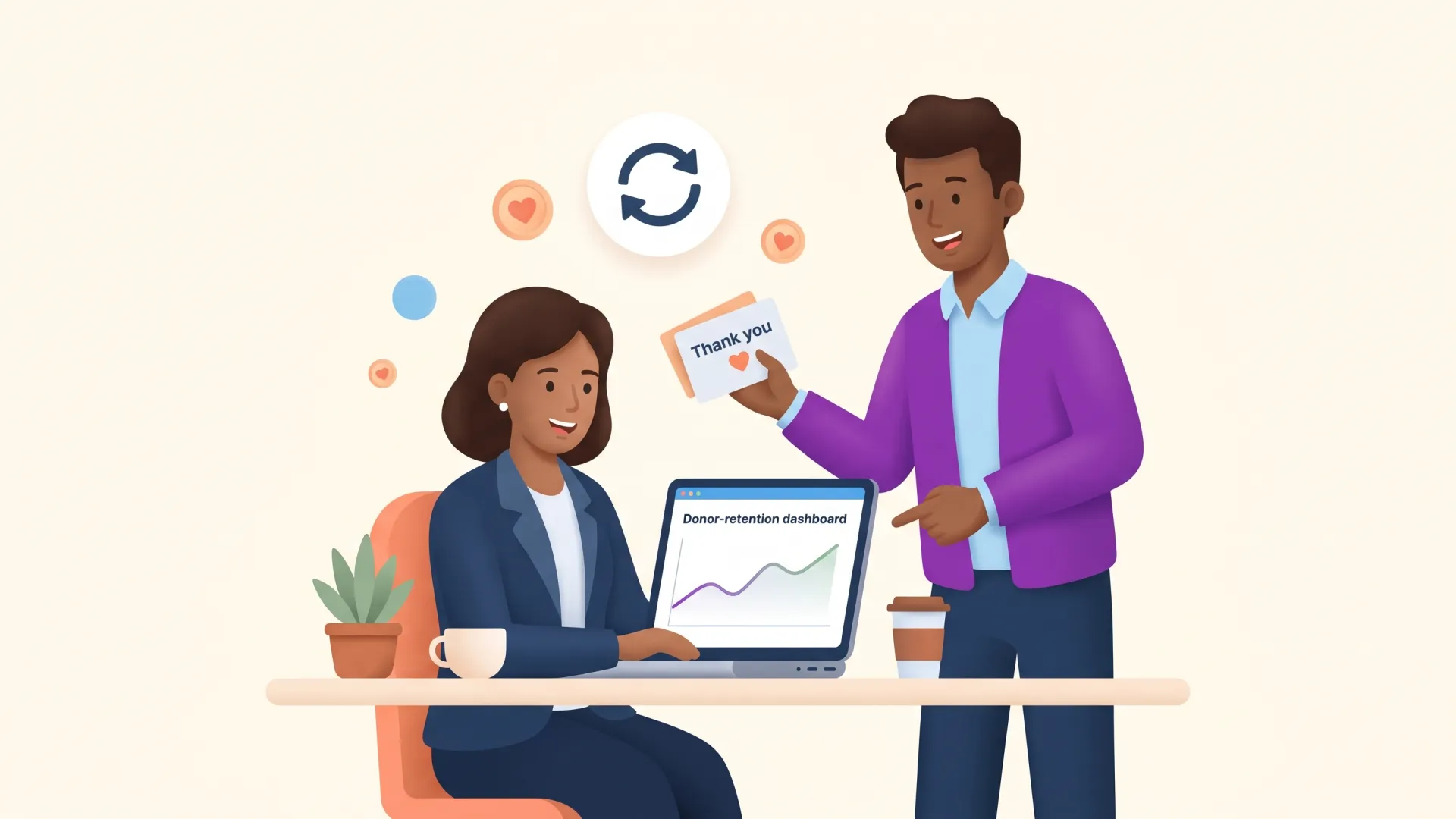
Technology can help you remember details, surface patterns, and manage follow-ups. But it can't replace the moment when a donor feels truly heard. When you reference their grandmother's legacy in a handwritten note. When you call on their birthday just to say thanks. When you connect them with a program participant whose story mirrors their own journey.
AI makes these moments possible more often by handling the administrative burden that used to consume your time. It doesn't eliminate the need for authentic human connection, it creates more space for it.
The nonprofits that thrive in the years ahead will be the ones that use technology to become more human, more responsive, and more focused on what actually matters: the relationships that fuel mission impact.
Your CRM notes are the institutional memory that keeps relationships alive through staff transitions, campaign cycles, and the general chaos of nonprofit life. When enhanced with AI, they become a strategic asset that helps growing fundraising teams build donor relationships at the scale of organizations three times their size.
You don't need a bigger team. You need a smarter system. And that system starts with taking better notes and having an AI assistant, like Otto, that actually knows how to use them.
Ready to build donor relationships that last? See how Otto and DonorDock can help you turn conversation notes into lasting donor connections with AI-powered summaries and recommendations designed specifically for lean fundraising teams.