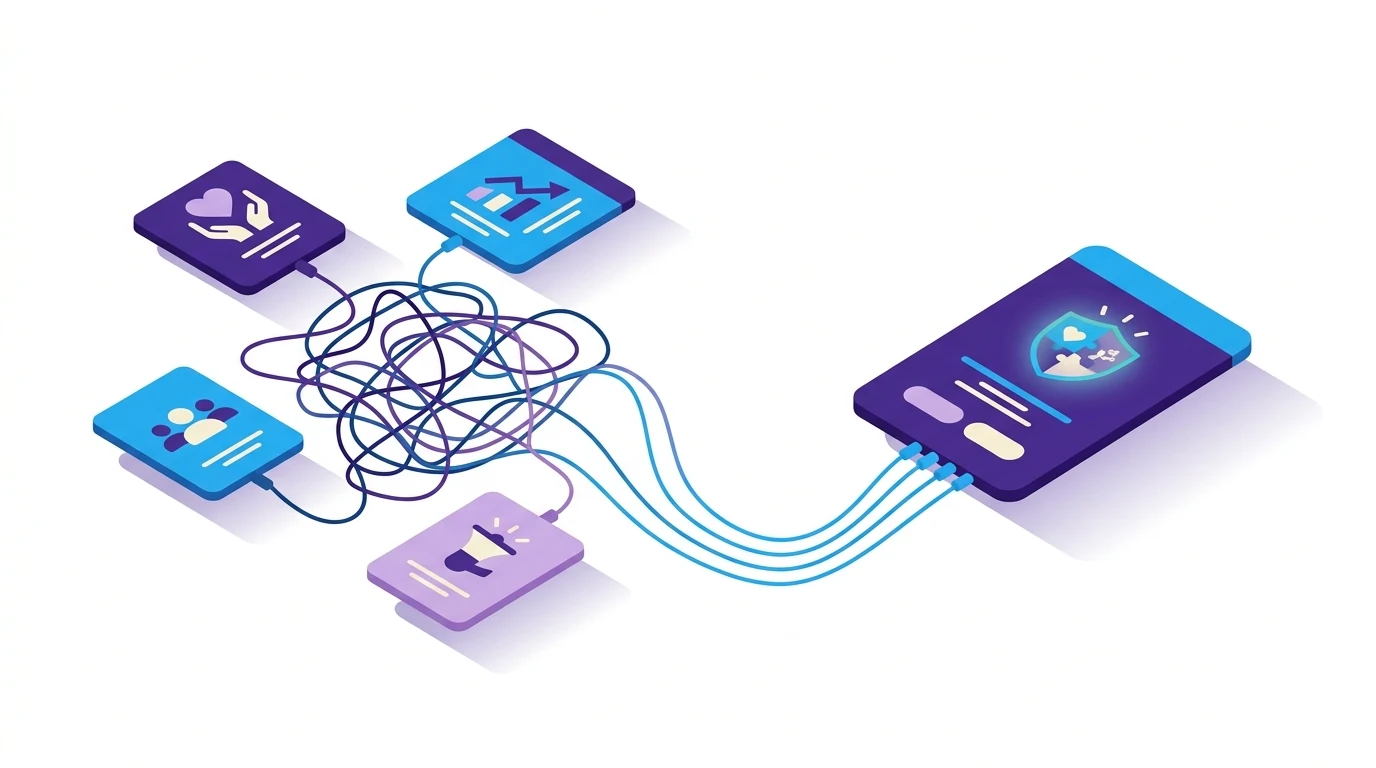
If you've ever sent a sponsorship packet to a corporation and heard nothing back, the problem probably wasn't your mission or your impact. It was your preparation. Getting corporate sponsors for your nonprofit isn't about casting a wide net. It's about doing targeted research, building a prospect list with intention, and creating a system that moves each prospect through a series of meaningful touchpoints before you ever make the ask.
This guide walks you through exactly how to build a corporate prospect pipeline from scratch, including how to use AI to accelerate your research, what your first outreach should look like, and how to track it all without losing your mind.
Step 1: Define Your Corporate Partnership Criteria
Before you research a single company, get clear on what makes a corporation a good fit for your organization. Not every Fortune 500 company is your prospect, and not every local business is too small to matter.
Write down answers to these four questions:
- What are your mission's core pillars? If you serve youth in workforce development, companies investing in education and job training are natural fits. If you focus on food security, look at grocery chains, agricultural companies, and food service corporations.
- What can you offer beyond logo placement? Think employee volunteer opportunities, skills-based pro bono projects, co-branded campaigns, speaking opportunities, or access to your community network.
- What geographic scope matters? National corporations with local offices can be ideal. They often have regional giving budgets managed by local leaders who have more flexibility than headquarters.
- What size of partnership are you ready to manage? A $5,000 event sponsorship requires different infrastructure than a $100,000 multi-year strategic partnership. Be honest about your capacity.
Step 2: Use AI to Build Your Initial Prospect List
Here's where your pipeline building gets a serious speed advantage. Instead of spending weeks manually researching companies, use AI tools to map the corporate philanthropy landscape relevant to your mission.
Open your preferred AI assistant and try prompts like these:
- "List 20 national corporations that fund [your cause area] and describe their current philanthropic priorities"
- "What companies in [your city/state] have employee volunteer programs focused on [your mission area]?"
- "Identify corporations whose CSR reports mention [specific keyword related to your work] and summarize their community investment strategy"
For each prospect that seems promising, verify what you find. Check the company's website for a foundation or community page. Look for their most recent CSR or ESG report. Search their press releases for recent grants or partnership announcements.
Aim for an initial list of 30 to 50 prospects. You'll narrow this down, but starting wide gives you options when some don't pan out. If your initial search doesn't produce enough options, ask ai to find similar companies to your chosen list.
Pro Tip: Find the Right Contact
The person who manages corporate philanthropy isn't always easy to find. In large companies, look for titles like Director of Community Relations, VP of Corporate Social Responsibility, Community Impact Manager, or Foundation Program Officer. In mid-size companies, it might be handled by HR, marketing, or even the CEO's executive assistant.
LinkedIn is your best tool here. Search the company name plus keywords like "philanthropy," "community," "CSR," or "giving" to surface the right person. Sometimes the philanthropy champion is a volunteer coordinator or a passionate employee who runs an internal giving committee, not someone with "philanthropy" in their title.
Step 3: Score and Prioritize Your Prospects
Not all prospects deserve equal effort. Create a simple scoring system to prioritize where you invest your time:
- Mission alignment (1 to 5): How closely do their giving priorities match your work?
- Existing connection (1 to 5): Does anyone on your board, staff, or volunteer base have a relationship there?
- Geographic relevance (1 to 5): Are they local, or do they have local operations that would benefit from a community partnership?
- Giving capacity (1 to 5): Based on their public giving data, what's a realistic partnership size?
- Engagement opportunity (1 to 5): Can you offer meaningful volunteer or employee engagement opportunities that would appeal to their team?
Total up the scores. Your top 10 to 15 become your "active cultivation" tier. The next 15 go into a "warm monitoring" tier where you track their activity but invest less direct outreach. The rest stay in your research file for future consideration.
This free scorecard rates a prospect on the five things that actually predict partnership success, then tells you whether to pursue now, warm them up, or park them. Score one in under a minute and export your scored list to use.
Rate each dimension 1 (weak fit) to 5 (strong fit). Your total out of 25 maps to a cultivation tier.
Rate each of the five criteria. You'll see the tier appear here.
Step 4: Map Your Pre-Ask Touchpoints
Before you ask for a dollar, plan 5 to 8 touchpoints with each top-tier prospect. These touchpoints should provide value, build familiarity, and demonstrate your credibility.
Here's a touchpoint sequence that works:
- Social engagement (Week 1 to 2): Follow their company and key contacts on LinkedIn. Like, comment on, and share their community-focused posts. Be genuine, not performative.
- Introduction email or LinkedIn message (Week 3 to 4): Introduce yourself briefly. Mention something specific about their community work that impressed you. Share one relevant piece of your own impact data. Don't ask for anything.
- Invite to an event or site visit (Month 2): Invite their community engagement contact to see your programs firsthand. Make it low-pressure. "We'd love to show you what we're working on" is better than "We'd love to discuss partnership opportunities."
- Share a relevant resource (Month 3): Send them an article, report, or data point related to the intersection of their industry and your cause area. Position yourself as a knowledgeable thought partner, not just someone who needs money.
- Facilitate a volunteer experience (Month 4 to 6): Offer a small-scale volunteer opportunity for their team. Even a half-day project creates emotional connection to your mission that a sponsorship deck never can.
- Personal follow-up after volunteer day (Month 6): Send a handwritten thank-you note or a short video message from a program participant. Share specific outcomes from their team's involvement.
- Strategic conversation (Month 7 to 9): Now you've earned the right to have a deeper conversation. Share your vision for how a partnership could create mutual value. Listen more than you pitch.
- Formal proposal (Month 9 to 12): Tailor a proposal based on everything you've learned. Reference their priorities, their team's volunteer experience, and the specific alignment points you've uncovered.
This 9 to 12 month timeline might feel slow, but according to AFP research, development relationships take 12 to 25 months to generate positive ROI. Starting with intentional touchpoints means your "ask" converts at a much higher rate than cold outreach.
Step 5: Build Your Tracking System
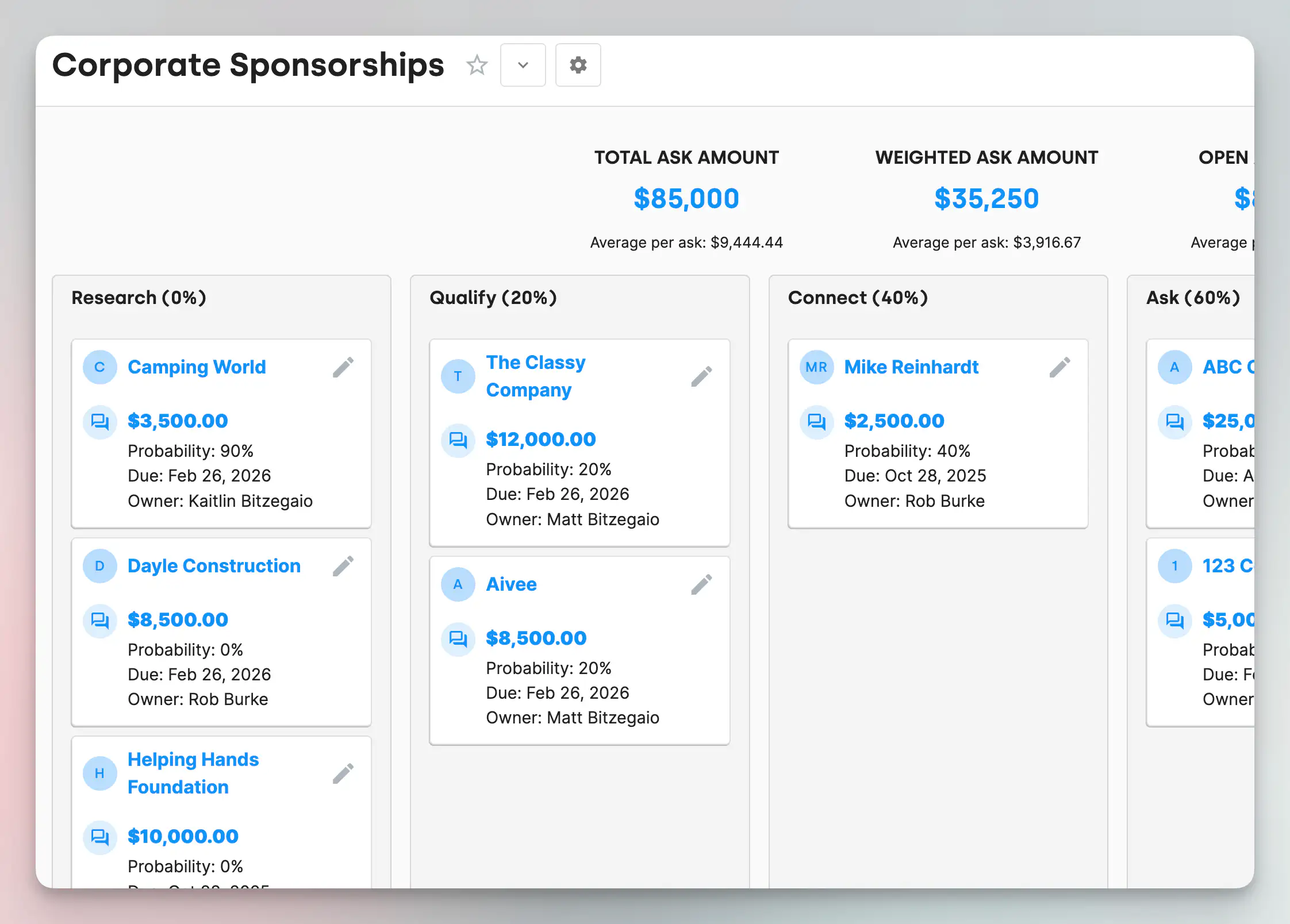
A prospect pipeline is only as good as the system you use to manage it. You need to track where each prospect stands, what your last touchpoint was, and when your next action is due.
At minimum, track these fields for each corporate prospect:
- Company name and key contact(s)
- Pipeline stage (Research, Initial Outreach, Cultivation, Ask Pending, Active Partner, Inactive)
- Last touchpoint date and type
- Next scheduled action and due date
- Alignment score from your prioritization
- Notes on conversations, interests, and internal champions
Your CRM should be the hub for this tracking, not a spreadsheet that lives on one person's desktop. With DonorDock's contact notes and activity tracking, you can log every touchpoint against the company contact record so your entire team has visibility into where each relationship stands. When your development director leaves (and statistically, they will), the institutional knowledge stays in your CRM instead of walking out the door.
Step 6: Celebrate the Small Wins Along the Way
In corporate pipeline building, the milestones that matter most happen long before the money.
Start recognizing and tracking these wins:
- A corporate contact returned your email or accepted a LinkedIn connection
- A company representative attended your event or site visit
- Their employees completed a volunteer project with your organization
- A contact introduced you to someone else in their company
- A company agreed to a formal meeting to discuss partnership
Celebrating these moments keeps your team motivated during the long cultivation period and helps you see progress even when the pipeline feels slow. It also gives your board concrete updates beyond "we're still working on it."
Step 7: Diversify Your Corporate Revenue Channels
Corporate partnerships aren't just event sponsorships. Once you're in conversation with a company, explore the full spectrum of corporate engagement opportunities:
- Matching gift programs: Over $2 to $3 billion in matching gifts go unclaimed annually. Ask corporate contacts whether their company has a matching gift program and build it into your donor communications.
- Employee giving campaigns: Many companies run annual workplace giving campaigns where employees can designate nonprofits. Getting on that list often just requires a conversation with HR.
- In-kind donations: Companies can donate products, services, or professional expertise. A law firm might provide pro bono legal review. A tech company might donate software licenses or volunteer developer time.
- Cause marketing: Co-branded campaigns where a percentage of sales goes to your organization. These require more established relationships but can generate significant unrestricted revenue.
- Grant programs: Many corporations have formal grant programs separate from sponsorships. Check their foundation websites for application timelines and eligibility criteria.
Your 30-Day Quick Start Plan
Here's what to do in the next 30 days to get momentum:
Week 1: Define your partnership criteria and use AI to generate an initial list of 30 to 50 prospects. Set up a tracking system in your CRM with the fields listed above.
Week 2: Score and prioritize your prospects. Identify your top 15 active cultivation targets. Research each one's philanthropy page and recent giving activity.
Week 3: Start social engagement with your top 15. Follow key contacts on LinkedIn. Begin engaging with their community-focused content authentically.
Week 4: Send your first round of introduction emails or LinkedIn messages to your top 5 prospects. Keep them brief, specific, and ask-free.
Within 30 days, you'll have a functioning corporate prospect pipeline with prioritized targets, active engagement, and a system to track every relationship as it develops. That's more than most nonprofits accomplish in a year of unfocused corporate outreach.
The money is out there. The corporations want to give. Your job is to make it easy, intentional, and relational. Start building that pipeline today!