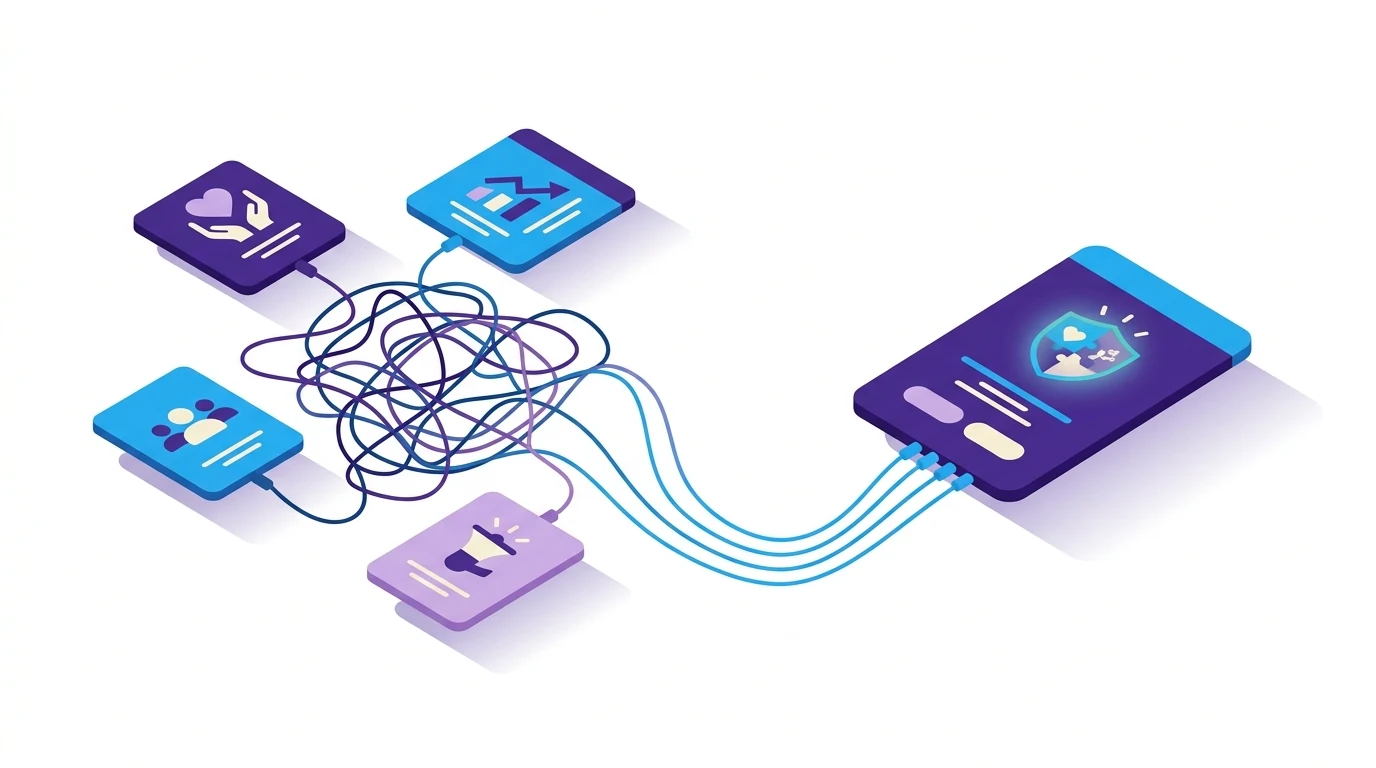
If you are running fundraising for a growing nonprofit, your to do list probably already feels like a Russian nesting doll. Every time you open one project, three more pop out.
So when you hear, “Fundraising is an and game,” it can sound like, “Cool, so I need to do even more.”
That is not our take.
Our opinion is simple:
You don't need to do more. You need to focus on what matters most.
Yes, healthy fundraising is an “and” game. But that does not mean “and another thing” forever. It means choosing a small set of connected plays that work together: events, major gifts, recurring giving, and stewardship. Then practicing ruthless elimination of more so you can actually run those plays well.
Let’s walk through how to do that in a way that fits a small, but mighty, team.
What does it really mean that fundraising is an “and” game?
Across the sector, average donor retention hangs in the low to mid 40% range, and new donor retention is often closer to 20%.
That means most nonprofits lose more donors than they keep.
You need an “and” in your fundraising, because:
- Events bring new people into the story and create energy.
- Major gifts deepen relationships with the people who can invest more.
- Recurring giving stabilizes the budget between big moments.
- Stewardship keeps everyone close enough to stay and grow with you.
But here is the key shift from a "we need to do it all" mindset:
“And” does not mean adding every channel you see on a webinar. It means choosing a few high leverage levers that support each other and saying no to the rest.
Data backs up why those levers matter:
- Average donor retention is around 44% to 46%, while repeat donor retention is closer to 69%.
- Recurring donors are often retained at 70%+ and stick around for about 8 years on average.
- Even a 10% improvement in retention can multiply donor lifetime value up to 200%.
So no, you do not need to run 12 campaigns and 4 signature events. You need a focused “and” strategy that protects your energy and grows retention.
For a deeper dive on why retention is such a powerful lever, check out DonorDock’s guide to donor retention.
Why does focusing on fewer plays help growing fundraising teams win?
When you are a growing fundraising team, your enemy is fragmented attention.
Context switching kills your momentum.
So instead of asking, “What else should we be doing?” try asking:
“Which 5 to 8 plays actually drive relationships and revenue for us?”
For most growing fundraising teams, those plays look something like this:
- One annual signature event that truly fits your audience.
- Two or three small, intentional cultivation events for mid and major prospects.
- A recurring giving program that runs year round.
- A simple, repeatable stewardship rhythm like The Smart Steward Method.
- Quarterly major donor focus, where leadership spends time with top relationships.
That is your “and.” Not everything, just the right things.
It is the move from “We do everything once” to “We do a few things well, over and over.”
How do you build a focused “and” plan for a nonprofit?
Let’s make this concrete.
Imagine your team is:
- An executive director who also fundraises.
- A development manager.
- A part time comms or operations support.
Here is how a focused “and” strategy might look in practice.
1. Give every play a clear job
Each of your core plays should have a specific role so you are not asking one event or one email to do everything.
For example:
- Signature event: find new donors, re engage existing ones, and tell one strong story.
- Small cultivation events: deepen relationships with 15 to 30 hand picked prospects.
- Recurring giving program: stabilize revenue, give donors an easy on ramp to ongoing support.
- Major gifts rhythm: move a small list of key donors from “interested” to “invested.”
- Stewardship loop: keep everyone, at every level, feeling seen and informed.
When each play has a clear job, it is easier to decide what you are not going to do.
2. Use events as a filter
With a focus lens, you stop treating events like one night cash grabs and start treating them like filters for deeper work.
You might decide:
- One well designed annual event that you actually have capacity to steward.
- Two or three low lift gatherings such as house parties, tours, or breakfasts.
- No extra events unless they directly support major gifts or recurring donors.
Every guest list becomes a prioritized follow up list:
- Potential major donors.
- Potential recurring donors.
- Potential champions who can host tables or introduce friends.
You are not doing more events. You are simply using the events you already run as on ramps into your other key plays.
3. Treat major gifts as a simple path
A focused “and” plan turns major gifts from something mysterious into a clear path.
DonorDock’s article on moves management for growing fundraising teams breaks that path into stages like Hello, Learn, Align, Ask.
For your top 25 to 50 donors and prospects, you can:
- Assign each person a stage.
- Choose one next move (not 10).
- Block weekly time for the ED and dev manager to take those steps.
You are aligning your time with the people who can make the biggest difference, and letting events and stewardship feed that pipeline.
4. Make stewardship a default rhythm
Stewardship is where focus really pays off. When you stop trying to customize 40 different touch points, you can actually run one simple loop consistently.
In daily life, that could look like:
- Thank within 24 hours in a way that fits the gift.
- Share one clear story of impact 30 to 60 days later.
- Invite the donor into the next best step after that story.
Then you repeat.
Where does recurring giving fit when you are trying to do less?
If there is one “and” that almost every growing fundraising team needs, it is recurring giving.
Recurring donors are your financial shock absorbers. Data from multiple studies shows they:
- Retain at around 70% to 85% each year.
- Stick around for roughly 8 years on average.
- Have a lifetime value several times higher than one time donors.
The beautiful thing is that recurring giving does not have to add a ton of work if you design it with simplicity in mind:
- Make “monthly” the default on your donation forms.
- Include a recurring invitation in your event follow up.
- Treat recurring donors as a named community and steward them with their own donor journey.
With DonorDock’s built in recurring gift management, you can keep those gifts organized without adding to your to-do list.
How can tools give you more focus and less frenzy?
You cannot run even a focused “and” plan in your head. Or in half a dozen shared spreadsheets.
That is where a nonprofit CRM built for small fundraising teams matters. It is not about doing more. It is about buying back time and attention so you can stay human with donors.
With DonorDock, you can:
- Keep contacts, tags, events, and gifts in one place so you see the whole picture at a glance.
- Send bulk emails and text messages.
- Use AI powered nudges and tasks to remind you who needs a thank you, an impact update, or a next step, instead of carrying it in your brain.
- Build simple journeys that send on brand thank yous and impact stories automatically, while leaving room for personal calls and notes.
Tools do not build relationships. You do. But the right tools protect your limited time so you can be present with people instead of wrestling with reports all day.
When the repetitive parts of your plan are automated, you are free to focus on the crucial few: the right donors, the right conversations, the right invitations. That is what “more focus, less frenzy” looks like in real life.
You do not need more. You need a sharper “and.”
If you remember one thing from this article, let it be this:
You do not need to add more tactics. You need to choose a small, connected “and” and run it on purpose.
- Anchor your year in a handful of plays that clearly support events, major gifts, recurring giving, and stewardship.
- Say no to the extra to protect your energy for the work that actually moves donors closer.
- Use tools like DonorDock to handle the admin, so you can handle the relationships.
Built for growing nonprofits, DonorDock is designed to help you cut through the noise, ease your mental load, and focus on what matters most: real relationships with real people who care about your mission.
If you are ready to build a focused “and” strategy instead of an overflowing calendar, see how DonorDock can help.