Babs was brilliant at her job. passionate, dedicated, and deeply connected to her community. But when you asked her about her donor management system, she'd pull out a stack of paper napkins.
That's right. Napkins. Dozens of them, covered in handwritten notes about who to call, which donors to thank, what follow-ups were overdue. Her entire fundraising operation lived in her pocket and her memory, held together by caffeine and sheer determination.
If you've ever managed donors on sticky notes, spreadsheets that multiply like rabbits, or a mental checklist that wakes you up at 2 a.m., you're not alone. The reality for small nonprofits isn't a lack of effort (you're working harder than ever). The problem is that most small teams are building fundraising on infrastructure designed to fail.
What Happens When You Run on Napkins (or Spreadsheets, or Your Brain)
Here's the thing about running fundraising without real systems: it works until it doesn't.
You're managing fine with your spreadsheet and your inbox reminders. You know exactly which donors gave last month, who needs a call this week, and what follow-ups you're behind on. Then someone gets sick for a week. Or you hire a new development person who has to learn everything from scratch. Or your star fundraiser leaves, taking years of relationship context with them.
Suddenly, donors fall through the cracks. First-time givers never get thanked. Major donor prospects go cold because nobody remembered to follow up. And you're stuck trying to reconstruct months of fundraising activity from fragmented notes and fading memory.
Research shows that nearly 60% of nonprofits face challenges due to inadequate technology resources, leading to inefficiencies and lost opportunities. When your infrastructure is built on manual processes and disconnected tools, you're not just making your job harder, you're actively limiting what your organization can accomplish.
Understanding Systems: People, Processes, and Platforms Working Together
When we talk about fundraising systems, we're not just talking about software. A system is the interaction between three core elements:
People – The team members, volunteers, and board members doing the work
Processes – The repeatable steps you take to accomplish fundraising goals
Platforms – The technology and tools that support your work
Think of these as ingredients in a recipe. You can have the best ingredients in the world, but without knowing how they work together, you're just hoping things turn out okay.
The strongest small nonprofits understand this interplay. They don't just buy software and expect magic. They build systems where the right people follow clear processes, supported by platforms that actually make their work easier, not harder.
The Hidden Cost of "Managing Just Fine"
Here's a question: How many hours did you spend last week on tasks that should happen automatically? Pause and think about this.
Manually entering donation data. Copying information between systems. Searching through old emails to remember when you last talked to a donor. Trying to figure out who needs follow-up this week. Creating the same thank-you email for the twentieth time.
Studies indicate that knowledge workers can save at least 26 minutes per person per day by reducing manual tasks through better systems. That's over two hours per week, per person. For a small team of three, that's six hours—nearly a full workday—lost to administrative friction every single week.
But the real cost isn't just time. It's opportunity. Every hour spent on manual data entry is an hour not spent building donor relationships. Every morning trying to remember your priorities is a morning that could start with clarity and focus. Every donor who slips through the cracks is a relationship that could have deepened your impact.
The fundraising you're not doing because you're too busy managing the fundraising you already did—that's the real price of weak infrastructure.
What Good Infrastructure Actually Looks Like
Good fundraising infrastructure doesn't need enterprise software or a massive budget. It means having systems that create leverage instead of adding burden.
Here's what that looks like in practice:
Your data lives in one place, not scattered across five tools
When someone makes a donation, you don't need to update three different spreadsheets and remember to add them to your email list. Everything connects, and your data flows where it needs to go automatically.
Repetitive tasks run in the background
First-time donors get welcomed consistently. Recurring donors get thanked without you having to remember. Lapsed donors get re-engagement outreach at the right time. The system handles the routine so you can focus on the relationships that need your personal touch.
You always know what matters most
Instead of waking up Monday morning wondering where to start, you have clear visibility into your priorities. Who needs follow-up today? Which donors are at risk? What projects actually move your mission forward this week?
Context travels with your team
When someone's out sick or a new team member joins, institutional knowledge doesn't disappear. Notes, history, and relationship context live in your system, not in someone's head or on their desk.
This isn't about doing more. It's about making what you already do sustainable, repeatable, and effective.
The Three System Changes That Create Leverage
If you're ready to move from your proverbial napkins to systems, here are three changes that compound quickly:
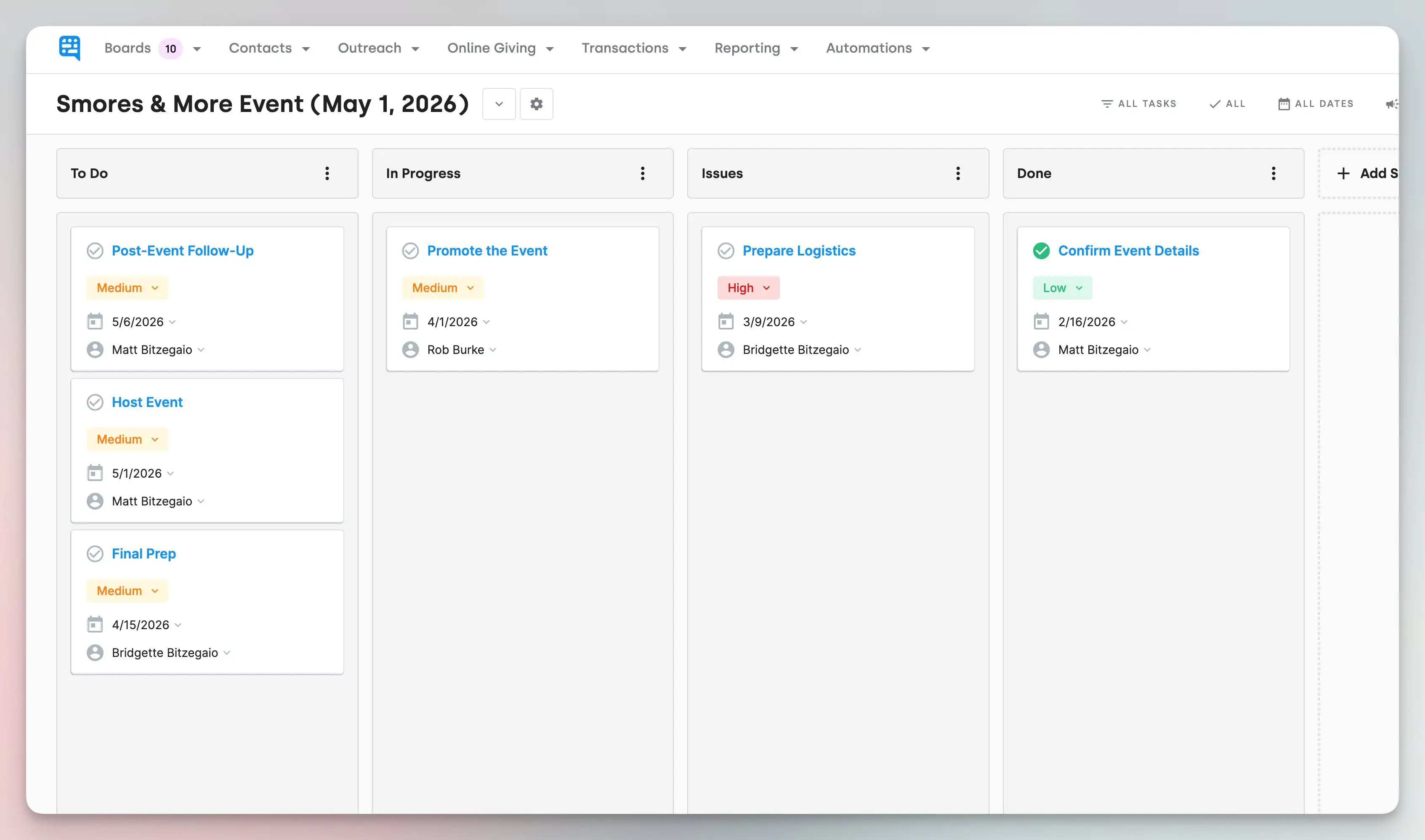
1. Protect Your Focus Through Project Management
The fastest way to feel overwhelmed is having fourteen priorities fighting for attention. Project management is about getting clear on what matters most and saying no to everything else.
Define your top three priorities for the quarter. Not ten. Three. Map out the specific steps needed to accomplish each one. Track progress in a way your whole team can see. This creates shared clarity and prevents Thursday afternoon from looking completely different than Monday morning's plan.
When everything feels urgent, you end up doing whatever's loudest instead of what's most important. Protecting focus means deciding ahead of time where you'll invest your energy, then building systems that help you stay there.
2. Multiply Your Inputs Through Automation
What tasks do you do every single week that look exactly the same? Those are opportunities to multiply your inputs.
Donor journeys are a perfect example. You'll have dozens, maybe hundreds of first-time donors this year. Instead of manually following up with each one and hoping you remember everyone, build the experience once. What should every first-time donor receive? A thank-you email within 24 hours? A phone call after two weeks? An impact story after 30 days?
Create that journey, let it run automatically, then refine it over time. Now every new donor gets that same excellent experience without requiring you to remember or execute manually each time. You did the work once, and it keeps paying dividends.
This applies to lapsed donor re-engagement, major donor cultivation, volunteer onboarding—any repeatable process where you want consistency without constant manual effort.
3. Expand Your Capacity With the Right Tools
You don't need a massive team. You need systems that expand what your current team can accomplish.
Modern nonprofit CRMs should be your command center. They surface what needs attention, automate routine follow-ups, track relationship history, and give you the clarity to make better decisions faster.
In 2025, 79% of nonprofits used five or more separate systems beyond their CRM, creating fragmentation and context-switching that drains productivity. So the goal isn't to add more tools, it's to consolidate into platforms that actually work together, reducing the mental load of juggling disconnected systems.
Look for platforms that combine donor management, fundraising automation, project tracking, and communication tools in one place. When everything connects, you spend less time managing your tools and more time using them to advance your mission.
From Babs's Napkins to What's Possible
Remember Babs? When DonorDock's founders sat down with her and saw that stack of napkins, they didn't build software to digitize the napkins. They asked a better question: "What would help Babs stop needing napkins in the first place?"
The answer was a system that would remember for her, prompt her at the right times, automate the routine, and surface what actually mattered each day. Technology that created space for her to do what she did best, build relationships, instead of drowning in logistics.
That's what good infrastructure does. It doesn't replace you. It amplifies you. It takes the administrative burden off your shoulders so you can focus on the human work that actually moves your mission forward.
Start Small, Build Momentum
Start with one system change that makes next week easier than this week.
Ask yourself:
- What task do I repeat every single week that could run automatically?
- Where is donor context currently living in someone's head instead of in a system?
- What would help me know, without thinking, what matters most today?
Pick one. Build a better process around it. Let that change compound.
Lean teams struggle when their infrastructure can't support the mission they're trying to accomplish. But when you build the right systems—people, processes, and platforms working together—suddenly the work gets lighter. Donors get better experiences. Your team has clarity instead of chaos.
And you finally get to put down the napkins.
Ready to build fundraising infrastructure that actually lightens the load? See how DonorDock can help you consolidate your tools, automate routine tasks, and focus on what matters most. Schedule a demo to see it in action.