“We don’t have capacity for stewardship” is one of the most common (and honest) things we hear from small fundraising teams.
You’re juggling events, grants, board reports, and probably HR and IT on the side. When someone says, “Let’s build a stewardship plan,” it can feel like they just handed you another 10-pound weight.
But here’s the twist: in a world where overall donor retention is hovering around 18%, and new donor retention is scraping the bottom near 14%, the real risk isn’t doing “too much” stewardship. It’s doing none at all.
The good news? You don’t need a bigger team to be a good steward. You need a simpler plan, and tools that create capacity for you.
That’s exactly where focused stewardship, a right-sized CRM, and light automation come together to ease your mental load.
What if “no capacity for stewardship” is really a focus problem?
Let’s start with why stewardship matters so much for small and growing nonprofits.
Retaining donors is consistently more cost-effective than acquiring new ones. Sector research shows that keeping a donor is significantly cheaper than finding a new one, and that retained donors become a more stable, predictable revenue base over time.
At the same time, national data keeps ringing the same alarm:
- Dollars raised are inching up.
- The number of donors and retention rates are trending down.
In other words, fewer people are giving more money, and many first-time donors never come back.
For a growing fundraising team, that has big implications:
- Constant acquisition is expensive and exhausting.
- Losing donors you already worked hard to acquire is painful.
- A handful of disengaged mid-level donors can blow a hole in your annual goal.
So when we say, “We don’t have capacity for stewardship,” what we’re really saying is:
“Our current to-do list is full of things that matter more than keeping our donors.”
That’s actually good news. You probably don’t need more capacity. You need more focus.
How do you make stewardship doable for a small fundraising team?
Let’s translate “stewardship” into something your calendar can handle.
Instead of a 20-page stewardship matrix, think in terms of minimum viable stewardship: the smallest set of consistent actions that make your donors feel seen, appreciated, and informed.
Here’s a simple framework to get you out of overwhelm and into action.
1. Pick 3 donor segments instead of 30
You don’t need a hyper-detailed segmentation strategy to start. Those three core groups could be:
- New donors (first gift in the last 12 months)
- Recurring / monthly donors
- Core supporters (for example, donors who give $1,000+ a year, or have given 3 years in a row)
Ask, “If we only did a few special things for these three groups, what would move the needle the most?”
2. Define “moments that matter” for each segment
For each group, identify key moments where a touchpoint will have outsized impact. For example:
New donors:
- Thank them within 24 hours of their first gift
- Show impact 30–45 days after first gift
- Touch point before year-end
Recurring donors:
- Call them immediately when they start their recurring gift
- Send a quarterly “insider” update
- Mail an annual thank you + impact summary
Core supporters:
- Personalized thank you after each significant gift
- One “no ask” gratitude touchpoint during the year
- One intentional conversation about impact, goals, or future support
Now you’re no longer trying to “steward donors better” in general. You’re committing to a handful of specific donor moments.
Stewardship becomes manageable when you move from “be better with donors” to “do these 3 things for these 3 groups.”
3. Create “good enough” templates, not perfect masterpieces
Perfection is the enemy of capacity. You don’t need 15 versions of every email. You need a solid first draft you can personalize when needed.
Build simple templates for:
- New donor welcome email
- Recurring donor “insider” update
- Year-end gratitude email that’s not just “here’s another appeal”
- Quick call script for thank-you follow ups
Later, you can refine. For now, aim for warm, clear, and on brand, not Pulitzer-worthy. Utilize tools like Otto to help you draft these templates and save time.
4. Protect a small weekly stewardship block
If stewardship always loses to “urgent,” it needs a reserved seat on your calendar. Try blocking:
- 1–2 hours per week labeled “Donor stewardship only”
- No event planning. No grant writing. Just follow ups, thank yous, and impact updates.
Even tiny, consistent blocks will add up if your system is focused and your tools are doing their job.
How can a nonprofit CRM and automation create capacity you don’t think you have?
Here’s the reality: you can’t sustain stewardship at scale with spreadsheets, sticky notes, and your memory. That’s where a nonprofit CRM built for growing teams changes the game.
A tool like DonorDock’s CRM, which is purpose-built for small and mid-sized nonprofits, centralizes donor data, giving history, and engagement in one place so you don’t have to chase information across a dozen systems.
Then you layer in light automation to take work off your plate instead of adding more.
1. Turn “I should follow up” into automatic thank you flows
Instead of manually sending every thank you, you can:
- Trigger an automatic receipt plus a warm thank-you email after each gift.
- Automatically create a task in your CRM for personal outreach when a gift hits a certain threshold.
DonorDock’s workflows and stewardship journeys are designed exactly for this kind of “first line” automation, so the basics of gratitude happen every time without you babysitting the process.
You still get to add human touches. Automation just handles the repetitive “first pass” so you’re not constantly worried about who you forgot.
2. Let smart nudges decide “who needs you next”
One of the biggest capacity killers is decision fatigue. You sit down at your desk, look at a massive list of donors, and think, “Where do I even start?”
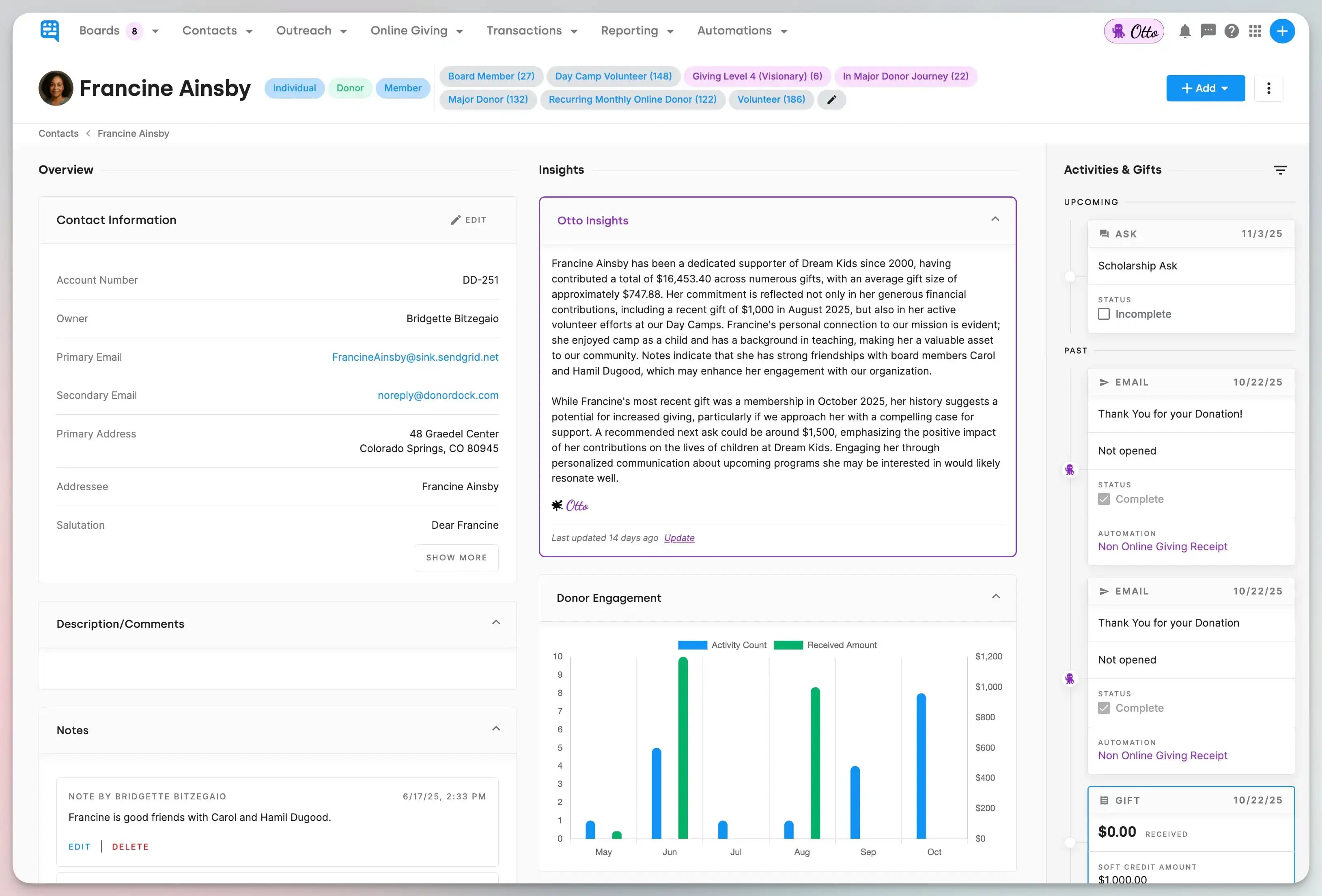
DonorDock’s smart assistant (Otto) is built to surface the donors who need attention, with suggested next actions, so you’re not relying on guesswork or memory to prioritize your outreach.
Instead of scanning spreadsheets, you log in and see:
- “These 10 lapsed donors need a re-engagement touch.”
- “These 5 recurring donors haven’t hear from us in a while.”
- “These 8 new donors haven’t been called yet.”
That’s capacity. The system is thinking with you.
3. Use journeys to carry the relationship between touchpoints
Stewardship journeys are pre-defined paths donors can move through automatically:
- New donor welcome series
- Recurring donor gratitude cadence
- Lapsed donor re-engagement sequence
Tools like DonorDock make it easier for growing fundraising teams to build these journeys once and then let them run in the background, while you jump in personally where it counts most.
You’re not replacing the relationship. You’re creating a safety net of consistent touchpoints so donors aren’t dependent on your memory.
The goal of automation is to make sure the human moments actually happen.
4. Choose tools that match your reality
A lot of CRMs were built for big development departments. If a system feels too complex to adopt, you’ll never get the capacity benefits.
DonorDock was intentionally built as an all-in-one CRM and outreach tool for nonprofits with limited staff, so donor management, email, and online giving live in one simple place instead of five separate tools.
That’s how tech creates capacity:
- Less time copying data between systems.
- Less energy spent learning three platforms.
- More of your day available for actual donor relationships.
What’s a realistic plan to build a stewardship system?
If you’re thinking, “Okay, but where do I start on Monday?” here’s a simple path you can follow over the next 90 days.
Map the reality, not the ideal
- List the last 20 meaningful donor touchpoints you actually did.
- Note which segments they were for (new, recurring, core supporters).
- Circle the 3–5 that felt most impactful and sustainable.
You’re looking for proof of what already works, not inventing from scratch.
Design your minimum viable stewardship plan
- Choose your core segments.
- Identify at least 3 moments that matter for each segment.
- Draft simple, “good enough” templates for those moments.
Keep everything in one place, ideally in your CRM so you’re not digging through old Google Docs.
Build your first automations
Inside a tool like DonorDock, set up:
- Automatic gift receipts + thank-you email, with a follow-up task for gifts over $X.
- A basic 2–3 touch new donor welcome journey. (or better yet, turn on pre-built journeys for 6 key segments)
- A quarterly touch for recurring donors (impact update, quick video, or story).

Test these internally first, then turn them on and let them run.
Add smart prioritization and refine
- Start every “stewardship block” by looking at smart nudges or task lists from your CRM.
- Track which donors are responding and where you might add a personal call, note, or visit.
- Adjust subject lines or content based on what actually gets engagement.
By the end You’ll have:
- A short list of high-impact actions.
- Automations handling repetitive tasks.
- A CRM acting as command center instead of a static Rolodex.
That’s capacity you didn’t have before, without adding a single FTE.
Bringing it all together
You'r donors want presence, gratitude, and clarity about the impact they’re making.
When you:
- Narrow your focus to a few key segments and moments.
- Use templates so you’re not rewriting everything from scratch.
- Let a CRM and automation carry the repetitive load.
…stewardship stops being “one more thing” and becomes the backbone of a healthier, more predictable fundraising program.
The ruthless elimination of “more” is what finally makes room for meaningful stewardship.
If you’re ready to move from “we don’t have capacity for stewardship” to “stewardship is built into how we work,” take the next step:
Schedule a quick demo and start building a stewardship system that protects your energy, deepens donor relationships, and helps you focus on what matters most.