
If you’ve ever stared at your fundraising results and thought, “Cool… but why did this work?” you’re not alone.
Small fundraising teams don’t need more data. You need the right handful of numbers that tell you what to do next, without turning your day into a spreadsheet marathon.
Let’s talk about what to track, what to ignore, and how to turn reporting into your easiest decision-making tool.
What fundraising metrics should a growing nonprofit team track?
Start with metrics that answer one question: What should we do more of, less of, or differently next time?
Here’s a focused set that works for most small and growing fundraising teams:
- Total dollars raised by campaign (and vs. goal)
- Donor retention rate (overall and by segment)
- New donors acquired (and how many gave again)
- Average gift (and average gift by channel)
- Recurring donors gained (and recurring revenue trend)
- Revenue per outreach (ex: revenue per 1,000 fundraising emails)
- Landing page completion rate (donation page drop-off)
- Top performing segments (who responded best and how)
Why these? Because donor retention is getting harder, and you need clarity fast. The Fundraising Effectiveness Project estimates overall donor retention was 42.9%, down 2.6% from.
And while dollars can be up, the donor count can still shrink. FEP’s Q4 2024 data found dollars raised increased 3.5%, but the number of donors fell 4.5%.
That’s the reality check: You need to keep donors and protect your base, especially at the $1 to $100 level where declines have been sharp.
Focused fundraising isn’t tracking everything. It’s tracking what changes your decisions.
Your CRM is your most important tool in this.
Which metrics are misleading during an appeal?
Let’s be honest: some metrics make us feel productive, but they don’t tell us what’s happening.
The big trap: email open rates
Open rates have gotten unreliable thanks to privacy changes, including Apple’s Mail Privacy Protection, which can inflate opens by preloading tracking pixels.
So instead of obsessing over opens, focus on outcomes:
- Click-through rate (CTR)
- Donation page completion rate
- Revenue per 1,000 fundraising emails
- Conversion rate by segment
M+R Benchmarks’ 2024 findings put a hard number on it: for every 1,000 fundraising emails sent, nonprofits raised $58.
And their email charts show a tough but helpful truth: the average fundraising email CTR was 0.48% and the page completion rate was 12%.
Those aren’t numbers to panic about. They’re numbers that help you plan.
If you can’t connect a metric to revenue, retention, or a next action, it’s probably a vanity metric.
What reports should you run before, during, and after a campaign?
This is where growing fundraising teams win with a rythm.
Before the appeal: set baselines (so you can spot real lift)
Run these 2 weeks before you launch:
- Donor list health: active donors, lapsed donors, new donors this year
- Retention snapshot: overall retention and first-time donor retention
- Segment list: major donors, monthly donors, LYBUNT, SYBUNT, event-only donors
- Last campaign performance: dollars, response rate, average gift, top channels
If you’ve ever felt like reporting is painful, it helps to define a short, consistent set of indicators and stick to them. DonorDock’s article on measuring impact makes this point really well, especially for missions that are hard to quantify.
During the appeal: watch leading indicators (not just the total)
Check these 2 to 3 times per week:
- Gifts per day and dollars per day
- Average gift and gift size distribution
- Conversion rate on the donation page
- Performance by segment (who is responding)
- Channel performance (email vs. social vs. direct mail)
This is where you get to be strategic instead of reactive. If one segment is responding well, you can double down. If a channel is lagging, you can adjust messaging or timing.
After the appeal: do a simple post-mortem that actually helps next year
Within 7 days of wrap-up, answer:
- What was the best performing segment and why?
- Which message had the highest revenue per send?
- Did donors who got stewardship touches before the ask perform better?
- What did new donors do in the 30 days after giving?
- What will we repeat next time?
How do you use reporting to improve donor stewardship, not just revenue?
This is where the “numbers people” and “relationship people” finally high-five.
Your reports should help you spot who needs love next, like:
- First-time donors who haven’t received a thank-you call
- Donors who gave in December last year but have not given this year
- Monthly donors who hit an anniversary (perfect time to celebrate and upgrade)
- Donors whose giving is growing (quiet major gift signals)
One of the best uses of a CRM isn’t fancy analytics. It’s making sure donors don’t fall through the cracks when you’re juggling 48 other priorities.
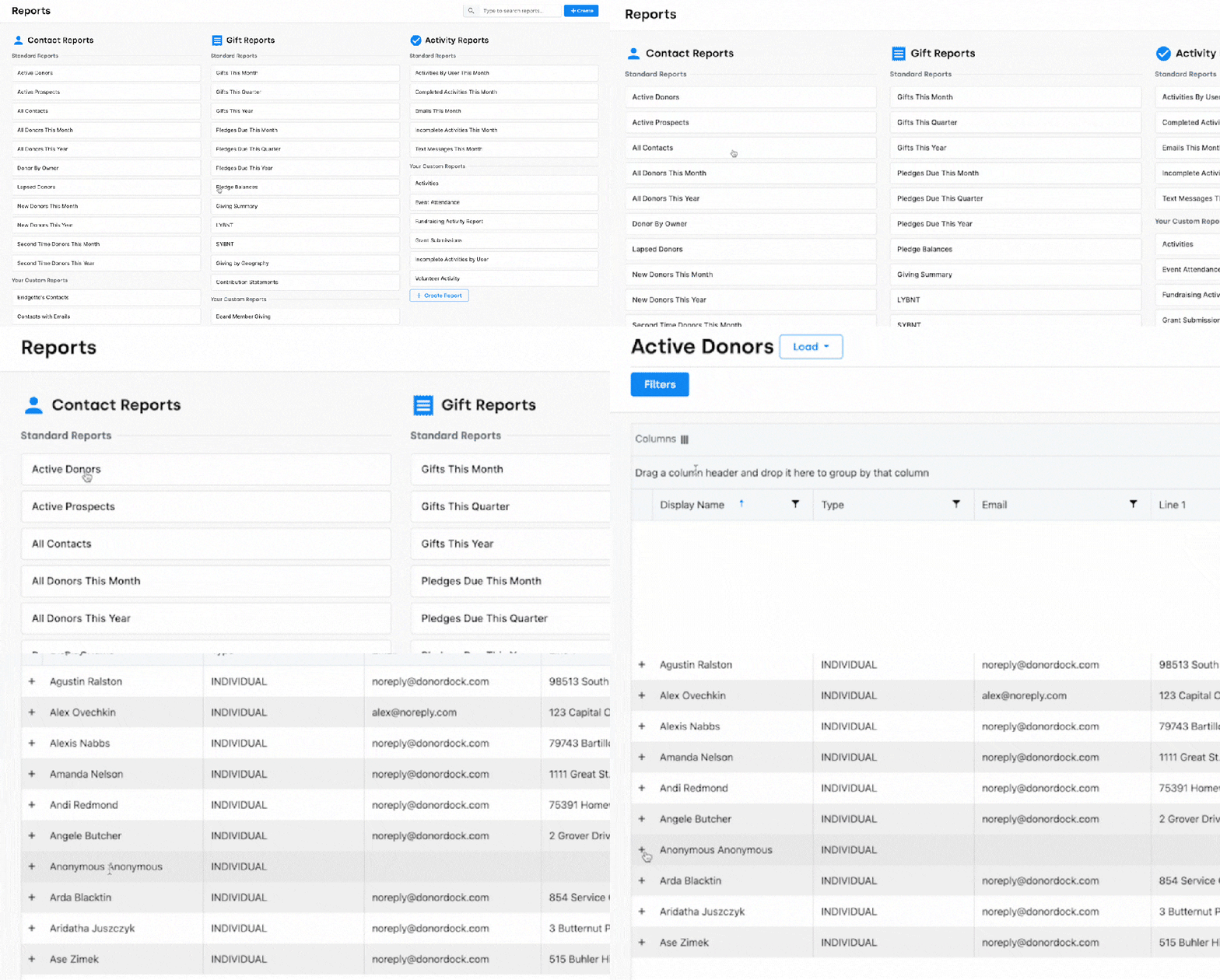
A simple fundraising dashboard can reduce your mental load by keeping progress visible and making it easy to spot trend lines without exporting data every time.
And yes, I’m biased, but I’m biased for a reason: growing fundraising teams deserve tools that don’t require a data analyst to answer basic questions. Reporting should be as simple as filtering.
What does “good” look like if you’re benchmarking?
Benchmarking is useful when it keeps you grounded, not when it makes you spiral.
Here are a few anchor points you can use:
- Retention: FEP estimates 2024 retention at 42.9% overall.
- If you’re above that, you’re doing something right. If you’re below it, you’ve got a clear stewardship opportunity.
- Email fundraising efficiency: M+R shows $58 raised per 1,000 fundraising emails in 2024.
- If you’re below, look at segmentation and landing page friction. If you’re above, you’ve got something worth repeating.
- Click-through and completion: Average 0.48% CTR and 12% completion rate can help you spot whether the issue is the email itself or the donation page experience.
Also zoom out once a year. Giving USA reported total U.S. charitable giving reached $592.50 billion in 2024, up 6.3% in current dollars (and 3.3% adjusted for inflation).
Plenty of generosity exists. The challenge is earning attention, trust, and repeat giving in a crowded environment.
How do you make reporting simple if you’re short-staffed?
This is the part I want you to take seriously: you don’t need to become a “data person.” You need a focused system.
Try this:
- Pick 6 to 10 core metrics you’ll track all year.
- Create a weekly 15-minute check-in: what’s up, what’s down, what needs action.
- Create a monthly 30-minute review: retention, acquisition, recurring, campaign performance.
- Document what you learn after each appeal so next year’s planning starts smarter.
- Assign ownership even if it’s rotating. Someone has to be the “numbers driver,” even if they’re not a numbers nerd.
Ruthless elimination of more applies to reporting, too. More focus, less frenzy.
If you’re building this from scratch, start with DonorDock’s focused metrics guide and make it your team’s shared language.
Conclusion: data doesn’t replace relationships, it protects them
The point of metrics isn’t to turn you into a robot fundraiser.
It’s to help you:
- stop guessing,
- focus on what matters most,
- and build repeatable fundraising that outlives any one person on your team.
If you want reporting that’s built for growing fundraisers, DonorDock’s fundraising dashboard and reporting tools are designed to make the “what’s working?” question ridiculously easy to answer.
Schedule a demo and see how DonorDock can help you track the right metrics, tighten stewardship, and run smarter appeals without piling on extra work.