
If you’re running fundraising on a growing fundraising team, “year-end season” can start to feel like a personality trait.
You know the drill. It’s October and suddenly your calendar looks like someone dumped a box of Legos down a staircase. Program wants stories. The ED wants projections. The board wants a plan. Finance wants clean numbers.
And somewhere in the middle of all that, you’re supposed to create a beautiful, moving, on-brand year-end appeal that hits the goal, keeps donors happy, and doesn’t make you cry into a reheated lunch.
Here’s the good news: you don’t need more hustle. You need a longer runway.
In a recent episode of The Focused Fundraiser, Maddie Szymanski shared what happened when her team stopped treating year-end like a last-minute campaign and started building donors into a story all year long. The result: an end-of-year appeal budgeted at $100,000, tracking toward about $140,000. (Yes, really.)
Let’s break down how to plan your appeals a year ahead so Q4 feels focused, not frantic.
When should you start planning your end-of-year appeal?
Start in January, because donors don’t decide in December. They decide based on what they’ve felt all year.
If you’ve ever looked at your year-end results and thought, “We worked so hard… why did this feel harder than it should’ve?” the real issue probably wasn’t effort. It was timing.
Year-end isn’t “just another campaign.” For many organizations, November and December drive a massive share of annual online revenue. The 2025 M+R Benchmarks Study is often summarized as showing nonprofits raise 24% to 47% of annual online revenue during those two months, depending on cause area.
So planning early isn’t about being type-A. It’s about making your year-end ask feel like the natural next step in a relationship you’ve been building all year.
Think of it this way: if your donors only hear from you when you need money, the ask feels like a transaction. If they’ve been part of the story all year, the ask feels like belonging.
A simple year-ahead planning cadence you can actually stick to
This is a “set it and breathe” roadmap. Not a perfect plan. A usable one.
January: Debrief and decide what you’re repeating
This is the month where you do the thing nobody has time to do in December. You pause.
Pull your year-end numbers. Skim your emails and letters. Look at what actually got traction.
Then ask:
- What worked last year that we should keep?
- What felt chaotic or overly complicated?
- What can we ruthlessly eliminate this time?
February to March: Pick the one message you want to repeat all year
Not 12 themes. One.
This is the part that feels almost too simple, which is why it works.
Pick one thread you can repeat across updates, events, social posts, newsletters, thank-you calls, and appeals:
- One problem you solve
- One outcome donors make possible
- One transformation you can show over time
When growing fundraising teams spread messaging across too many priorities, donors feel it. They might still like you, but they don’t know what you stand for. Clarity beats variety.
April to June: Build the list and the segments
This is where grown-up fundraising happens. Not glamorous, but it buys back your time later.
- Clean addresses and emails
- Confirm who is actually mailable
- Tag and segment donors in ways that match how they behave
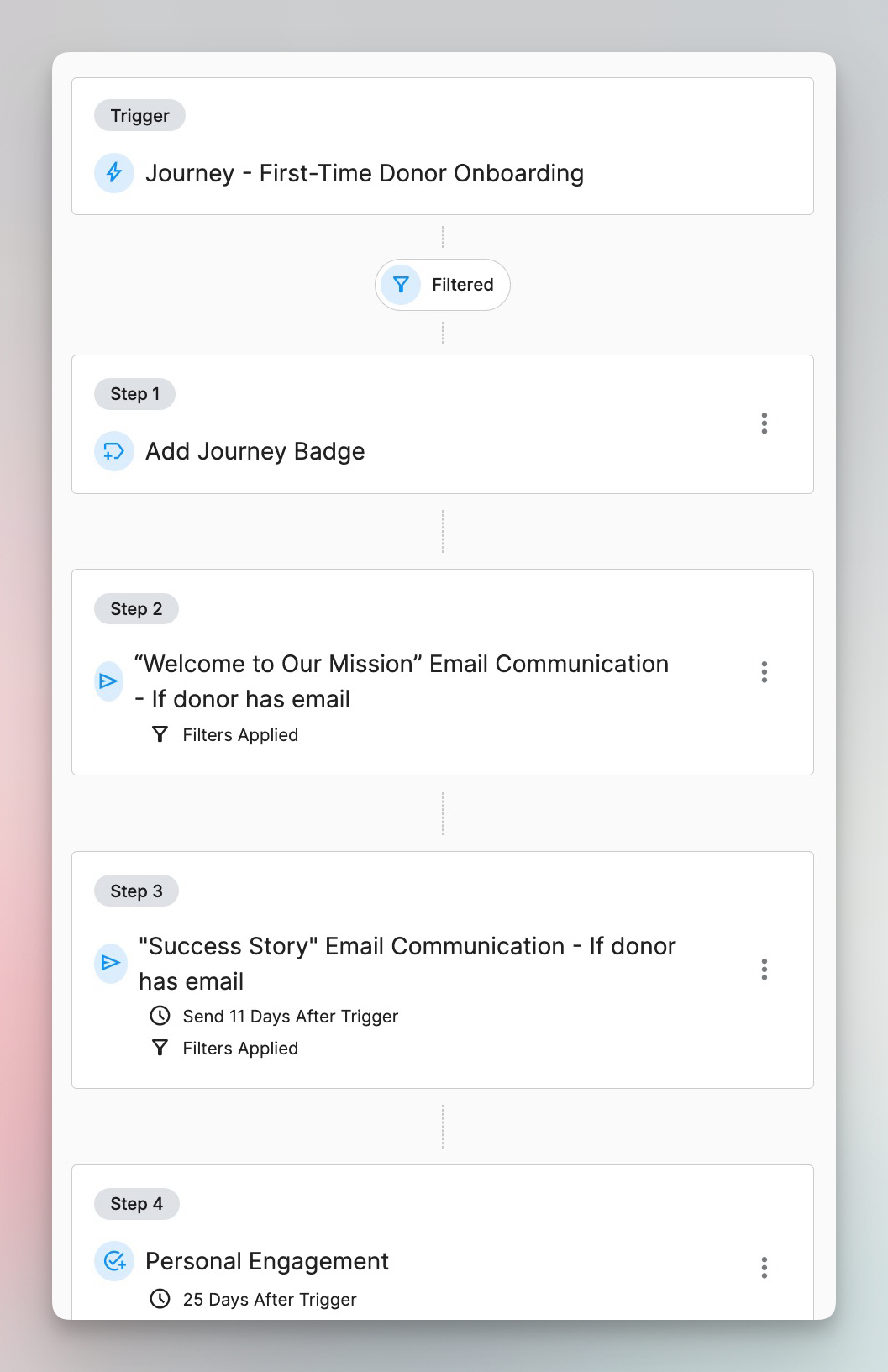
If you need a simple segmentation model, DonorDock’s built-in Donor Journeys can help you steward engagement without extra staffing needed.
July to August: Collect story assets before you “need” them
This is the part almost everyone skips, then regrets in November.
In the summer, your programs are actually moving. People are available. Photos are accessible. Stories are happening in real time.
So take 2 hours and gather:
- Photos that show real work (not just posed smiles)
- Quotes you can use as story anchors
- One clear impact stat or before-and-after detail
- A short story from a client, student, patient, family, or community partner
If you wait until November, you’ll end up using whatever you can grab.
September to October: Warm up donors
No pressure. No panic. Just connection.
This is where you turn “year-end appeal” into “year-end continuation.”
You’re laying emotional groundwork so the ask doesn’t feel like a cold call. You’re also training your donors to expect consistency from you. And consistency is one of the most underrated growth strategies in fundraising.
November to December: Execute the plan
Q4 should feel like execution and donor conversations, not starting from zero.
What do you send before the ask so donors are warmed up?
Send value, proof, and belonging. Then when you ask, it feels earned.
This is where a lot of year-end appeals fall apart. Not because the copy is bad, but because the donor experience is basically:
- Silence
- Suddenly: “Hey bestie, can I have $500?”
If your donors feel like they only exist when you need money, your year-end appeal has to work twice as hard. It has to both build trust and ask for cash in the same breath.
Maddie’s point was simple: their results improved because they didn’t wait until the appeal to build the relationship.
“We’re building those relationships with our donors before they actually receive the ask… our holiday end-of-year appeal was budgeted for $100,000… we’re coming up on 140 right now.”
Your “pre-ask runway” (steal this)
Aim for 4 to 8 touchpoints between summer and the big ask, depending on your capacity. You’re not trying to overwhelm donors. You’re trying to show up like a trustworthy organization.
Here are options that work well for growing fundraising teams:
- Impact proof: one clear outcome and what made it possible
- Not a long report. One sharp win donors can picture.
- A behind-the-scenes moment: show the work, not the polish
- A quick photo, a short story, a “here’s what today looked like” update.
- A donor-centered story: “You made this happen” with specifics
- The more specific, the more believable. Donors can smell vague gratitude.
- A values reminder: why your mission exists and what’s at stake
- This helps donors connect their giving to something bigger than a transaction.
- A soft invitation: volunteer, tour, reply to a question, share a post
- Even a simple “Hit reply and tell us why you care about this” can create connection.
- A board-led moment: thank-you calls, a matching gift, peer intros
- Board help works best when it’s structured and time-bound, not “everyone talk to your friends sometime.”
If you want a ready-made menu of stewardship touchpoints that make donors feel the difference they’re making, DonorDock’s 7 Touchpoints article lays out a practical sequence you can repeat without needing extra staff.
How do you run a multi-channel year-end appeal without burning out?
Build one campaign, then repurpose it across channels. Don’t build five separate campaigns.
Growing Fundraising Teams burn out when every channel becomes a separate creative project.
Email becomes its own thing. Direct mail becomes its own thing. Social becomes its own thing. The donation page becomes its own thing. Then you’re juggling four mini-campaigns while also doing your actual job.
Instead, you want a single campaign engine with swappable parts.
The minimum viable multi-channel campaign
Here’s a structure that’s realistic for small and growing teams:
1) One core message
You’re answering the same three questions everywhere:
- What’s happening?
- What do we do about it?
- What can the donor do now?
Keep it consistent. Donors don’t get bored of your message as quickly as you do.
2) One anchor story
One person. One family. One community partner. One moment.
This story becomes:
- the letter
- the email series
- the landing page
- the “last chance” reminder
- the social captions
Consistency doesn’t make your campaign boring. It builds trust that you are consistent in your pursuit.
3) Two to four “push” moments
- Early November: “We’re getting ready”
- Late November: “Here’s what’s at stake”
- Mid-December: “We’re close”
- Final days: “Last chance to be part of this”
4) Channels that match your donors (not your guilt)
You don’t need to be everywhere. You need to be consistent where it counts.
If your donors respond to email, focus there. If direct mail is still a meaningful channel for your organization, coordinate it with digital so the message feels like one campaign, not competing voices. M+R Benchmarks data and related analysis often reinforces that coordinated fundraising across channels supports performance because donors experience it as a connected story, not a scattered scramble.
A burnout-proof rule that keeps Q4 sane
If a task doesn’t directly support:
- donor connection,
- donor clarity, or
- donation completion,
…it probably doesn’t belong in the final 6 weeks of the year.
This is how you ease your mental load. Not by doing less important work faster, but by doing less important work not at all.
Conclusion: Your year-end appeal starts the moment your last one ends
If Q4 has been feeling like a recurring crisis, planning a year ahead is the way out.
Start earlier so you can:
- tell one consistent story,
- warm donors up like real people,
- execute with a plan instead of panic.
If you want a system that makes segmentation, outreach, and stewardship easier, DonorDock is built for small and growing fundraisers.